
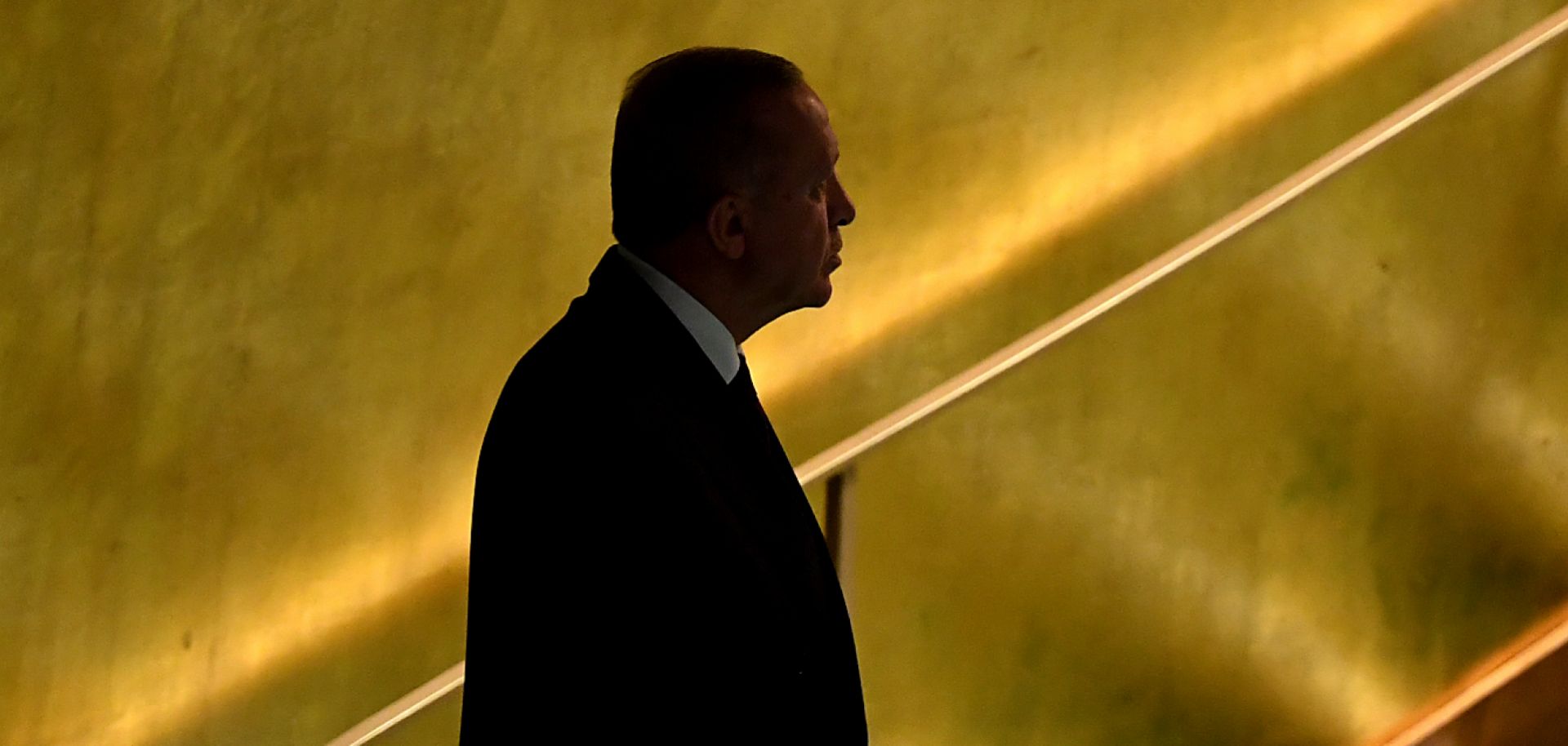
Turkish President Recep Tayyip Erdogan arrives at the U.N. headquarters in New York City on Sept. 21, 2021.
To survive the next national election, Turkey’s flailing ruling party risks resorting to more authoritarian and nationalist measures, which could increase the country’s exposure to U.S. and EU sanctions in the coming years. After more than two decades in power, the popularity of Turkish President Recep Tayyip Erdogan’s Justice and Development Party (AKP) has slid to the point where its victory in the 2023 national election is not assured. As a result, the AKP and its governing ally, the ultranationalist Nationalist Movement Party (MHP), are preparing to change Turkey’s constitution to lower the electoral threshold for a party to enter parliament from 10% to likely 7% of the national vote. The AKP has also been floating various judicial, climate and economic reforms at home, while attempting to reset relations abroad with former rivals like the United Arab Emirates and Saudi Arabia to improve Turkey’s low foreign investment numbers and increase trade ties.
By lowering the election threshold, the AKP is hoping to ensure the MHP will still enter parliament, even with less popular support. The AKP is only able to pass legislation with its narrow majority in parliament because of its alliance with the MHP. The MHP, however, has been losing voters to the rival ultranationalist IYI "Good" Party, which is likely to cooperate with the CHP to topple the AKP-MHP government if they win enough seats in 2023.
- Turkey’s electoral threshold, which is one of the highest in the world, has come under domestic and international criticism for being undemocratic since it shuts out smaller (especially Kurdish) parties from politics.
- The AKP and Turkey’s main opposition Republican People's Party (CHP) have both proposed various changes to the threshold over the years, with the CHP preferring a 3% threshold and the AKP preferring higher ones.
This constitutional change, however, won’t fix the greater economic, political and foreign policy issues weakening the AKP’s popularity. The AKP-MHP alliance’s approval ratings have continued to fall due to a combination of factors, including Turkey’s poor economic performance (with high inflation, unemployment and debt problems); political scandals like the 2019 Instanbul mayoral election (which many Turks believe the AKP attempted to subvert); the government’s botched response to this summer’s devastating wildfires; and Ankara’s increasingly controversial foreign policies in places like Syria, Libya and Azerbaijan.
- In March 2019, the AKP lost Istanbul’s mayoral election to opposition CHP candidate Ekrem Imamoglu. The AKP attempted to hold the seat by annulling the election and holding a controversial second poll — only to have its candidate lose again, securing Imamoglu’s place as mayor of Turkey’s largest city.
The AKP will thus likely be forced to use other means to win the 2023 election, like undermining electoral institutions’ independence, censoring media, indulging in rising Turkish nativism and exploiting international crises for political gain. The party lacks the means to single-handedly turn around the Turkish economy, which is dragged down by debt, a weak currency, unemployment and declining international investment. Moreover, the AKP’s own domestic political imperatives will make it hard for the party to implement policies to improve the economic situation by 2023. The AKP is constantly pushing for the central bank to enact lower interest rates to appease religious voters (as well as President Erdogan himself) who see interest as un-Islamic, reducing the central bank’s independence, along with its ability to fight inflation and boost growth. Another political factor undermining the Turkish economy is the AKP’s relationship with Russia, which — while popular with nationalist Turks who prize Turkey’s foreign policy independence — has brought U.S. sanctions on Ankara over its purchase of the Russian S-400 defense system.
- In June 2015, the AKP endured its first electoral setback when national results produced a hung parliament. But the AKP managed to pivot to electoral victory in November 2015 by growing more overtly nationalist and cracking down on Kurdish rebels in the southeast of the country.
- The AKP has also long used strong-arm tactics to keep opposition Kurdish parties from like the HDP from gaining too much power, including disbarring HDP mayors from office, using security operations to interfere in elections, and holding HDP leader Selahattin Demirtas in prison since 2016.
Such riskier tactics ahead of the election could further irk Turkey’s Western allies and increase the probability of additional sanctions against Turkey for its foreign policies and human rights record. In recent months, the European Union and the United States have held off on threats to enact more expansive sanctions for fear of alienating Turkey — a key NATO ally and a critical country in Europe’s strategy to prevent another refugee flood. However, repeated reports from the European Commission and U.S. Congress have highlighted concerns about Turkey’s drift away from democracy under the AKP’s rule. And that sentiment will only be reinforced the more the AKP uses extra-legal tactics in the run-up to the election. If Turkey exploits an international crisis that appears detrimental to Western interests, Western governments will also grow more amenable to enacting more sanctions on Turkey. Even if Brussels and Washington fail to impose any concrete sanctions, the mere threat of more financial penalties will likely keep investors away from Turkey, further undermining the country’s already weak currency and economy.
- In April, the United States broke with decades of diplomatic tradition by recognizing the Armenian Genocide, despite Turkish protests — reflecting rising anti-AKP sentiment growing in the U.S. political system.
- In March 2021, the EU froze plans to sanction high-level Turkish executives at the state-owned Turkish Petroleum Association, in part because Ankara appeared to be toning down its aggressive foreign policies, especially drilling in the Eastern Mediterranean. These plans and other additional sanctions, however, could be revitalized in the future.
