
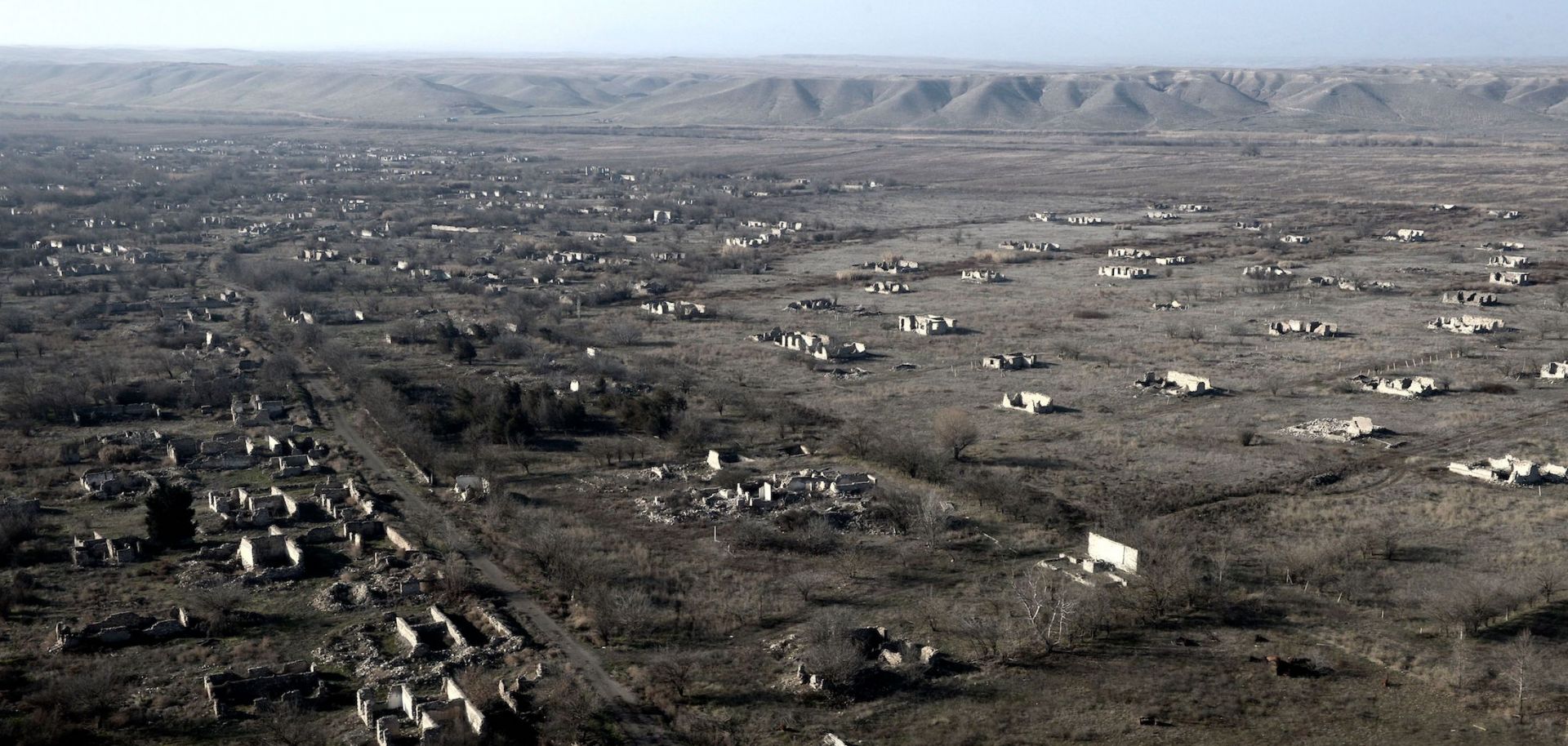
An aerial view shows the ruins of a village on Jan. 5, 2021, in an area of Nagorno-Karabakh that was recaptured by Azerbaijan in October 2020.
The Azeri-Armenian cease-fire will be undermined by both sides on the ground and in their capitals. But for now, Turkish-Russian cooperation and domestic problems in Armenia seem poised to prevent more large, state-on-state clashes. On Dec. 28, Azerbaijan said one soldier was killed by an Armenian armed unit in the disputed Nagorno-Karabakh region, violating the Nov. 10 truce. The clash followed several earlier incidents in December. Nagorno-Karabakh authorities accused Azeri troops of capturing some of their soldiers following clashes between Azeri and Armenian-backed forces between Dec. 11-13 that killed several soldiers on both sides. Azeri and Armenian authorities have begun regularly accusing one another of violating the truce that ended weeks of fighting and resulted in reported casualties on both sides.
Armenia has entered a phase of deep political turbulence since the cease-fire, with ongoing threatening the continuity of the government. Yerevan’s current focus on securing domestic power reduces the probability of Armenia trying to restart the war in the short-term, though fringe groups and small militias may still violate the cease-fire. Russia will likely pressure Armenia not to resume hostilities, which would force Russian peacekeeping forces in the region to intervene. In a longer timeframe, a new Armenian government could seek new hostilities against Azerbaijan in an attempt to regain the territories that Yerevan conceded in the cease-fire. Issues like the exchange of prisoners, the status of Armenian populations in the territories ceded to Azerbaijan, and the status of churches and other symbolic buildings will lead to frequent disputes between Yerevan and Baku, creating the risk of new armed clashes between them.
- Since late October, there have been frequent protests in Armenia calling for the resignation of Prime Minister Nikol Pashinyan.
- Opposition political parties do not control enough seats in Armenia’s parliament to oust Pashinyan through legislative procedures. As a result, Pashinyan’s fate will depend on the support of the members of his own government alliance, as well as on the evolution of street protests.
- Armenian opposition parties held a nationwide strike on Dec. 22.
- Russia has said it has asked both Armenia and Azerbaijan to respect the cease-fire and has expressed concern about recent violations of the agreement.
Galvanized by October’s victory, Azeri President Ilham Aliyev has been ramping up politically aggressive rhetoric, though the lack of material gains left in Nagorno-Karabakh, along with the presence of Russian peacekeepers, will disincentivize further action by Azeri and Turkish forces. Deepening ties between Turkey and Azerbaijan will continue to stoke fears in Armenia that the two countries may again coordinate to retake its remaining controlled areas of Nagorno-Karabakh. But while likely militarily successful, another direct offensive by Azeri and Armenian forces is unlikely to move the needle from a strategic standpoint. For one, Baku has already accomplished its broader goals in the region, including repatriation of displaced Azeris and regaining a protected corridor connecting Nagorno-Karabakh to the Azeri region of Nakhchivan. Continued military efforts would exceed these gains, and would risk spurring retaliation from Russia by putting its peacekeeping troops directly in harm’s way. The downing of a Russian helicopter prompted the signing of the Nov. 10 cease-fire, implying that the Kremlin holds tremendous negotiating sway in the region when directly threatened. So while Baku will remain brazen for its domestic audience, it will also wary of angering Russia.
- On Dec. 10, Aliyev and Turkish Prime Minister Recep Tayyip Erdogan held a military parade in Baku celebrating victory in Nagorno-Karabakh
- 2000 Russian peacekeepers arrived in Nagorno-Karabakh in mid-November.
