
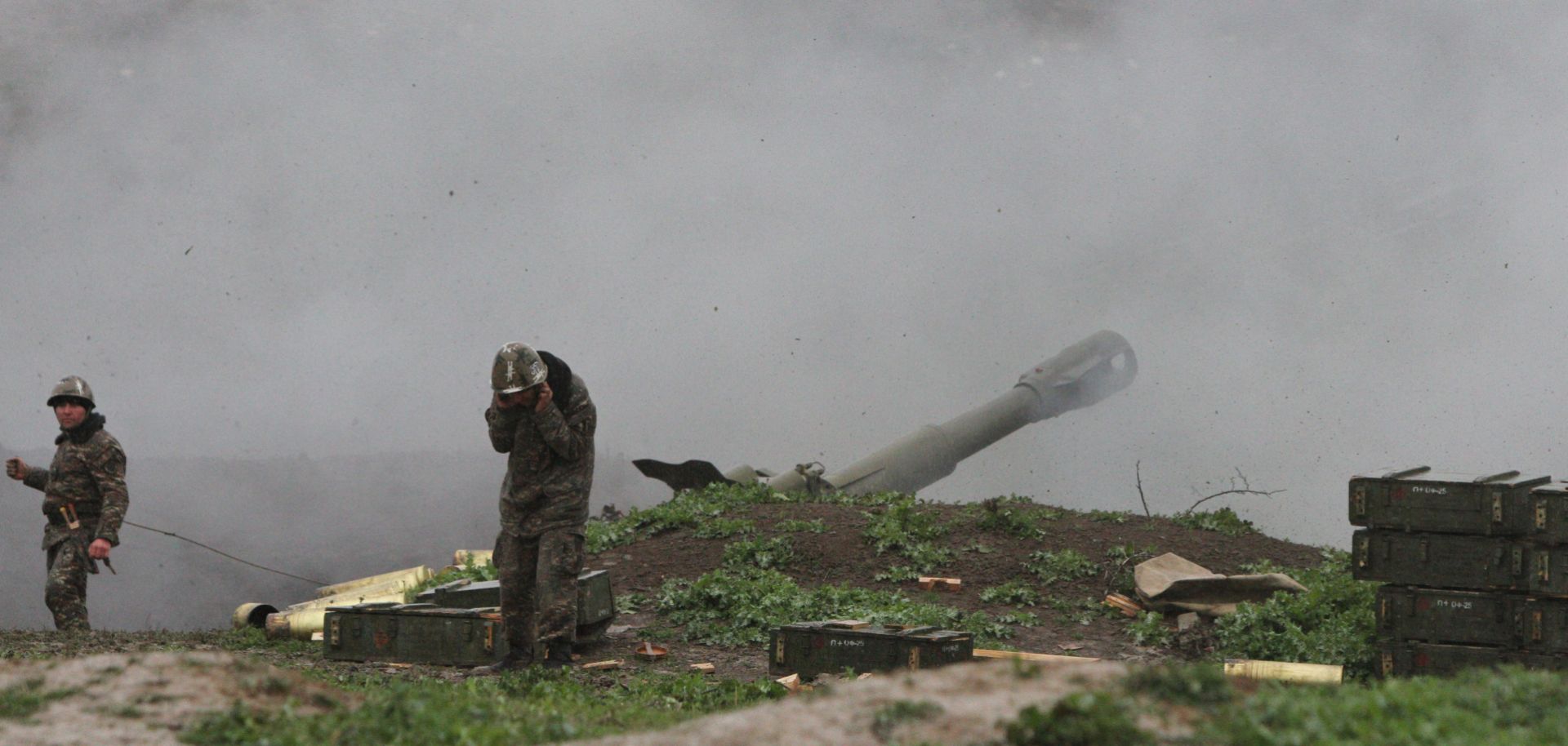
Armenian soldiers fire artillery shells toward Azeri forces in the town of Martakert, located in the disputed Nagorno-Karabakh region, on April 3, 2016.
Intense border fighting between Azerbaijan and Armenian forces has raised the risk of a new cycle of elevated combat, but military constraints on both sides, as well as geopolitical interests guiding Russian and Turkish policy, will likely keep the two countries’ decades-old conflict confined to established patterns. The current fighting near the Nagorno-Karabakh region, which started early on Sept. 27, follows months of atypically high levels of ceasefire violations between the two sides since a July 2020 skirmish in a different sector of the Armenia-Azerbaijan border.
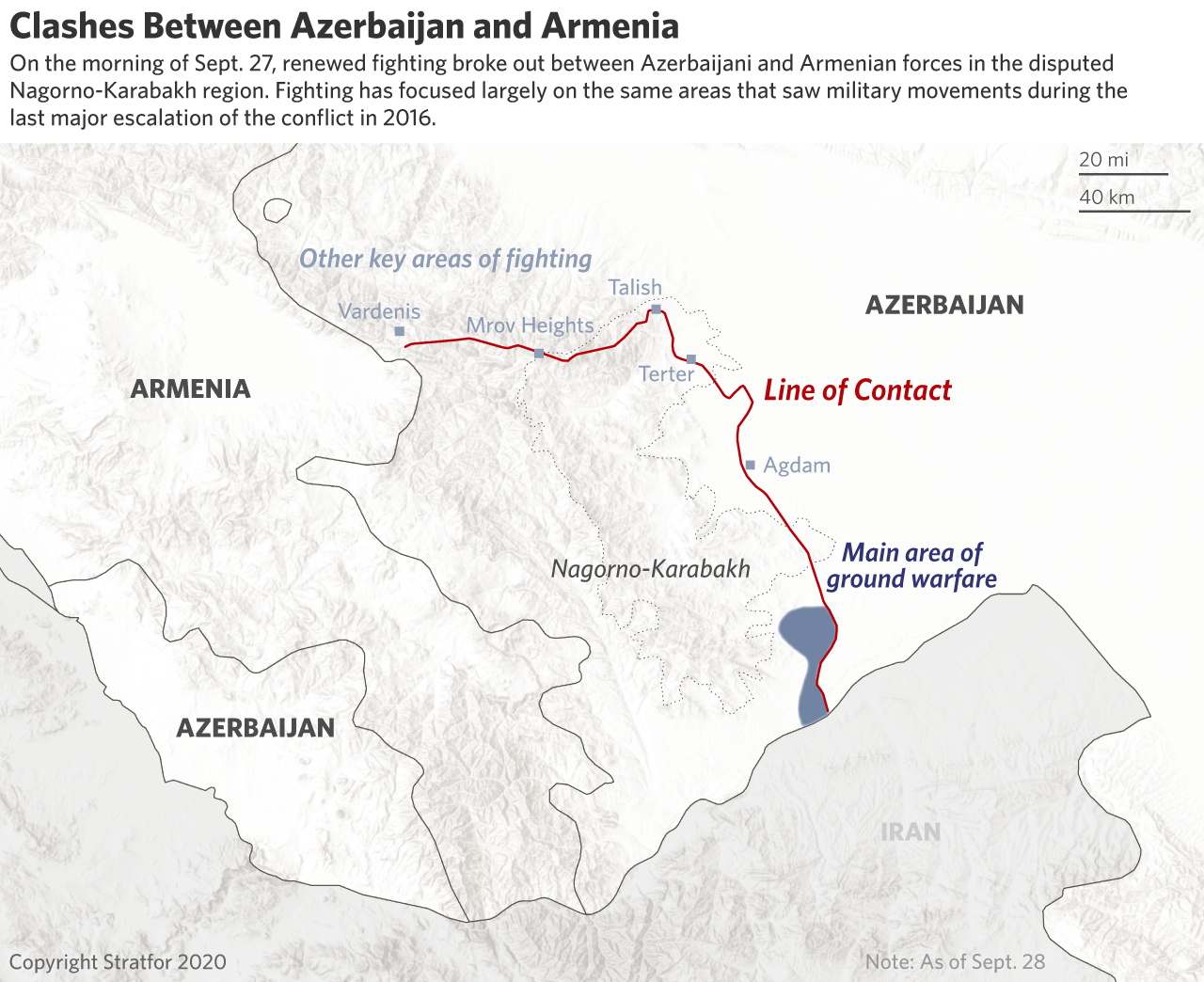
- Drone strikes, artillery fire and the maneuvering of armored units occurred near several critical sectors of the Nagorno-Karabakh line of contact, including the areas around Fuzuli, Terter, Vardenis and the Murovdag mountain range.
- Azerbaijan claimed to have gained control over several villages in the same Fuzuli area that was central to its 2016 offensive. These villages are all uninhabited and are part of the Armenian-held no man’s land between Azerbaijan and the Republic of Artsakh (an autonomous Armenian-supported state in Nagorno-Karabakh).
- Both the Republic of Artsakh and Armenia announced full mobilization of their armed forces over the weekend, signaling their readiness to fight off any Azeri offensives on the line of contact.
- Azerbaijan announced only a partial mobilization and declared martial law throughout its territory. It also imposed closures of roads near Nagorno-Karabakh, suspended international flights and announced curfews in several of its main population centers.
Russian efforts to alter its strategy in the South Caucasus may have signaled an opportunity to Azerbaijan, prompting an attempt to advance its position on the battlefield while still enjoying strong Turkish support. Russia’s position in the region has shifted between balancing power (through its military support and presence in Armenia) and pragmatically managing relations between Azerbaijan and Armenia. To this end, Russia engages in diplomatic, economic and military interaction with Azerbaijan, balancing its commitments between the two countries in the hopes of avoiding direct conflict between them. Escalation of the conflict would be considered detrimental to Russia’s position in the South Caucasus, as it could invite additional Turkish and NATO influence through Azerbaijan and leave Armenia as the only Russian-friendly nation in the border region. Azerbaijan, however, may read this shift in Russian strategy as a reduced commitment to backing Armenia in conflict, or having some leeway to force minimal adjustments of the frontline. Azerbaijan is also further bolstered in these ambitions by continued Turkish support of Azeri military capabilities through arms deliveries, joint training and allegedly even deployments of Syrian fighters to Azerbaijan. On Sept 28, Armenia also claimed that a Turkish plane shot down one of its own jets, which Turkey has since adamantly denied.
The established dynamics of Armenia and Azerbaijan’s ongoing conflict, however, are expected to persist, as local geography and a lack of resources limit both sides’ ability to challenge the higher-level reality along the line of contact. Azeri forces are able to advance and contest Armenian and Artsakh control in lower-laying terrain immediately adjacent to the line of contact, but Azerbaijan would lose considerable momentum upon advancing into the complex mountainous terrain of Nagorno-Karabakh. This favorable geography has previously enabled Armenia and the Republic of Artsakh to stand their ground against Azeri offensives, and renewed offensives are unlikely to challenge that precedent. But Armenia and the Republic of Artsakh also don’t possess the ability to permanently degrade Azerbaijan’s military capabilities or to move the fight deeper into Azerbaijan. Limited shifts in territorial control along the line of contact itself, however, are more feasible and could allow either party to gradually achieve a better military position over a series of small0scale escalations. In the longer term, a situation may arise where either side obtains the ability to challenge the status quo, though this unlikely to materialize unless either Russia or Turkey drastically alter their involvement in the conflict.
