
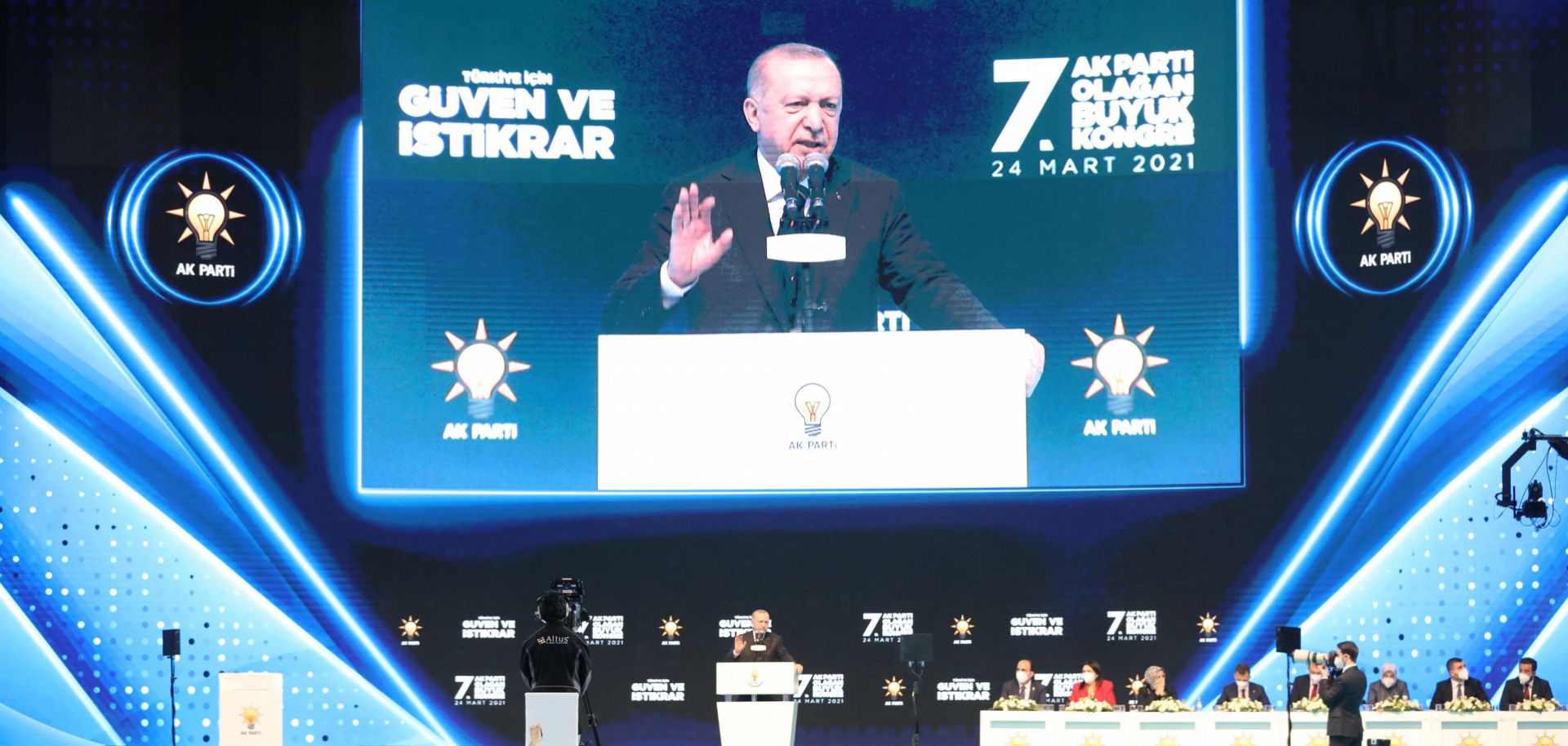
Turkish President Recep Tayyip Erdogan addresses supporters of his ruling Justice and Development Party during a political rally in Ankara on March 24, 2021.
Editor’s Note: This analysis is part of a two-part series that looks at Turkey’s seemingly contradictory behavior at home and abroad, as Ankara oscillates between diplomacy and aggression to avoid further rattling its economy without forfeiting its nationalist agenda. Read the first part of this series here.
Ahead of 2023 elections, Turkey’s ruling Justice and Development Party (AKP) will embrace policies that appease its Islamist base by further entrenching religion into the country’s culture and economy. The AKP will also ramp up efforts to rig the country’s electoral system in its favor, pulling Turkey toward authoritarianism. Sliding poll numbers, the emergence of rival parties and an uncertain economic future are forcing Turkish President Recep Tayyip Erdogan’s Justice and Development Party (AKP) to rethink its political strategy ahead of June 2023 elections. As the AKP loses control of managing Turkey’s economy, the party is considering old tactics, like reshaping the country’s electoral system to better benefit the AKP and its ruling partner, the Nationalist Movement Party (MHP), leaning into more Islamist-friendly cultural conservatism at home while pragmatically picking confrontations with the international community abroad. While it’s not certain that such tactics will necessarily position the AKP for yet another national victory in the elections, whether those are in 2023 or earlier, it’s becoming increasingly clear that the AKP’s economic record will be a less viable centerpiece of its politicking.
- A Reuters compilation of 15 polls in the first quarter of 2021 showed that the combined popular support for the AKP and MHP had declined to 45% — a level that suggests in a new election, the ruling coalition could lose both the parliament and presidency.
- Several AKP defector parties have emerged, led by former high-ranking AKP officials angry over Erdogan’s stewardship of the economy and approach to centralizing power. These include AKP founding member Ali Babacan’s Democracy and Progress Party (DEVA) and former AKP prime minister Ahmet Davutoglu’s Future Party.
Turkey’s poorly performing economy, along with the government’s management of COVID-19, has eroded the AKP’s economic record. The AKP originally ran on a platform of economic growth, the so-called “Turkish Miracle” of the 2000s. But the recession of 2018 and the economic fallout from COVID-19 has exposed the country’s long-standing problems with inflation, corporate debt and currency weakness, undermining the AKP’s economic legitimacy and prompting a decline in popularity. The AKP’s repeated political interference of the central bank has also weakened domestic confidence in the party’s ability to lead the economy, while Erdogan’s own unorthodox economic views on inflation have reinforced the perception that the AKP is unfit to handle the country’s ongoing financial challenges.
- The lira is down over 50% since the June 2018 election that saw Erdogan return to power, undermining the AKP’s long-standing efforts to convince Turks to use the lira over the U.S. dollar. Private bankruptcies are also at a ten-year high, while the unemployment rate has gone from 10% in June 2018 to over 12% in 2021. Moreover, COVID-19 emergency measures have made it difficult for companies to lay off employees, suggesting a weaker labor market than what appears in official unemployment figures.
- Turkey’s foreign policies under the AKP have also risked economic damage, including U.S. sanctions for the purchase of the Russian S-400 defense system and potential EU sanctions over drilling in disputed waters in the eastern Mediterranean. In response to this economic damage, Ankara is pivoting to fewer confrontations on policies likely to incur sanctions.
To limit the potential gains made by opposition parties in a future election, the AKP is likely to experiment with electoral laws and procedures that make it more difficult for them to compete, while imposing restrictions and even outright bans on the Kurdish-dominated Peoples' Democratic Party (HDP). The AKP will be able to utilize its control of parliament to change electoral laws and thresholds to better suit the AKP and MHP over splinter factions like DEVA and the Future Party, reducing the potential political threat from defectors. It will also likely carry out crackdowns on the Kurdish-dominated HDP party to weaken the ranks of the opposition and dilute the anti-AKP Kurdish vote. The AKP-MHP alliance will look for ways to weaken the opposition’s remaining influence in the judiciary as well, where opposition parties will attempt to win cases designed to reserve the electoral engineering of the AKP.
- Turkey’s electoral threshold for a party to enter parliament is 10% of the national vote. Compared with other parliaments around the world, this extraordinarily high bar has long been intensely criticized by Turkish opposition parties who see it as unfavorable. The AKP, however, has reportedly considered dropping the threshold to better ensure the MHP is able to weather its decline in popularity. But such proposals to reduce the threshold would still stay well above the current polling numbers of parties like AKP splinters Future Party and DEVA to prevent them from entering parliament.
- In early March, a top AKP-affiliated state prosecutor filed a case against the HDP to ban the party due to its alleged ties to Kurdish terrorists. Several days later, Turkey’s Constitutional Court rejected the indictment, citing procedural errors, which then prompted MHP leader Devlet Bahceli to call for the court’s closure on the grounds that it has been too soft on the HDP. The HDP is not formally affiliated with the militant Kurdistan Workers’ Party (PKK), but the AKP has long built a narrative of collusion between the two. Without the HDP, the AKP’s proportional control of the national vote would likely increase.
The AKP’s backing of conservatives portends more central bank interference and rhetorical condemnations of high interest rates, as well as more crackdowns on LGBTQ groups and deeper Islamic influence in both schools and the media. The AKP’s ties to Islamist conservatives have weakened over time amid scandals involving AKP officials and the formation of alternative splinter parties. The ruling party’s attempt to appease both secular and Islamist voters has also caused it to neglect some of the policy promises it made to cultural conservatives. But with fewer options to restore the AKP’s economic legitimacy, strengthening its ties to the country’s large Islamist community now has greater urgency.
- On March 19, Erdogan pulled Turkey out of the Istanbul Convention, an international accord designed to reduce violence against women. This decision was likely driven by the AKP’s desire to win back conservatives, as the accord was unpopular among Islamists who saw it as interfering in Islamic law. While Turkey’s withdrawal triggered protests in Europe, the move did not yield any threats of EU sanctions.
- Turkey has held off on some Islamization policies, like crackdowns on LGBTQ individuals and groups, for fear of inflaming tensions with the European Union, which regularly assesses Turkey’s human rights record to decide on the feasibility of Turkey’s ascension into the bloc. But with no current viable path to EU membership, Ankara is now less incentivized to appease European views on human rights. That calculus, however, could change if EU concerns with Turkey’s controversial domestic behavior rise to the level of potential sanctions that could further damage its fragile economy.
The AKP’s increased utilization of these tactics will cause Turkey to drift toward Islamic authoritarianism — further politicizing the country’s economic management and potentially radicalizing elements of the opposition, while increasing reputational risks for international firms doing business in Turkey. Electioneering could make it difficult if not impossible for republican, secular, and Kurdish parties to win a governing majority in Turkey regardless of the AKP’s overall popularity, freeing the AKP and MHP to enact long-term policies that ideologically transform Turkey into a more Islamo-nationalist country. With less public accountability for both governance and economic performance, the AKP will also be freer to deploy economic policies designed to boost its base and commercial interests, from indulging Islamist economic ideals to interfering with economic policies, including the central bank. But with a greater focus on enforcing Islamist cultural norms, some international firms will face more scrutiny from human rights groups critical of Turkey’s authoritarian slide. Additionally, with fewer opportunities to win elections, parts of the Turkish opposition may radicalize, strengthening ongoing insurgents like the PKK and introducing more potent protest movements in Turkey’s more secular urban centers.
