
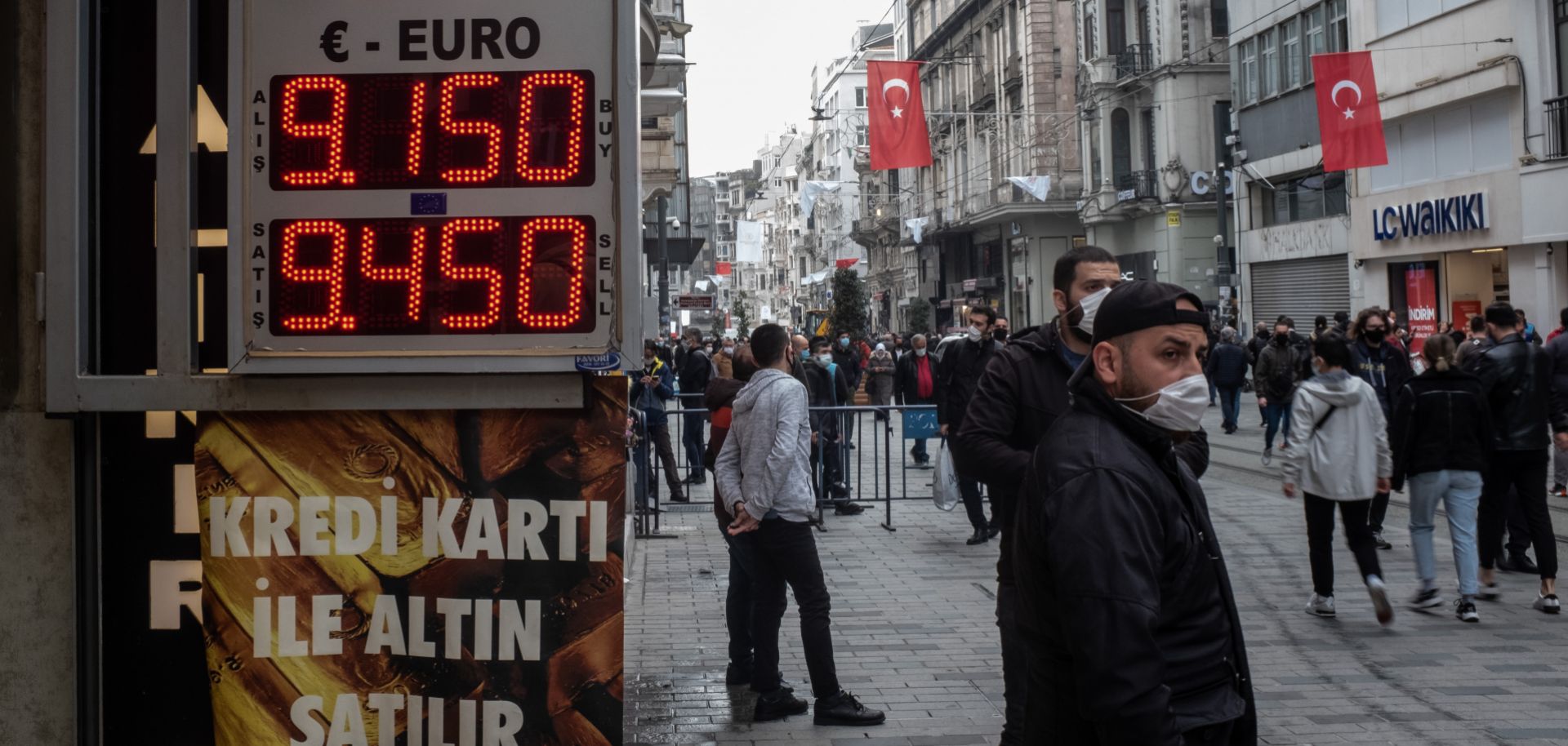
A currency exchange board in Istanbul shows the lira’s plummeting value after the unexpected firing of Turkey’s central bank chief on March 22, 2021.
Turkish President Recep Tayyip Erdogan’s sudden replacement of Turkey’s central bank governor with a like-minded loyalist portends deeper banking and financial crises to come and complicates the government’s battle to revive the economy by further damaging the central bank’s credibility. Erdogan abruptly fired Central Bank Governor Naci Agbal on March 20 and replaced him with Sahap Kavcioglu, an economist and banker, as well as a former member of parliament from Erdogan’s Justice and Development Party (AKP). The Borsa Istanbul lost 9%, triggering two circuit breakers on March 22.
- The Turkish lira slid by 14% when markets opened in Asia on March 22. By mid-morning, trading was down in all markets by about 10%.
Erdogan’s dismissal of Agbal reinforces the extent to which his unorthodox preferences ultimately direct financial and monetary policy in Turkey, infringing on central bank independence. Erdogan’s preference for low interest rates and easing at all costs, even amid high inflation in favor of encouraging economic growth, is well known. Erdogan’s patience with Agbal’s tight monetary policy ran out after an especially aggressive 200 basis point hike led by Agbal on March 18, amid high Turkish inflation driven by domestic factors and global inflationary pressures stemming from high commodity prices.
- Agbal’s 4.5-month tenure saw an overall interest rate increase by 875 total basis points, a substantial hike that by raising real rates to positive levels helped reverse lira depreciation. As a result, the lira’s value against the U.S. dollar increased by 18% over the course of his tenure, which also helped partially reverse net capital outflows. But this improvement also happened in an environment with high inflation.
- The replacement marks the third installation of a central bank governor since 2019.
Based on his dislike for high interest rates and his close alignment with Erdogan, new Central Bank Governor Kavcioglu is likely to lower rates even if inflation is high. The timing and magnitude of probable interest rate cuts are unknown, but if real interest rates go negative, this will put further downward pressure on the Turkish lira and create a drain on foreign currency reserves if the government seeks to prop up the currency. A sliding lira will stoke domestic economic uncertainty and drive dollarization, which will hamper Turkish government efforts to recover from pandemic-related slowdowns by promoting swift growth. Embracing economic growth, even if fragile and fueled by credit, helped the AKP cement its dominance in Turkey in the 2000s.
- Turkish annual consumer inflation was 15.6% in February, pointing to an overheated economy. Among the members of the Group of 20 (G-20), Turkey’s GDP grew the most behind China in the fourth quarter of 2020, increasing by 5.9% (year-over-year) thanks to domestic credit creation.
- Like Erdogan, Kavcioglu is a known critic of high interest rates, which both he and the president believe are the enemy of growth and actually contribute to inflation. Kavcioglu wrote on the topic recently in his regular column in the pro-government daily Yeni Safak. Kavcioglu maintains that low interest rates in Western Europe and the United States justify low interest rates in Turkey, despite Turkish inflation substantially exceeding persistent low inflation in developed economies.
Moving forward, Turkish financial fragility risks a currency crisis, banking crisis, a balance of payments crisis and a political crisis before 2023 elections. A sudden reversal in fragile investor sentiment will retard capital inflows, particularly as long-term yields on U.S. dollar bonds rise, and could cause Turkey to use alternatives such as capital controls, price controls, or limits on domestic withdrawals of foreign currency assets. More than half (51.6%) of domestic bank deposits are in foreign currency. Limiting access to those, which in addition to higher inflation strains household and business finances, could cause political instability. The potential negative economic impact has already prompted political attacks from Erdogan by all notable AKP challengers in 2023, including the Good Party, the Future Party, and the Republican People's Party.
- Turkey’s immense foreign currency financing requirements, which in addition to a chronic current account deficit that will be exacerbated by rising commodity prices, includes $190 billion in external debt maturing in the next year, compared with gross foreign currency reserves of only $52 billion and net negative reserves (excluding gold) of $84 billion.
If the central bank decides in its next scheduled meetings April 15 and May 6 (or in a possible emergency meeting) to lower rates as high inflation continues, the likely negative impact on the Turkish lira and investor sentiment could force the government to consider unpopular capital controls, including currency, price and bank controls to stem likely foreign currency outflows. Banking system withdrawals will increase as Turks conserve foreign currency, harming liquidity and stoking dollarization. The government will likely also struggle to finance imports and pay external obligations with dwindling foreign currency reserves. While the intent of an interest rate slash would be to encourage growth, the damaged credibility of the central bank and the likely resultant lira volatility won’t lead to sustainable growth in the near term, no matter what the government tries to encourage.
- On March 21, in an effort to encourage investors’ confidence, Turkish Finance Minister Lutfi Elvan said that Turkey would stick to “free markets and liberal foreign exchange” and support the central bank’s efforts to rein in inflation.
- Earlier today, Kavcioglu published a statement saying the bank will “use monetary policy tools effectively in line with its main objective of achieving a permanent fall in inflation” to reassure observers that all previously held monetary policy committee meetings will still be held.
