
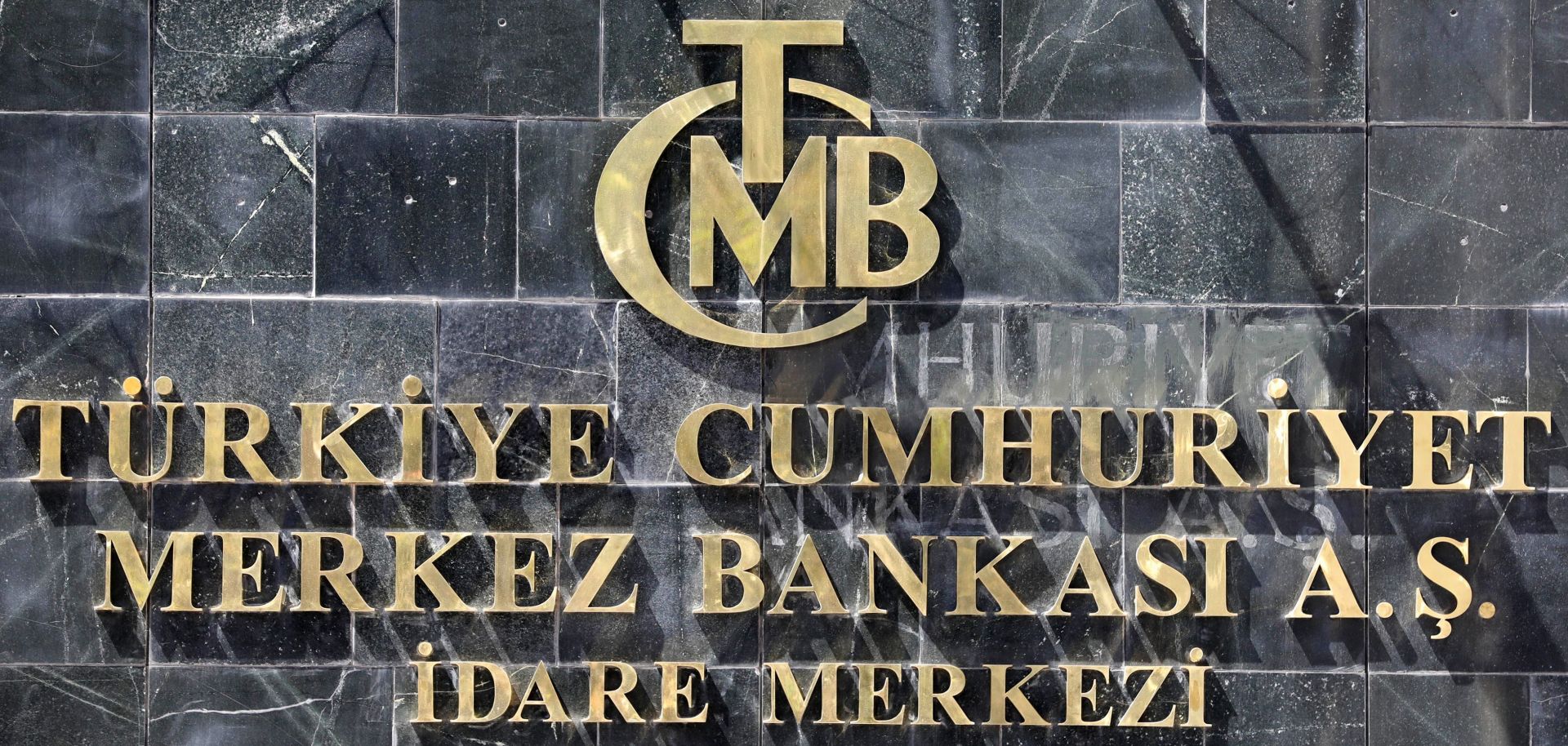
A picture taken on Aug. 14, 2018, shows the logo of Turkey's central bank at the entrance of its headquarters in Ankara.
The Central Bank of the Republic of Turkey (CBRT) appears committed to a tighter monetary policy for the coming years to battle inflation. But the risk of President Recep Tayyip Erdogan reverting to pressuring the bank back into an easing remains high, which would undermine confidence in CBRT while increasing the Turkish economy’s exposure to external global economic shocks. Through statements issued Jan. 21, Turkey’s central bank is indicating it wants to hold a tight monetary policy until 2023 if necessary, as Turkey struggles to reach its 5% inflation target. The CBRT also said that 10% consumer price inflation was possible in 2021 as the COVID-19 pandemic eased and higher interest rates helped control inflation by depressing credit demand, signaling that the bank no longer sees its 5% inflation goal as achievable this year.
- Turkey’s January numbers were disappointing, with annual inflation rising slightly to 14.97% from December’s 14.6% rate as the price of energy and miscellaneous goods rose.
- The bank’s statements come a few weeks after Erdogan once more blamed high interest rates for inflation, a view not shared by his economists or international investors.
The bank’s comments will reinforce the central bank’s attempts to build a new-found reputation for independence, reassuring international investors and encouraging them to bring money to Turkey’s pandemic-wracked economy. However, the bank has limited tools to encourage growth, and factors outside the bank’s control could undermine domestic political confidence in the CRBT. External economic shocks remain possible due to the Turkish lira’s continued weak exchange rate with the U.S. dollar, as well as Turkey’s low foreign exchange reserves and its central bank’s lack of credibility.
- Naci Agbal took over as CRBT chief in November. Since then, Turkey’s central bank has helped arrest the slide of the lira, which has regained 19% of value against the dollar. But while Agbal’s appointment has helped assuage some concerns over the independence of the country’s economic institutions, the lira remains near a 10-year low, having depreciated more than 78% against the dollar over that time
- Turkey’s net reserves minus foreign exchange swaps fell $70 billion in 2020, according to Fitch Ratings, as the country struggled to defend its lira during the pandemic. Agbal vowed to improve the country’s foreign exchange reserves in 2021 by encouraging investment in the country. According to CBRT figures, Turkey had $48.5 billion in gross foreign exchange reserves, minus gold. But the country also had some $136.9 billion in liabilities, bringing its net reserves into negative territory.
If Turkey’s economic recovery slows, Erdogan will likely seek to help offset public anger by blaming the central bank’s policies and undermining its independence once more by demanding it lower interest rates. Sanctions (particularly from the United States or European Union), along with a slower-than-expected global economic recovery and/or a shift in investor sentiment toward either Turkey or emerging markets, could all stymy Turkey’s recovery. If Erdogan returns to blaming the CBRT’s high interest rates for the prolonged economic malaise, foreign investors will reassess their interest in Turkey, reducing investment and cash flows into the country and further exacerbating its economic problems.
- The United States and European Union continue to float the possibility of sanctions against Turkey over policy disagreements. Washington wants Turkey to abandon the S-400 missile system it purchased from Russia, while Brussels wants Ankara to back off from its confrontational approach and aggressive energy exploration activities in waters claimed by Greece in the eastern Mediterranean.
- Erdogan’s criticism of the CBRT has undermined confidence in its ability to carry out sound monetary policy. But despite investor pushback, the president has adhered for years to his unorthodox view that the bank should make lower interest rates a priority despite high inflation.
