
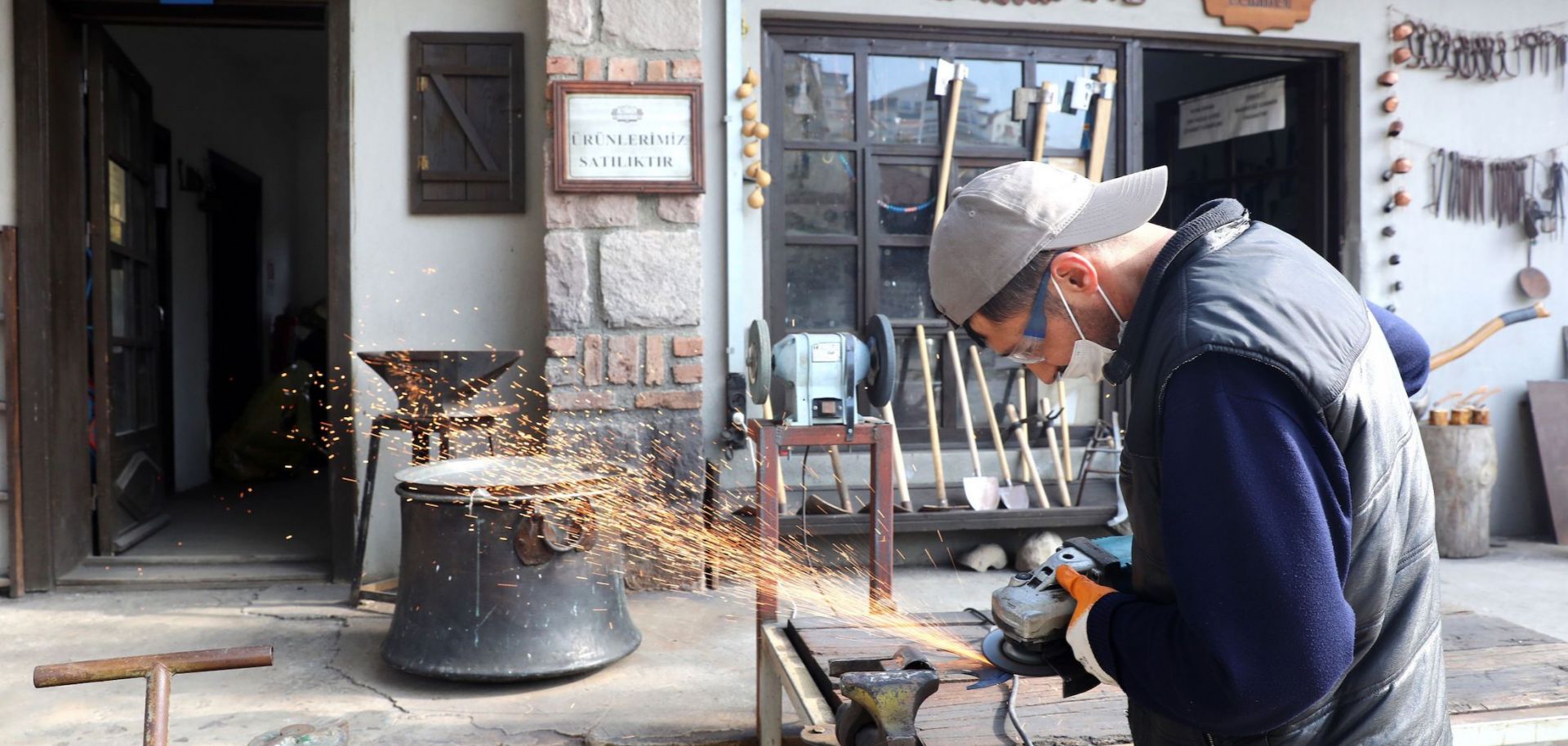
A blacksmith crafts metal in a village mansion in Ankara, Turkey, on Nov. 18, 2020.
New U.S. sanctions will stymie Turkey’s strategy to develop an indigenous defense sector, prompting Ankara to continue exploring alternative security ties while intensifying bilateral tensions for U.S. President-elect Joe Biden’s incoming administration. On Dec. 14, the United States announced a series of defense sector-aimed sanctions under the Countering America’s Adversaries Through Sanctions Act (CAATSA), fulfilling long-term threats that Washington would impose penalties on its fellow NATO ally for the purchase of the Russian S-400 missile system. The sanctions target Turkey’s Presidency of Defense Industries (SSB), including its chief Ismail Demir and three other senior officials, and come as the U.S. Congress was poised to mandate CAATSA sanctions through the annual National Defense Authorization Act.
- Washington also issued an export license ban to SSB, which is the main Turkish civil institution that brings together the Turkish presidency, armed forces and defense ministry for decisions on foreign procurement and the domestic production of military equipment.
Despite targeting a relatively narrow aspect of Turkey's defense sector, the sanctions will still complicate Ankara’s procurement of U.S. defense technologies and materials, including those that Turkey uses in its own national defense industry. The sanctions will make procurement from foreign suppliers much more complicated, disrupting the Turkish government’s ambitious plans to build out its indigenous defense industry and achieve self-sufficiency in defense production by 2023.
- Turkey’s defense sector only makes up about one percent of its economy and employs about 30,000 workers compared with the country’s 31 million-strong labor market.
- Turkey claims that its defense sector is 70% independent and has aggressively sought to expand exports of military equipment to boost domestic production. Defense exports amounted to $2.74 billion in 2019 after Ankara first surpassed $2 billion the year prior.
The sanctions will likely produce a nationalist surge in Turkey that will only embolden Ankara to continue building up its own indigenous defense capacity, as well as explore alternative defense ties to other major arms exporters, such as Russia and China. Turkey’s indigenous military-industrial sector is politically sensitive given its direct links to President Recep Tayyip Erdogan. The U.S. sanctions will thus prove as much a political hit for Erdogan — especially as the fallout from the COVID-19 pandemic continues to strain his ruling Justice and Development Party (AKP)’s economic record.
- In recent years, Erdogan has prioritized building out Turkey’s military-industrial sector to reduce the country’s dependence on foreign suppliers.
- The SSB was brought more directly under the Turkish president’s control in 2018, reflecting the strategic importance with which Erdogan views the sector.
Heightened U.S.-Turkey tensions will also thwart the Biden administration’s ability to foster a more productive relationship with Ankara upon taking office. The Biden administration has said it will seek engagement with Turkey in areas of mutual interest, such as Syria. The new White House is also hoping to utilize Turkey as part of a more multilateral approach to the region after the past four years of U.S. President Donald Trump’s unilateral diplomacy. But while the Biden administration will seek engagement, its predecessor’s sanctions will likely only continue Turkey’s drift away from the West toward China and Russia.
- Tony Blinken, Biden’s presumptive-secretary of state, has specifically highlighted cooperation in Syria as a key aspect of the U.S.-Turkey relationship that the new administration seeks to reset.
- Beyond the S-400, Turkey has also explored the option of purchasing the Russian SU-35 jet to offset the loss of the American F-35, and has already purchased Chinese ballistic missile technology.
- In addition to the ruling AKP, Turkey’s opposition Republican People's Party and ultranationalist splinter Iyi Party have also condemned the new U.S. sanctions, with an official from the former even urging Turkey to activate its S-400 system despite the risk of creating another crisis with the United States.
