
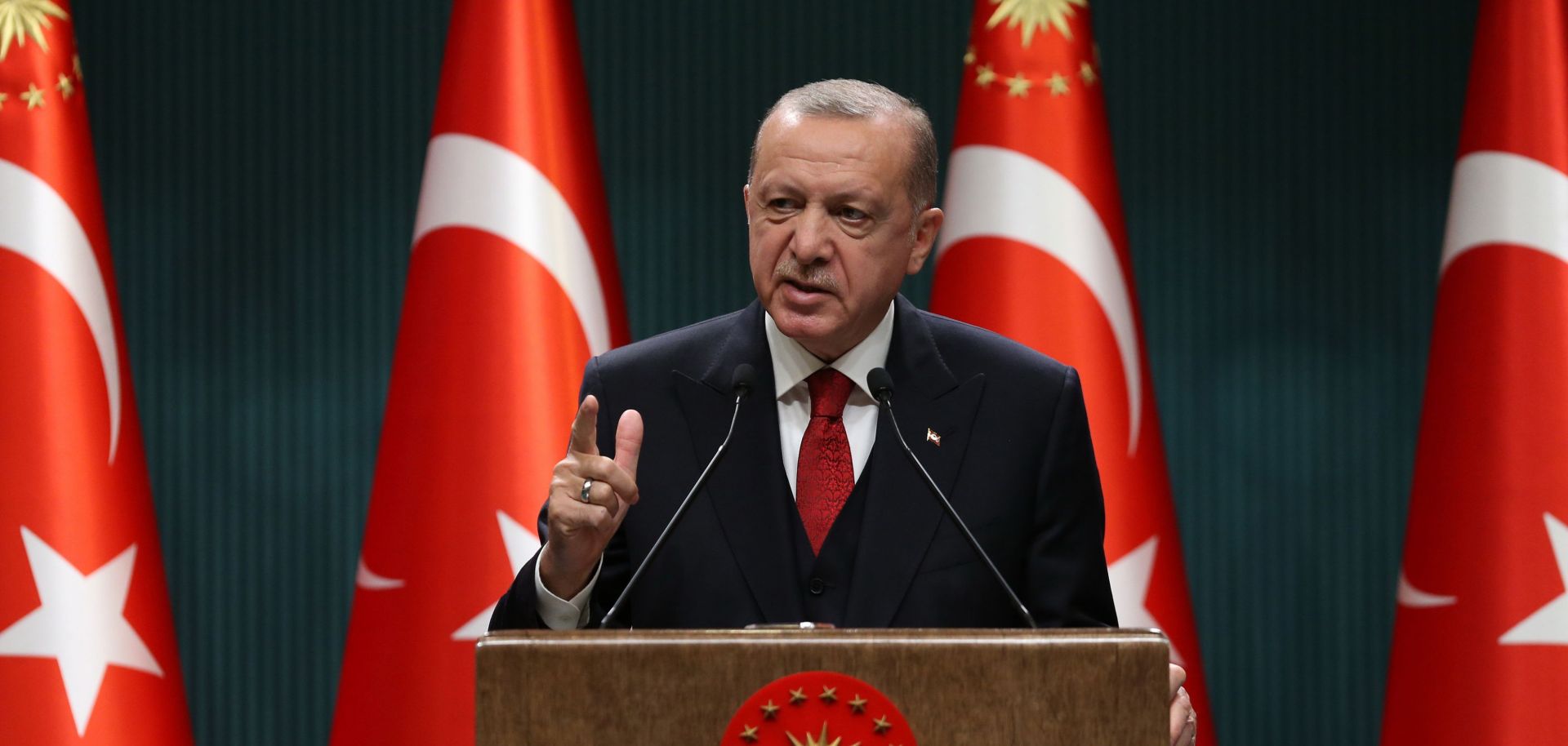
Turkish President Recep Tayyip Erdogan gestures as he gives a press conference in Ankara, Turkey, on September 21, 2020.
Turkey’s traditionally combative leader is trying his hand at a more conciliatory approach, as the economic fallout from the COVID-19 pandemic erodes his ruling Justice and Development Party (AKP)’s political standing. His warm words, however, will likely remain just that. In recent months, Turkish President Recip Tayyip Erdogan has promised economic and judicial reforms at home and diplomacy with Europe, the United States and Israel abroad. But this notable shift in tone is likely aimed at shoring up investor confidence and avoiding sanctions just long enough for the Turkish economy to get back on track — at which point, Ankara will probably return to its former confrontational self.
Promises Made
At the end of 2020, as Turkey’s economy reeled from the pandemic and U.S. sanctions for its purchase of the Russian S-400 defense system appeared inevitable, Erdogan began promising that 2021 would be the “year of reform” to help spur confidence in the country and attract investment. On Dec. 25, Erdogan publicly floated improving ties with Israel after years of icy relations over the 2010 killing of Turkish activists in Gaza by Israeli forces. On Dec. 26, he then declared Turkey would carry out “radical” judicial and economic reforms to help propel its recovery from COVID-19. Meanwhile, Turkey’s central bank began to steadily raise interest rates to combat double-digit inflation. Turkey also began to hold out olive branches to the West, offering to hold talks with the new administration of U.S. President Joe Biden about Ankara’s plans for the Russian S-400 missile system received in 2019. Meanwhile, in Europe, Erdogan also greenlit exploratory talks with Greece on Jan. 25 to ease tensions over disputed waters in the eastern Meditteranean.
All these moves suggest a moderate shift for Turkey's ruling AKP, which has favored political tight control of the economy and judiciary as bulwarks of power, and has also proven unafraid to confront the United States, Europe, and Israel over items of national interest. But whether Ankara will actually follow through on these promises is a different story.
Promises Kept?
Since taking power in 2002, the AKP has espoused an Islamic-nationalist ideology that fuses Sunni Muslim Brotherhood teachings with Turkish nationalist ideals. Early on, the AKP leaned more on the Sunni Islamist pillar than the nationalist one. But after breaking with the Islamist Gulenist movement in 2013, the AKP began to take on more overtly nationalist policies and rhetoric. This ideological foundation enabled the AKP to attract conservative Sunnis, both Turkish and Kurdish, more hardline political Islamists and right-wing secular nationalists into a formidable political coalition.
Taking reform talk too far would risk jeopardizing the AKP’s ideological foundation, starting first with its so-called “People’s Alliance” with Turkey’s Nationalist Movement Party (MHP). This alliance with the ultranationalist MHP is the only thing keeping Erdogan’s party in control of Turkey’s legislature after the AKP lost its parliamentary majority in the June 2018 elections. Should the MHP bolt the alliance, it would likely take fresh elections to restore the AKP’s control of parliament — and even that wouldn’t be guaranteed, as the opposition is largely united against the ruling party.
Moreover, following through on its promises of diplomacy and reforms would constitute a fundamental change in the AKP’s worldview and long-term vision for Turkey’s future. Abandoning the S-400 missile system, for example, would signal that Turkey’s drive for defense independence can be vetoed by the United States, which could risk emboldening future American policymakers to further try to shape Turkish foreign policy in Washington’s favor. Conceding claims to Greece in the eastern Mediterranean would not only reduce Turkey’s potential share of valuable energy reserves, but would humiliate Turkey against a decades-old rival. And economic and judicial reforms at home could upend the tightly controlled social contract that has enabled AKP to dominate political, social and religious life in Turkey by inviting a resurgence of secularism or religious rivals.
All Talk
So long as Turkey needs to message reform to the outside world, managing its central bank seems likely to be a primary vehicle to do so. Manipulating the country’s interest rates to improve investor confidence and tighten the monetary supply offers a way to improve Turkey’s economic conditions without necessarily undermining the AKP’s ideological tenets. As the global economy improves and with it potentially Turkey’s, the AKP can also always reimpose controls on the central bank.
Warming up to Israel is also an easy concession to make. Israel and Turkey have a long history of trade and diplomacy. Turkey was the first Muslim majority state to recognize Israel in 1949. And the Gaza flotilla incident, now eleven years old, has receded from Turkish domestic politics. Israel, however, is likely to play hardball with restoring ties, as it’s already indicated by demanding Ankara expel leaders of the Iran-backed Palestinian group Hamas living in Turkey. But this hesitance ultimately plays into the AKP’s hands by enabling it to blame Israel if their restored ties do flop.
Beyond the central bank’s management and Israel, Turkey is more likely to engage in surface-level reforms and ongoing international negotiations to create the appearance of change. Negotiations, like the delicate ones with Greece, can drag on, given that the two sides engaged in 60 rounds of talks between 2002 and 2016 over their disputed maritime boundaries. Ankara can then leverage the talks to make diplomatic inroads with the European Union, potentially buying goodwill for further refugee aid from Brussels and warding off EU sanctions over its drilling activities in disputed Mediterranean waters.
In talks with the United States, Turkey may have less time, as the Biden administration seeks to quickly imprint its policies on U.S.-Turkey relations. The S-400 is now just one of several issues that the new Biden administration wants to address, which also include Turkey’s military operations in Syria, human rights record and overall aggressive regional behavior. On the S-400, Ankara might be willing to end further tests of the system or sell it on to a third country, but only if Washington promises something beyond sanctions relief in return.
The Biden White House, however, is unlikely to provide new concessions that could incentivize other allies to try to leverage Russian arms sales against the United States. In Syria, the United States and Turkey are also at loggerheads, which may come to the fore soon, as the two clash over Washington’s support of the Syrian Democratic Forces. It also remains uncertain how far Biden might go in pressing Turkey to follow through on domestic reforms designed to address what he views as human rights violations in the country.
But the urgency of addressing these issues will decline as Turkey’s economy gradually emerges out from under the weight of COVID-19. The International Monetary Fund (IMF) expects Turkey’s economy to grow by 6% GDP in 2021 — a speed that would enable the AKP to concoct a narrative of recovery that undercuts the attacks on its economic record. As that economic pressure declines, the AKP is more likely to revert back to its more confrontational policies.
Eroding Trust
Failing to follow through on reformist promises will come at the risk of further undermining trust among Turkey’s international allies and investors. But that trust is less important to the AKP’s long-term plans for Turkey compared with its nationalist policy priorities and the overall strategic vision the party has. Ankara will likely gamble as it often has that the erosion of trust — and even overt tensions — between itself and the international community will be manageable, giving the AKP the time it needs to transform Turkey into a more independent, more Islamo-nationalist regional power.
