
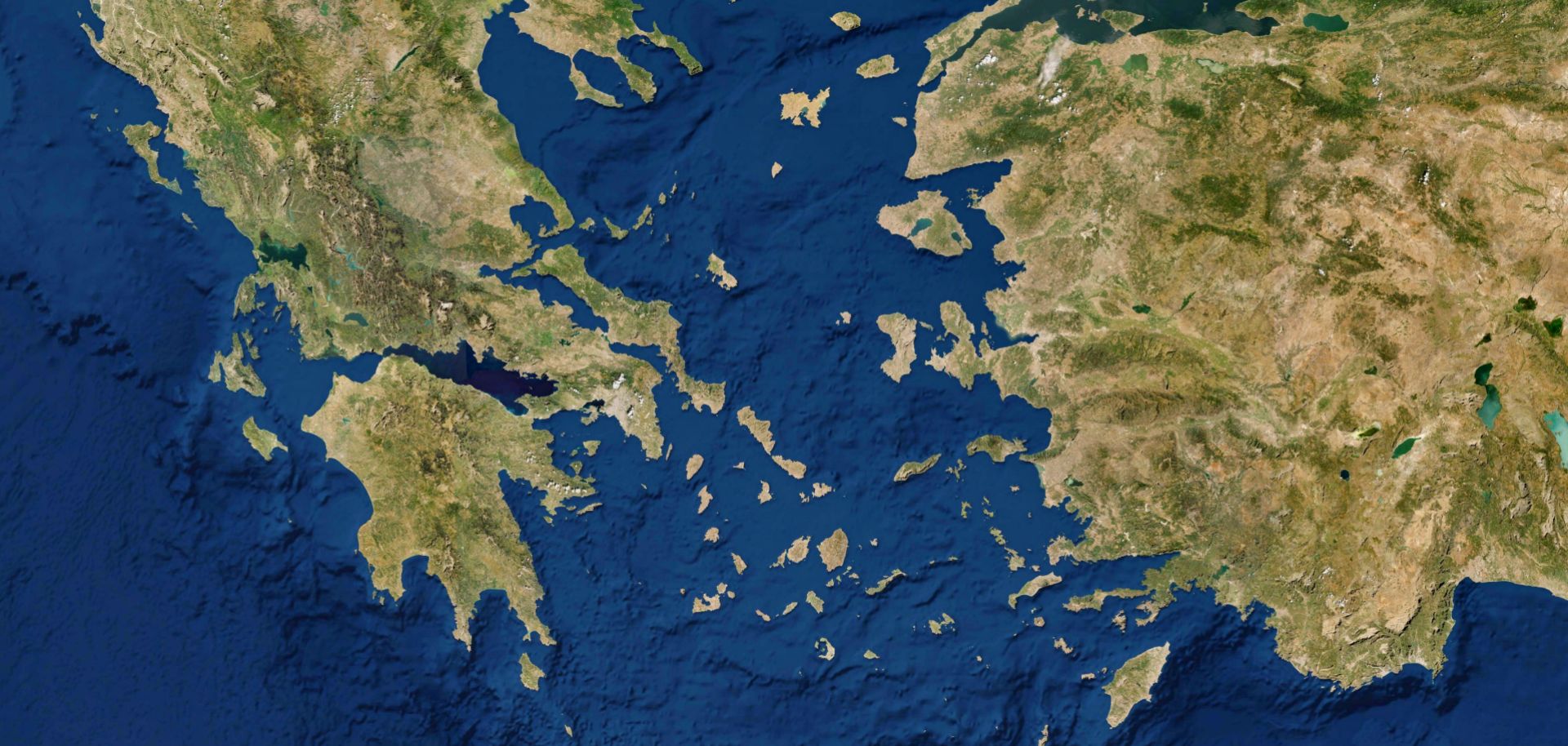
A 3D rendering of a satellite image shows the Aegean Sea between Greece (left) and Turkey (right).
Turkey's expansion of energy exploration in the Mediterranean is prompting Greece to cautiously exercise its international maritime rights in order to protect its own claims to offshore economic resources in the region, such as natural gas and fisheries, without provoking a new round of conflict. On Aug. 26, Greek Prime Minister Kyriakos Mitsotakis announced that Greece would extend its territorial claim in the Ionian Sea along its Western coastline from six nautical miles to 12 nautical miles — the maximum extent under the United Nations Convention on the Law of the Sea (UNCLOS). For now, Athens isn't extending its claims in the Mediterranean and Aegean seas, though Mitsotakis said that Greece maintains the ability to exercise that right in the future if it so chooses.
- In 1996, Greece and Turkey sparred over disputed claims in the Imia/Kardak islets, which prompted Athens to send in special forces units. Greek hydrocarbon exploration near the island of Thassos in 1987 also provoked threats of military action.
- Since the 1970s, Turkish policy has considered any extension of Greek territorial water claims from 6 nautical miles to 12 nautical miles in the Aegean Sea to be a "casus belli," or cause of war.
- Greece has long avoided declaring an Exclusive Economic Zone (EEZ) in the Mediterranean Sea to avoid conflict with Turkey. Greece's recent maritime agreements with Italy and Egypt were the first times that it had signed such pacts.
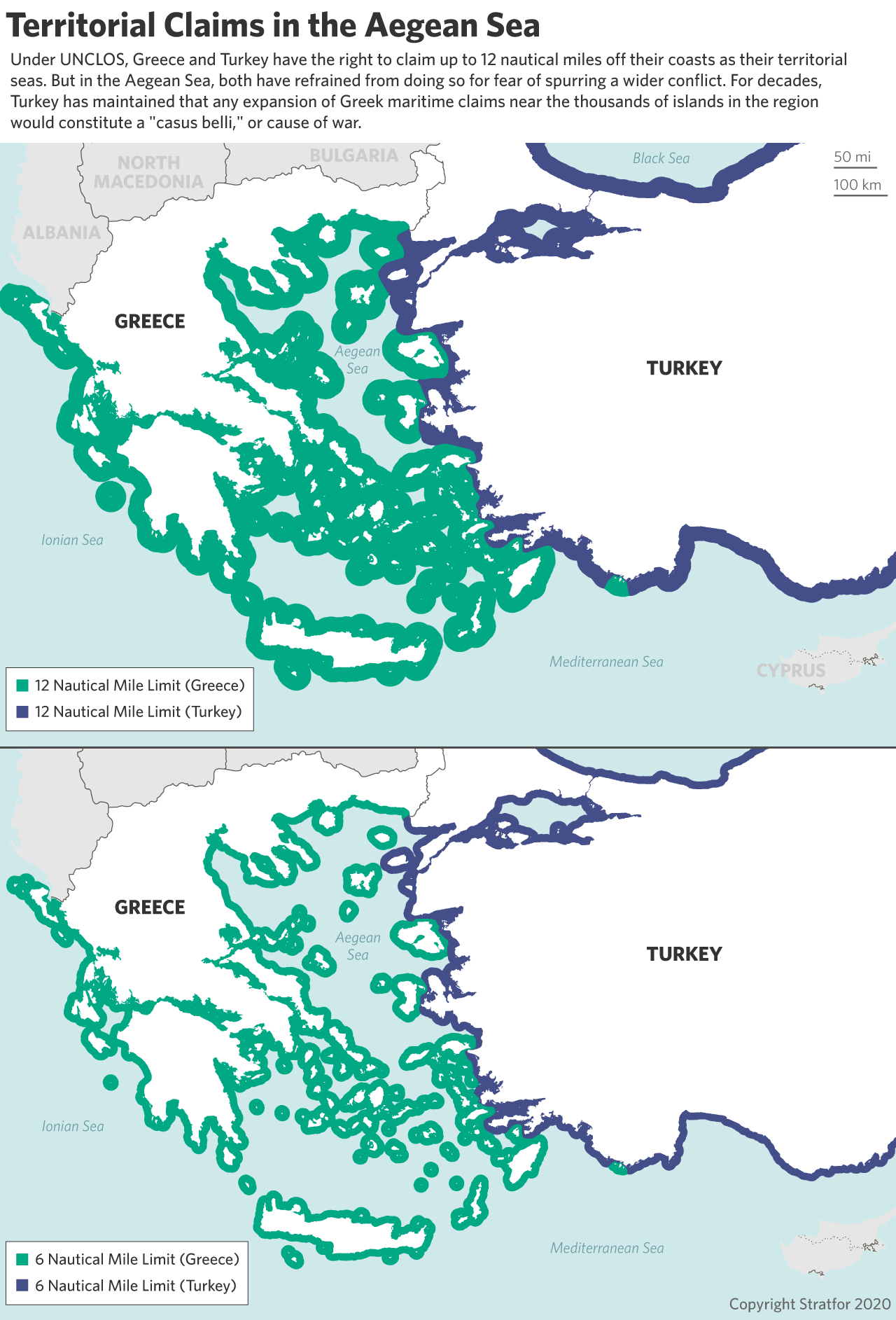
At the heart of the dispute is whether Greek islands, such as Crete and Kastellorizo, have the same level of rights when it comes to generating maritime claims as large mainland countries with lengthy coastlines, such as Turkey. Turkey's provocative maritime moves over the last year have been specifically designed to support Ankara's position that these islands cannot claim the same rights, challenging Greece and UNCLOS’s position that they can. The use of Crete, Kastellorizo and other islands in demarcating an EEZ would limit Turkey's potential maritime claims due to the significant number of small Greek islands laying off the coast of Turkey — resulting in what Ankara perceives to be an inequitable distribution of territorial waters between it and Greece.
- Turkey's Oruc Reis seismic survey vessel has been explicitly challenging Kastellorizo's ability to generate an EEZ claim by transiting waters near the island.
- In late 2019, Turkey signed a maritime agreement with Libya that challenges Crete's ability to generate claims further south and west. Greece's maritime agreement with Egypt, however, explicitly states that Crete can generate such a claim, but Athens refrained from fully declaring an EEZ under what Kastellorizo could generate.
Additional disagreement between Greece and Turkey over these maritime claims will probably require mediation by outside powers to prevent escalation, though a negotiated resolution to their dispute remains unlikely. Turkey will probably continue to aggressively defend what it perceives as its own claims, as Turkish President Recep Tayyip Erdogan increasingly turns toward nationalism and national security to distract from the country's domestic economic challenges.
Turkey will seek to avoid actions that could trigger a war with Greece or significant EU sanctions on its fragile economy. But the two countries' expanded naval presence in the Mediterranean will raise the risk for more accidents that could further escalate the situation, as evidenced by the Aug. 10 "mini-collision" between Greek and Turkish frigates near Kastellorizo. Greece's calls for broad sectoral and economic sanctions against Turkey's expansionary efforts have yet to yield significant economic recourse from the European Union. But a direct Turkish challenge to Greece's territorial sea claims around Crete or in the Aegean Sea, or a major incident between rival naval forces, would make such sanctions more likely. Should Greece and Turkey's maritime dispute unfold into a wider military crisis between the two NATO members, Europe and the United States would likely closely back Greece by sending more naval vessels to the region and conducting military exercises with its navy. Such obvious favoritism would reinforce Erdogan's belief that Turkey's security imperatives — such as fending off Kurdish militants in nearby northern Iraq — are not high on NATO's priorities, thus emboldening Ankara's push for strategic autonomy. This could, in turn, prompt Turkey to reduce its collaboration with its NATO allies and seek to deepen its defense cooperation with Russia, further fraying Ankara's ties with the West.
