
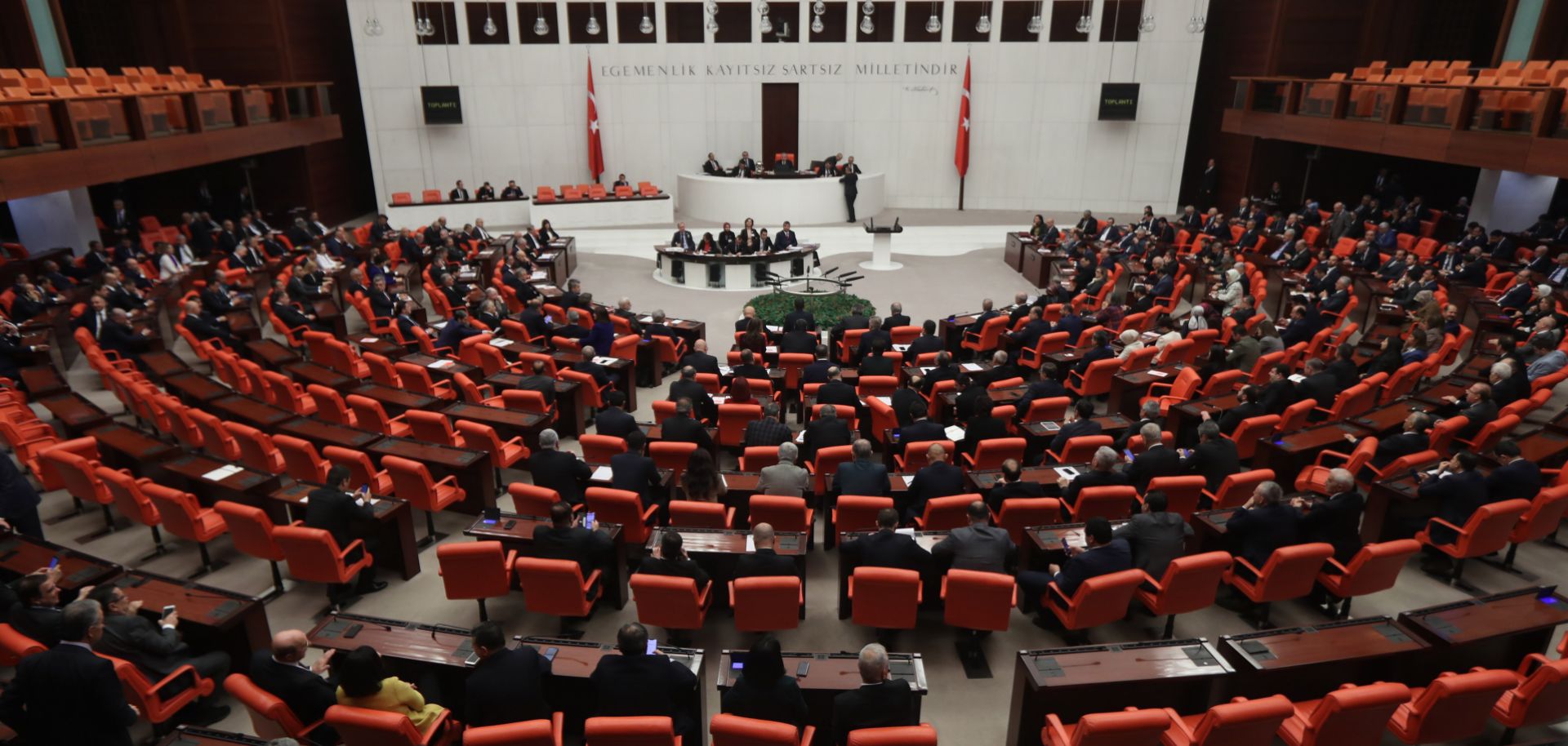
Members of Turkey's parliament vote to send Turkish troops to Libya on Jan. 2. Turkey's strategy of advancing its economic and foreign policy interests via greater involvement in Libya carries a risk of mission creep.
Editor's Note: This assessment is part of a series of analyses supporting Stratfor's 2020 Annual Forecast. These assessments are designed to provide more context and in-depth analysis of key developments over the next quarter and throughout the year.
Turkey faces the risk of mission creep as it increases its involvement and investment in Libya. For the second time in four months, Turkey is planning a controversial military deployment in an Arab country now that Libya's internationally recognized Government of National Accord (GNA) has requested air, land and sea support from Ankara to help defend Tripoli.
Increased military support from Turkey would certainly help the GNA and the militias trying to turn back an offensive on Tripoli by Khalifa Hifter's self-styled Libyan National Army (LNA) backed by Russian mercenaries and Egypt, the United Arab Emirates and Saudi Arabia, though why Turkey would even consider deploying forces to Tripoli to protect the feeble GNA might perplex some outsiders. The answer is that Ankara must protect the government in Tripoli if it wants to fulfill its regional ambitions.
But increased involvement in Libya comes at great risk: An increased Turkish presence will not win the war for the GNA, and Hifter's foreign backers will undoubtedly increase their support for him. Turkey risks becoming the GNA's only lifeline, and if it does not increase its support, the GNA could well fall — giving rise to a significant risk that Turkey could be drawn into a quagmire.
A Turkish Foreign Policy Shift
Over the past decade, Turkish President Recep Tayyip Erdogan and the Justice and Development Party (AKP) have sought to shift Ankara's foreign policy from deepening ties with the European Union (and even NATO) toward a larger role in the Middle East and North Africa, and the larger Muslim world.
The fall of autocratic governments like that of Moammar Gadhafi in Libya during the 2011 Arab Spring presented Ankara with an opportunity to pursue this foreign policy shift. Erdogan and the AKP wasted little time in doing so, supporting Islamist political groups — like the Muslim Brotherhood in Egypt and the Justice and Construction Party in Libya — closely aligned ideologically with the AKP's populist and grassroots-driven brand of Sunni Islam.
Turkish efforts to restore its historic status in the Muslim world plus the rise of Islamist political groups, however, greatly perturbed Egypt, Saudi Arabia and the United Arab Emirates, which see Turkey as encroaching on their traditional sphere of influence. Turkish economic, political and military might could effectively curb Emirati and Saudi influence in the region, and Islamist groups that Turkey supports and the democracy it promotes pose an existential threat to Gulf monarchies. A collision course between Abu Dhabi and Riyadh on one side and Ankara on the other thus became inevitable when Turkey decided to become more active in the Arab world.
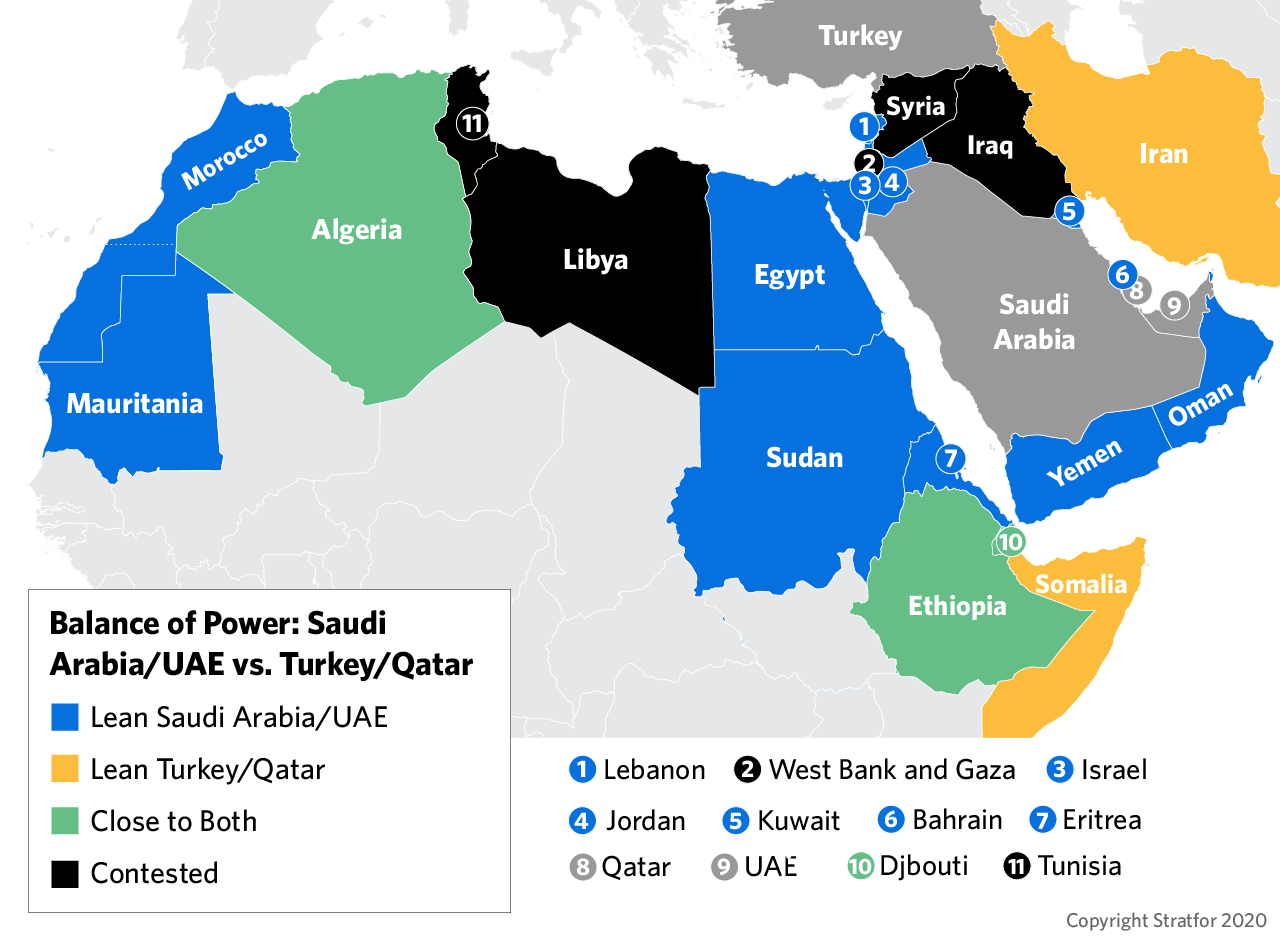
Despite Turkish support, Islamist governments in the region have faltered. In Egypt, Mohammed Morsi lasted barely a year as president, and his Muslim Brotherhood is now banned. Under President Abdel Fattah el-Sisi, Cairo is now firmly in the Saudi and Emirati-led camp against Turkey. In Tunisia, the Islamist Ennahda party has seen its share of votes decline by nearly 50 percent since 2011 and has been forced to become more moderate to participate in coalition governments. Turkish efforts to support Ennahda triggered intense blowback from Tunisia's liberal and secular political parties and media. To the south in traditionally more Islamist-friendly Sudan, the Islamist government of Omar al Bashir fell in 2019, and the country is now closely aligning itself with Abu Dhabi and Riyadh. Meanwhile, in Libya, although the Muslim Brotherhood clings to power in Tripoli via the GNA despite being routed in 2014 parliamentary elections, the Islamists still play only a minor role in the GNA's overall support base.
Protecting Turkish Interests in Libya
Turkey's ability to project influence through Islamist groups in North Africa is waning, with Libya perhaps its last opportunity to do so. It will struggle to do so, however, given the seemingly bottomless financial, arms, equipment and air support enjoyed by the LNA. The GNA has not received anything like the support the LNA has, prompting Erdogan to step in lest the GNA collapse.
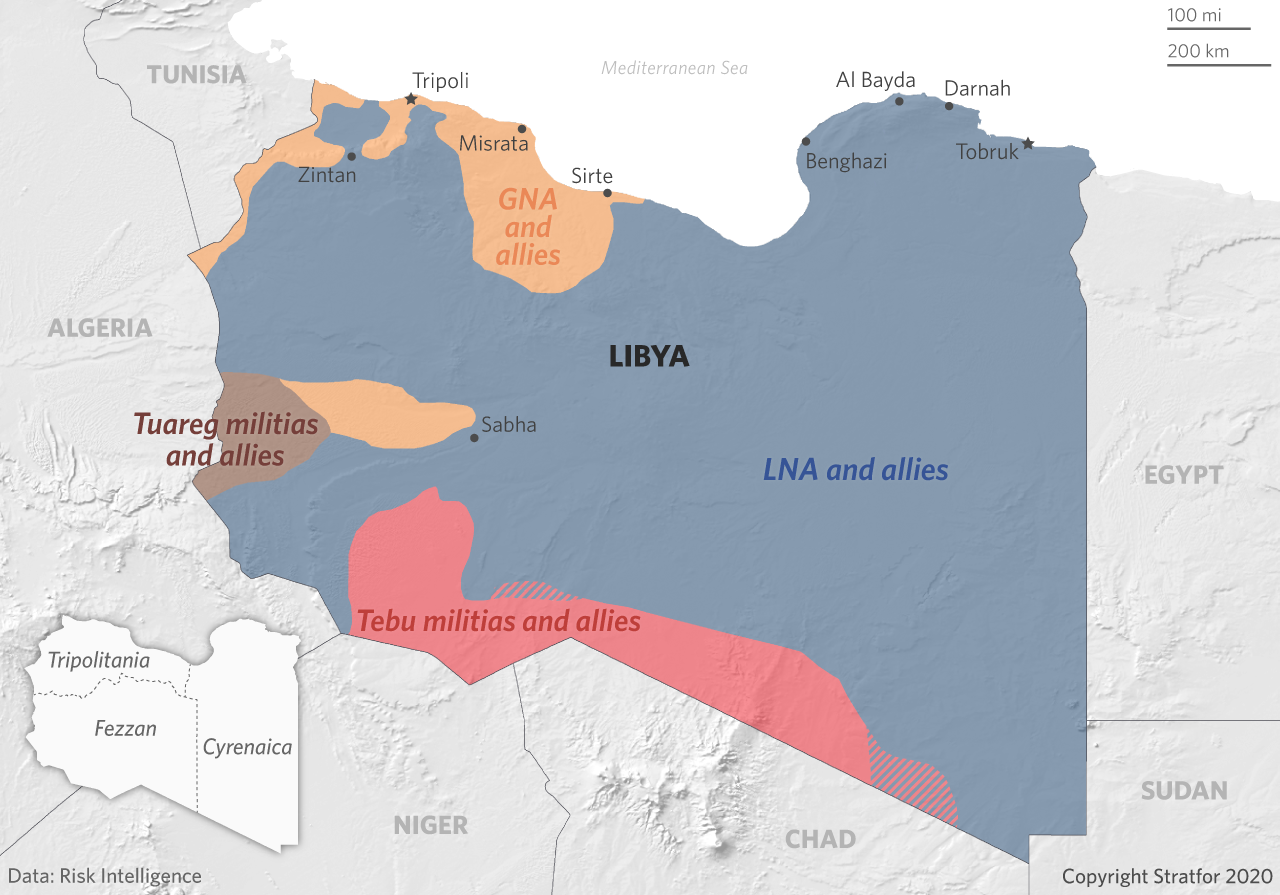
Were the GNA to collapse and Hifter to install his own government, Egypt, Saudi Arabia and the United Arab Emirates would enjoy yet another strong ideological and military partner. For its part, Turkey would almost certainly lose all its economic ties to Libya, given that the pro-Hifter House of Representatives in Tobruk has banned Turkish contractors from working in Tripoli.
Turkey has significant economic and cultural ties to Libya. It's estimated that Turkish businesses are owed more than $15 billion in unpaid debts in Libya. They are also eyeing Libya's potentially lucrative eventual reconstruction once the civil war ends. Unlike in Syria, Libya has vast oil and natural gas wealth plus roughly $67 billion in assets currently frozen by the Libyan Investment Authority with which to finance its reconstruction. In addition, more than half the population of the powerful merchant city of Misrata — including many prominent figures involved in the current Libyan civil war — have Ottoman ancestry and maintain significant economic ties to Turkey.
Moreover, as a part of a November defense agreement, Turkey and the GNA signed a second deal delineating a maritime border between the two countries, giving Turkey a rare ally in the eastern Mediterranean. Although the maritime border agreement runs counter to international maritime law, which states that two countries cannot negotiate a maritime border that infringes on another country's claims without involving the third country, this deal purports to give Turkey expanded claims near the Greek island of Crete.
Turkey can cite the agreement as justification for oil and gas exploration projects in the area and exploit increased legal ambiguity to stymie the proposed eastern Mediterranean pipeline project. The pipeline project, backed by Cyprus, Egypt, Greece and Israel, aims to take natural gas produced in Cyprus, Egypt and Israel and export it to Europe via Greece.
The eastern Mediterranean pipeline increases Turkey's incentive to keep the GNA alive. Turkey argues that any energy exploration in Cypriot-claimed waters must be done in cooperation with the Turkish-recognized government of northern Cyprus. At least on paper, its maritime deal with Libya essentially would block a pipeline directly between Greek- and Egyptian- and/or Cypriot-claimed waters, since the pipeline would pass through waters claimed by either Libya or Turkey. This added legal complication could give Turkey de facto veto power over any eastern Mediterranean pipeline to Europe. Were the GNA to fall, however, Hifter and his allies would reverse the decision. Risks aside, Turkey's increased involvement in Libya may be the only way for it to keep its regional strategy alive.
