
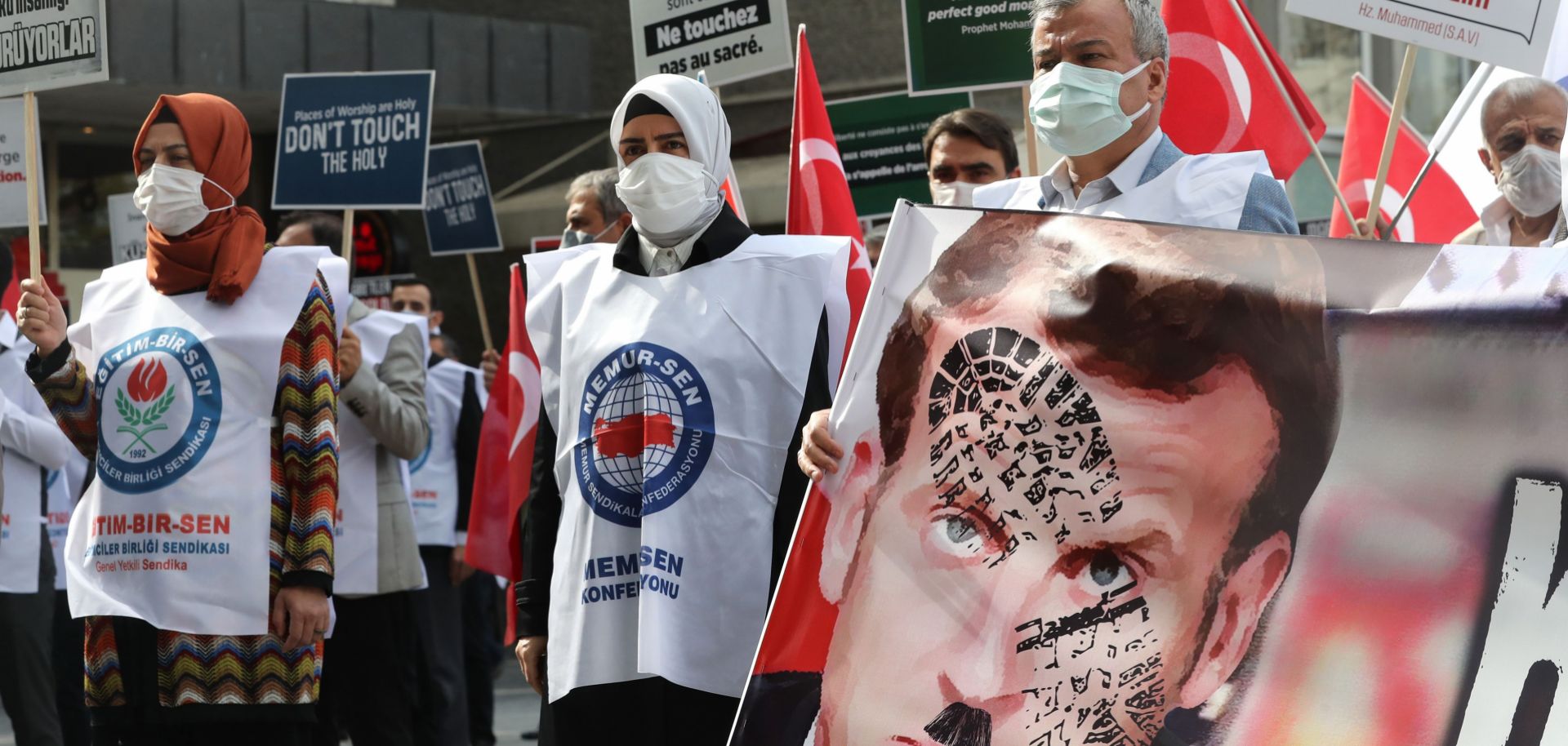
Protesters hold a sign with a picture of French President Emmanuel Macron in Ankara, Turkey, on Oct. 27, 2020. On Oct. 20, Macron blamed radical Islam for the violence that led to the recent beheading of a teacher in a Paris suburb.
Turkey’s harsh condemnation of France’s reaction to the killing of a French teacher will help Ankara position itself as a bold leader of global political Islam, even if it risks harming Turkey’s economic ties with Paris. On Oct. 25, Turkish President Recep Tayyip Erdogan said his French counterpart, Emmanuel Macron, needed “mental treatment” due to his attitude toward Muslims in France, and called for a national boycott of all French consumer products. France has recalled its ambassador to Turkey in response to Erdogan’s comments. On Oct. 18, a Chechen refugee beheaded a teacher in a Paris suburb who had shown his class satirical drawings of the Prophet Mohammed. The teacher’s execution has since rekindled French public anger against Muslims in the country, spurring several large rallies in support of the teacher and prominent republications of the cartoons in France — which have in turn fueled protest actions, calls for boycotts and diplomatic tensions in the Muslim world.
- On Oct. 20, Macron blamed radical Islam for the violence that led to the teacher’s murder, adding to his statement earlier this month that Islam was a “religion in crisis.”
- High-ranking officials across France have come out in defense of the slain teacher and the Mohammad cartoons over the past week. Several French cities have also projected images of the cartoons onto public buildings.
- In addition to Turkey, France’s reaction to the teacher’s murder has also prompted public condemnations in 13 other Muslim countries, including calls for boycotting French products in Kuwait, as well as anti-France protests and flag burning in Iraq and Bangladesh.
Ankara’s boldness in challenging Paris is built on simmering French-Turkish tensions across multiple areas. At the core of France and Turkey’s ideological rift is the two countries’ opposing views on the role of religion in society. But Paris and Ankara also support opposing sides of various foreign feuds and conflicts, including the Libyan civil war and the fight over resources in the eastern Mediterranean Sea.
- Macron is planning to introduce reforms in December that would further protect the separation between church and state in France. Erdogan, by contrast, has pushed to have religious values take more of a central place in Turkey’s technically secular government.
- In the Mediterranean Sea, France has been particularly vocal in condemning Turkey’s aggressive oil and gas exploration activities in disputed waters claimed by Greece and Cyprus.
- In Libya, France temporarily pulled out of a NATO mission after a Turkish frigate targeted a French frigate. The French ship was inspecting another Turkish vessel that was suspected of violating the arms embargo on Libya.
Turkey and France’s industrial trade could be threatened if the former’s boycott expands from its current focus on the latter’s consumer goods.
- Turkey and France’s economic relationship sees about $17 billion in trade volume.
- Turkey is France’s 13th-largest global supplier of imports (mostly industrial products, such as machinery) while France is Turkey’s sixth-largest customer.
- The Turkish city of Bursa is home to one of the largest global production centers of the French car manufacturer Renault.
Despite the financial risk, Erdogan and his ruling Justice and Development Party (AKP) will inflame anti-French tensions to gain domestic stature among nationalist and religious Turks. By eroding living standards in the country, Turkey’s declining economic performance and weakening currency have also eroded support for Erdogan and the AKP. And challenging France provides a welcome political distraction from Turkey’s grim financial outlook.
- The AKP routinely uses foreign tensions to offset political pressure at home, particularly during periods of economic stress that damages their popularity.
- A survey conducted by Metropoll in August gave Erdogan only narrow leads against Istanbul’s mayor Imam Imagoglu and other hypothetical opposition figures who may run in Turkey’s next presidential race, which is scheduled for 2023.
- The Turkish lira’s exchange rate against the U.S. dollar recently reached an all-time low. The lira’s value has declined by 20 percent since the beginning of 2020.
Abroad, Ankara will try to capitalize on growing anti-French sentiment to position itself as the leader of the Muslim world at the expense of its regional rivals. Turkey’s willingness to directly challenge France contrasts with the more moderate approaches of Saudi Arabia and the United Arab Emirates. While they’ll allow informal boycotts of French products, Riyadh and Abu Dhabi are both unlikely to officially take the same strident tone against France for fear of upsetting defense and trade ties with Europe with alienating Islamist rhetoric. In addition, both countries are trying to shift away from promoting political Islam abroad and don’t want to be seen as following Turkey’s leadership.
- The AKP has a long-standing soft power strategy to establish Turkey as the leader of the Sunni world, which has seen the Turkish government set up schools, mosques and pose as the champion of global Sunni rights.
- Since coming to power in 2002, the AKP has pushed an Islamist vision abroad that competes with Saudi Arabia’s influence.
- The AKP often views this soft power strategy as a combination of genuine religious missionary activity and a vehicle to secure influence and allies with religious fellow travelers.
