
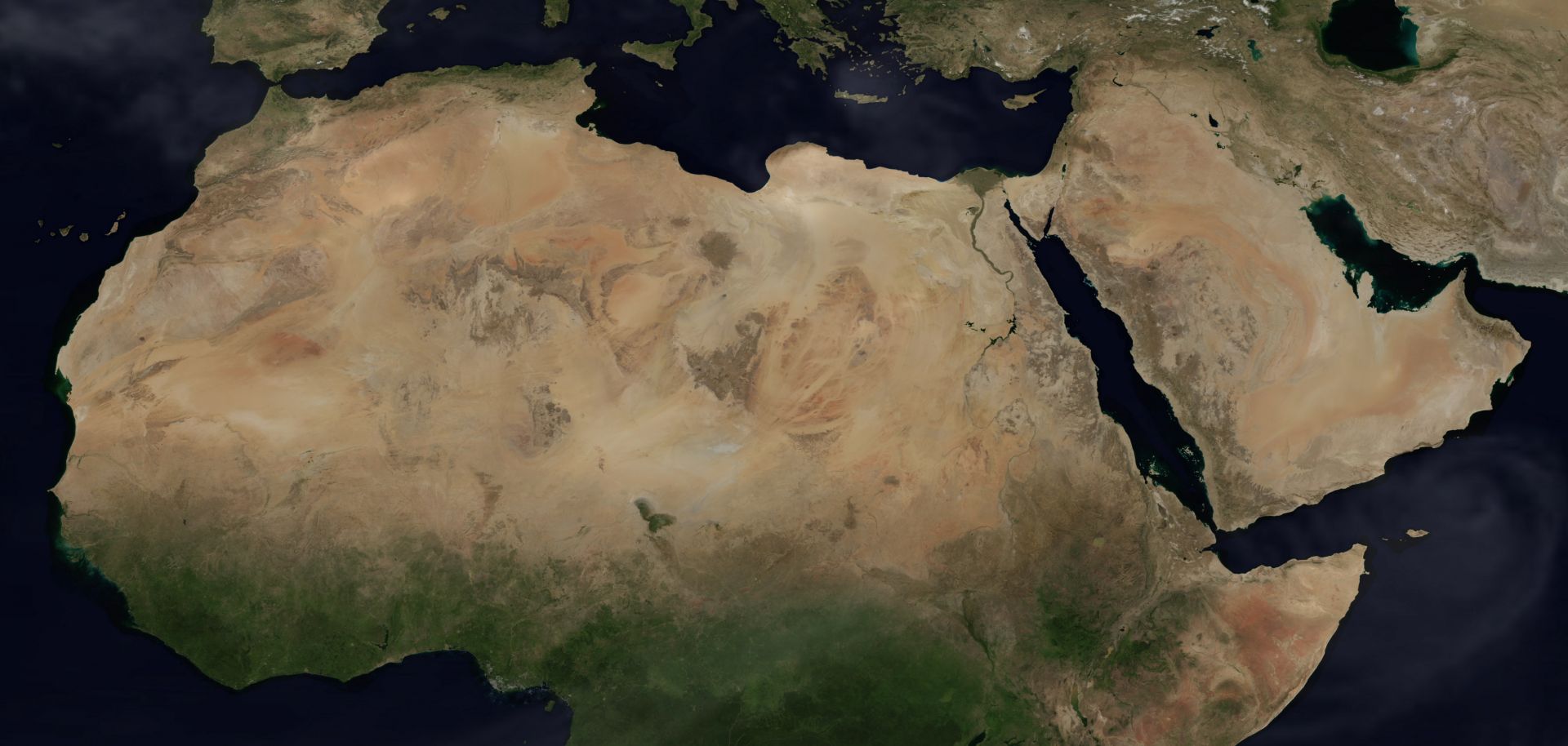
A satellite image of the Middle East and North Africa.
Once the salve for crushed Middle Eastern empires, Pan-Islamism and its vision of a singular caliphate are now increasingly seen as a threat to stability in the region, with countries such as the United Arab Emirates and Saudi Arabia turning toward nationalism to instead define their policies and behavior. Indeed, even the countries that still claim to embody the movement’s ideals, such as Qatar and Turkey, are only doing so as a means to a nationalist end, exploiting its preachings of Islamic unity to project their government’s strength at home and abroad. This trend has most recently been illuminated by the UAE-Israel normalization pact by dealing yet another blow to the idea that a global Muslim community, despite its many differences, could at the very least agree on issues such as the Palestinian question.
The Birth of a Movement
Pan-Islamism emerged after World War I as an ideological counter to the encroachment of the European ideals. As European imperialism shattered the Ottoman Empire and colonized the Muslim world, Muslim leaders sought new modes of political thought to turn back the tide of Western power. Some embraced the nation-state model of their colonizers; Turkish President Mustafa Kemal Ataturk (1923-1938) famously abolished the Sunni caliphate in his bid to transform the ashes of the Ottoman state into a modern, competitive Turkey. Beyond Turkey, some attempted Pan-Arabism, embodied by Egyptian President Gamal Abdel Nasser (1954-1970), who sought a politically unified Arab world. But after Egypt suffered repeated military defeats against Israel in 1967 and 1973, followed by Nasser’s death in 1970, pan-Arabism rapidly waned. This gave space for those who sought to update Islamist governance, borrowing aspects of the Western nation-state while not fully embracing Europe’s secular and often divisive brand of nationalism.
Pan-Islamism helped shape the social contracts of budding Middle Eastern states just beginning their own paths after decolonization. Many freshly-founded countries embraced Islamic law in their constitutions and courts, and shrouded their political traditions with Islamist titles and rituals. While some states famously resisted Pan-Islamist influence, most were either overpowered by or eventually adapted to the increasing pressures of Islamists within their borders. Iranian Shah Mohammad Reza Pahlavi's opposition to Pan-Islamism helped get him overthrown and replaced by the Islamic Republic 1979. Saudi Arabia’s relatively modest modernization program in the 1970s also caused an Islamist backlash at Mecca that same year, which convinced Riyadh to give much of the country’s social contract over to the Islamists until the 2010s. In Iraq, even nominally secular Saddam Hussein pivoted toward Islamism in the 1990s as Iraqi nationalism waned after defeat in Kuwait, adding part of the Islamic creed to the Iraqi national flag.
Unity in Name Only
Despite preaching unity in the Muslim world, the ideology underpinning Pan-Islamism, however, proved unable to resolve the national differences between varying Muslim states, as evidenced by both the ruinous Iran-Iraq War in 1980-88 followed by the Gulf War in 1990-91, and eventually inspired radicals such as the Islamic State and al Qaeda. Its adherents were divided on the exact form that Islamism should take: some, like members of Turkey’s Justice and Development party, advocated for a bottom-up approach of Islamism that governed society and then influenced politics. Others, including Shiite Islamists in Iraq and Iran, favored a top-down approach that had the ideology take front and center in politics. But perhaps most importantly, Pan-Islamists have had little to show in consolidating support for the Palestinian cause — an issue that, theoretically, should be the most unifying of all among Muslim countries.
Indeed, on both the diplomatic and military front, Pan-Islamism has provided little progress for Palestinians in their ongoing conflict with Israel. The more moderate wings of the Pan-Islamism movement have traditionally called to isolate Israel until it traded away the West Bank and the Gaza Strip to the Palestinians for a regional peace treaty. But calls for Israel’s destruction from the movement’s extremists overshadowed this moderate stance and alienated Israel’s powerful allies in the West, particularly the United States, who were key to an international settlement. Israel’s diplomats, in turn, often painted the entire movement with the same extremist brush, arguing that Islamist movements, in general, posed an existential threat to Israel.
But for some states, notably the United Arab Emirates and Saudi Arabia, the turmoil of the Arab Spring in 2011 forced them to directly confront the revolutionary potential of Pan-Islamism. The maelstrom of revolution gave both moderate and radical Pan-Islamists an opportunity to finally supplant regimes and project power. The Muslim Brotherhood seized Egypt and its vast military, while extremists surged into the Syrian civil war and began building proto-states designed to be exported abroad. For some states, these alarming developments proved the need to quickly shift the cozy relationship between state and mosque, lest other Pan-Islamist movements grow strong enough to overthrow more governments. Budding nationalist movements in countries such as Oman, Bahrain, and Saudi Arabia were put into overdrive, as governments looked to pivot the basis of their social contracts to the nationalist ideals that Pan-Islamists had worked to undermine for decades.
As Middle Eastern states turned toward self-preservation, involving themselves in the Palestinian-Israeli conflict made less and less sense. For countries such as the United Arab Emirates, the focus on the Palestinian question was designed to bolster an Islamist-friendly social contract with their domestic populations. But as Abu Dhabi’s threat perception changed, Pan-Islamists began to be seen not as glue in the social contract, but as agents of potential revolutionary rot. And as a result, the Palestinian question not only dropped in priority, but started to become inimical to national interests, as isolating Israel denied the United Arab Emirates access to Israel’s increasingly important tech, trade and security cooperation.
Nationalism Masked as Pan-Islamism
But not all states have been so quick to move away from Islamism. In Libya, Pan-Islamism manifested in the creation of a controversial maritime boundary treaty in 2020 with its Islamist-friendly Government of National Accord. And in Syria, its Islamist-leaning allies form the backbone of the militias that hold the remaining rebel territories in the northwest — and thereby keep at bay the millions of Syrian refugees that Turkey increasingly finds unaffordable.
Turkey and Qatar are also still trying to use Pan-Islamism to project power abroad, though their core goals are still inherently more nationalist than religious. In Turkey, power is channeled through Islamist movements and politicians as an expression of Turkish self-interest. Turkey’s affinity for the Muslim Brotherhood also gave Qatar the inroads to establish a military base in the Persian Gulf for the first time in over a century, which in turn bought Ankara credit with wealthy Doha, who has at times stepped in to ease Turkey’s recurrent currency woes.
Qatar, in particular, has also utilized its media powerhouse to pedal a domestic narrative that ties the kingdom to Pan-Islamism in a bid to reinforce the monarchy’s legitimacy, who must balance an occasionally fractious royal tribe with a history of coups, as well as long-standing Saudi and Emirati influence campaigns. But abroad, Qatar still sees Pan-Islamism as a means to secure itself: Doha’s closeness to the ideology has helped it maintain ties to Hamas, another Muslim Brotherhood offshoot. Those ties are valuable to Israel, which uses them to keep Hamas’s activity in the Gaza Strip in check. In exchange, the Israelis help boost Qatar’s image as a regional peace broker, especially in the United States, undermining attacks from the United Arab Emirates and Saudi Arabia that try to argue otherwise.
Yet even as they engage with Pan-Islamism, it is clear that Turkey and Qatar are also using the movement for the pursuit of self-interest. Neither is attempting to produce Islamist movements strong enough that they might supplant their own regimes. Instead, Islamists are simply a tool in Ankara and Doha’s social strategies at home and their soft power strategies abroad, and remain subordinate to either country’s national goals.
In that sense, Turkey’s rejection of the new UAE-Israel normalization deal, and Qatar’s current aloofness on the matter, are motivated not by Pan-Islamist ideologies but nationalist interests. For both countries, publicly normalizing their ties with Israel could undercut their ruling parties’ relationship with their Islamist supporters at home and abroad. For now, at least, the gains of normalization through trade, defense and positive relations with the United States would not be worth the loss of legitimacy that could damage relationships for both Ankara and Doha. In the meantime, the slipping social and political worth of Pan-Islamism means the ideology will become less a core of Turkey and Qatar’s policies and behavior, and more a thin veneer of commonality.
