
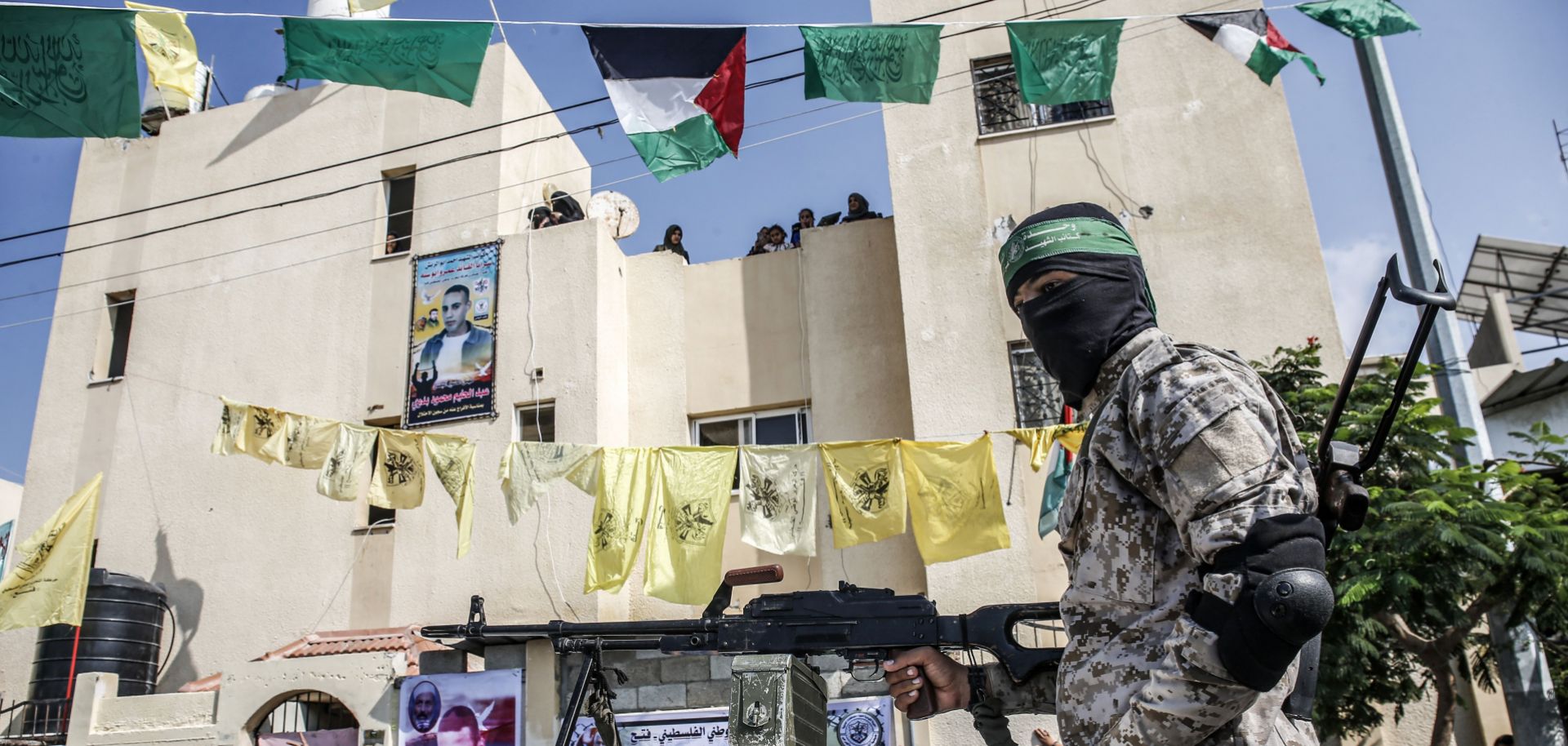
A masked Hamas militant mans a machine gun in the back of a pickup truck in the Palestinian city of Rafah, located in the southern Gaza Strip, on Oct. 17, 2019. The yellow flags of the Palestinian party Fatah can also be seen in the background.
What Happened
A Turkey-brokered agreement to hold the first Palestinian elections in 15 years suggests a new appetite for cooperation between the territories’ staunch political rivals, along with a new mediating role for Ankara, in light of warming Israeli-Arab Gulf relations. On Sept. 23-24, high-level representatives from Palestinian parties Fatah and Hamas met in Istanbul for a two-day discussion hosted by Turkey’s foreign ministry. After the meeting, a Hamas spokesperson announced that the two parties — which have been engaged in more than a decade of infighting — had agreed to begin planning elections within six months.
- Hamas’s surprise electoral victory in 2006 risked jeopardizing the political dominance Fatah had carefully built over years. Since then, the two sides have been locked in a fierce political battle, with controversy over when and how to hold the territories’ next round of elections at the core.
Why It Matters
Israel’s new peace deals with the United Arab Emirates and Bahrain have augmented both Hamas and Fatah’s shared sense of abandonment by the traditional patrons of Palestinian statehood. Despite their intense political rivalry, both parties are deeply concerned about the territories’ dwindling diplomatic and financial support from neighboring Arab Gulf states who have traditionally been important Palestinian allies. This has created a rare space for a compromise between Hamas and Fatah to avoid further isolation from the United Arab Emirates, Bahrain, and potentially others, as they normalize their ties with Israel.
- The Palestinian finance ministry says it has not received financial aid from any Arab Gulf country since March 2020.
- The level of overall foreign aid the Palestinian Authority has received has also decreased by 50 percent since the beginning of 2020, due in part to the United States’ move to cut off all aid to Palestinians in the West Bank and Gaza Strip beginning in February 2019.
Turkey, meanwhile, is capitalizing on the shifting regional dynamics created by the normalization deals to bolster its own credentials as a champion of the Palestinian cause. Saudi Arabia, Qatar and the United Arab Emirates once played a strong role in mediating between Hamas and Fatah, but in recent years, these have reduced their involvement in Palestinian political affairs. This has, in turn, left a vacuum of influence that Ankara is now seeking to fill, as evidenced by its role in hosting the recent talks that yielded an election agreement. The Turkish government will continue seeking to host future rounds of reconciliation talks between Fatah and Hamas as it tries to increase its political leverage with the Palestinians and popularity in the broader Muslim world, in which Palestinian statehood has long been a galvanizing cause.
What to Watch For
- Long-awaited elections. Elections are not guaranteed, as Hamas has said the two parties still need to finalize a concrete deal. But the fact that the Istanbul meeting has started the conversation — breaking one of the most stagnant impasses between the two parties — has opened the door for the territories’ first ballot in more than a decade.
- Additional breakthroughs between Fatah and Hamas. Both parties remain divided on a strategic roadmap to a Palestinian state, but the tentative agreement on elections has proven that compromise is possible. With Turkey’s help, improved goodwill between Fatah and Hamas may pave the way for more progress on other difficult decisions regarding leadership and policy.
- The next generation of Palestinian leaders. Ongoing negotiations on elections between Fatah and Hamas will yield clues about who from each party is best positioned for long-term leadership of the Palestinian Authority.
- Continued clashes over Israel. Hamas’ greater embrace of violence as a tool to retaliate against Israel and build popular legitimacy remains its largest differentiator from Fatah, who instead prefers peaceful negotiations with Israel to establish Palestinian statehood. Hamas and the Fatah-led Palestinian Authority have expressed similar fears about Israel’s annexation push in the West Bank and apparent disregard of Palestinian concerns. But the two parties will continue to clash over how to best respond to such Israeli threats.
