
The rivalry between Fatah and Hamas, the Palestinian Authority's two main political parties, is a fierce one. But despite their intractable differences, the two organizations have a lot of similarities. Fatah and Hamas face common pressures, for instance, not only from their support bases in the West Bank and Gaza Strip but also from regional powers such as Turkey and Egypt. Over the past few months, they have both undertaken leadership transitions to prepare for hard days ahead, restructuring their chains of command by installing younger leaders in prominent positions. And now that Israel has the unequivocal support of the new U.S. administration, the parties have more incentive than ever to band together to advance the Palestinian cause. Nonetheless, their common concerns will not bring Hamas and Fatah any closer together, nor will they bring the region any closer to peace.
Changing With the Times
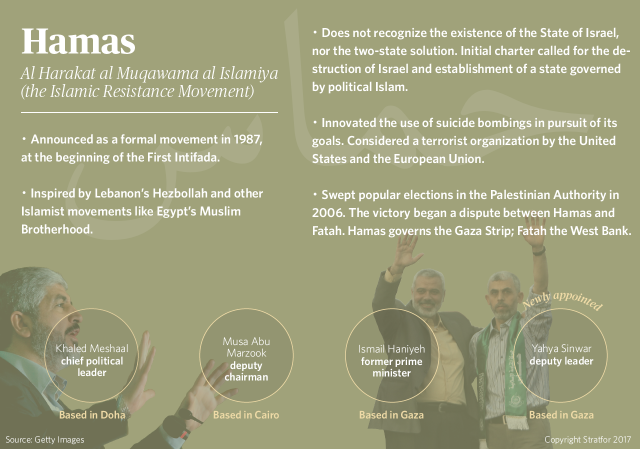
The strain on Hamas, the primary political party in the Palestinian Gaza Strip, is heavy and multifaceted. The rise of competing Salafist organizations, as well as the Islamic State, in Gaza has made it harder for Hamas to sustain its recruitment levels and legitimacy. At the same time, the party's militant arm has been losing access to crucial supply lines. The Sinai Peninsula's Islamic State affiliate has set up a blockade against Hamas in retaliation for the party's refusal to work with the extremist group. To make matters worse, Egypt and Turkey — two of Hamas' most important sources of supplies — have cracked down on its smuggling operations and militancy in an effort to maintain stable relations with Israel. (Cairo also hopes the crackdown will help alleviate the security problems plaguing the Sinai Peninsula.) Now Hamas is at their mercy — and Israel's — for basic supplies. The party has turned to Iran, which has historically provided Hamas arms and other material assistance, to fill in the gaps. But it is unclear whether Tehran has managed to furnish weapons and materiel to Hamas given the close eye that Egypt — and, of course, Israel — has been keeping on the group.
In the West Bank, meanwhile, Fatah has also been under mounting domestic and external pressure. Fatah leader and Palestinian President Mahmoud Abbas seems to have overstayed his welcome in power, having ruled long past his legal term limit to the growing dismay of many Palestinian voters. Outside the West Bank, regional powers such as Jordan, Egypt and the United Arab Emirates have been pushing Abbas to leave his office to a younger leader such as Mohammed Dahlan. Dahlan is a controversial figure, but he has popular appeal in the Palestinian Authority and possesses considerable connections in the region. What's more, Dahlan, who lives in Abu Dhabi, has demonstrated a willingness to listen to the Palestinian Authority's Arab allies. At the latest party congress in December, however, Abbas sidestepped him and the other candidates that Egypt, the United Arab Emirates and Jordan had championed and instead named loyalists, including his own sons, to Fatah's leadership positions. Abbas likewise had a hand in sidelining Marwan Barghouti, who remains a popular politician in the West Bank despite currently serving a term in Israeli prison. If Fatah's leaders keep defying their Arab allies, and if Abbas continues to micromanage his succession, the party could lose legitimacy among voters. The aging Palestinian president may learn this lesson the hard way during the next elections, slated for May.
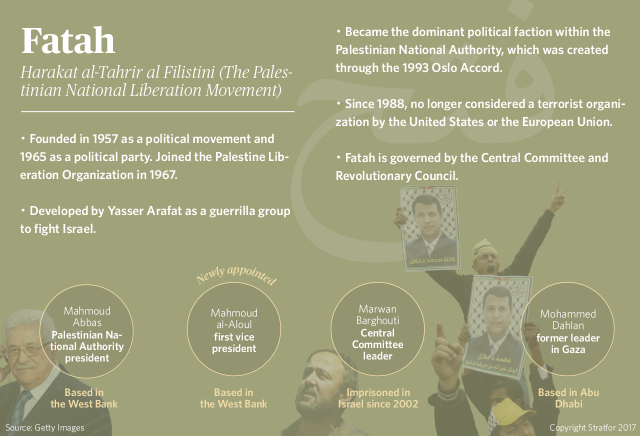
Abbas' intransigence notwithstanding, Hamas and Fatah have each introduced changes in their leadership to maintain legitimacy and relevance among their constituents. In February, Hamas installed a new deputy leader, Yahya Sinwar, thereby setting the stage for the incumbent deputy to eventually take over as head of the entire organization. Similarly, Fatah elected its first party vice president, Mahmoud al-Aloul. The shake-up was part of the party's efforts to prepare for the next security crisis in the West Bank, which appears all the more inevitable and imminent as Israeli settlements in the area proliferate.
Poor Prospects for Peace
The leadership transitions in Hamas and Fatah will do little to keep another incident with Israel at bay. In fact, they will only increase the risk of conflict. Hamas' new leader, Sinwar, hardened after years spent in Israeli prisons, is more militant than his successor was and hardly heralds a turn to moderation or reform for the party. Furthermore, since Israel's government has stronger support from the United States than ever, its leaders on the far right feel emboldened to move ahead with their assertive settlement policy (despite the U.S. administration's ambivalence on the issue). In the process, they could lay the groundwork for a third intifada. Palestinians in the West Bank typically lack access to heavy weapons or bombmaking supplies, but they could always resort to knife and vehicular attacks.
To mitigate the risk of another escalation, Israel and the United States have proposed calling on the region's Arab countries, including Saudi Arabia, to use their sway in the Palestinian Authority to improve the prospects for a new round of peace negotiations. Their failed efforts to persuade Abbas to step down, however, bode ill for that initiative. In their past attempts to usher Palestinian leaders to the negotiating table, these countries have never managed to overcome the differences that divide the Palestinian camp. That discord enables Israel to claim that the Palestinian Authority is not a reliable negotiating partner, preventing any meaningful progress in talks. A fresh attempt at peace talks would be no different. Though Hamas and Fatah reached an agreement in January to try to build a unity government and hold a long-overdue joint council meeting, the parties are still at odds over a host of issues. Before they can make an earnest attempt to reconcile, both parties must overcome their internal problems.
In light of the perpetual danger of escalation between Israel and the Palestinian Authority, other countries in the region will do their part to try to keep the peace, however tenuous. Egypt could play a central role in this effort. The country is important to Hamas, and its influence with the party has grown over the past two years. Egypt, meanwhile, depends on Hamas to help contain the growing threat of militancy on the Sinai Peninsula from extremist groups such as the Islamic State. In fact, the rise of the Islamic State has brought Egypt, Hamas and Israel together to fight their common enemy, more or less as allies. Workable relations with Hamas will also help Egypt manage its ties with the Muslim Brotherhood. (Cairo suspects that Hamas has links with that group's violent offshoots.) Egypt's relationship with Hamas puts it in an ideal position to circumvent a potential conflict with Israel, or at least moderate one before it gets out of hand. Egypt did that in 2014, settling a cease-fire between Israel and Hamas. In the years since, its ties with Hamas have improved significantly. Turkey, another important backer for Hamas, is also poised to intercede if needed.
The prospect of peace between Israel and the Palestinian Authority depends as much on the competing political groups in Gaza and the West Bank as it depends on Israel's internal dynamics. Unless Fatah and Hamas can manage their leadership transitions while maintaining the support of their constituents, peace negotiations will continue to fail before they even begin. But for now, the leaders of both parties are focused on their political survival.
