
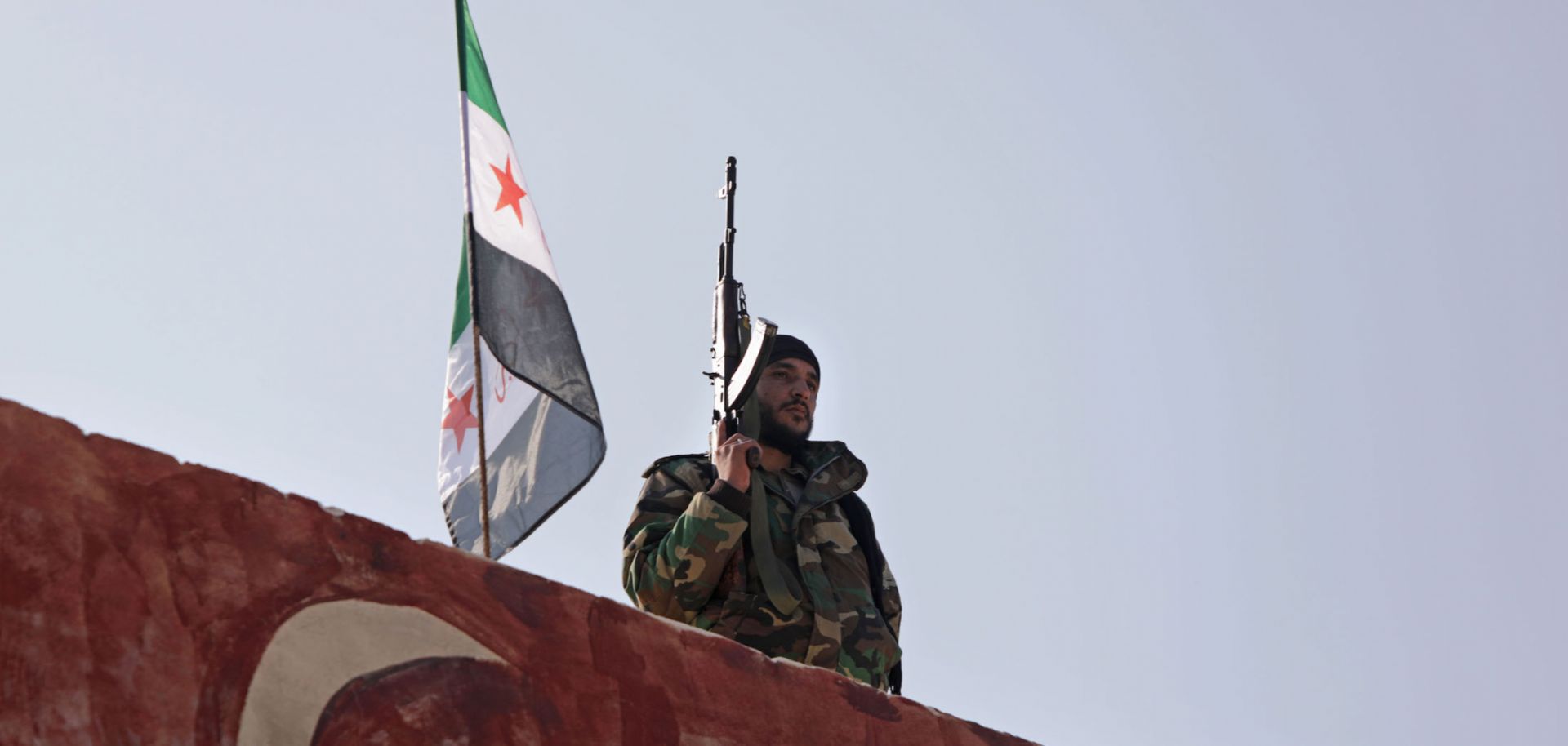
A Turkish-backed fighter guards the rebel-held province of Aleppo in northern Syria on Nov. 17, 2020.
Turkey’s gambit to undermine the U.S.-brokered 2019 cease-fire in northeastern Syria could strengthen its position on the battlefield, while increasing the Kurdish-led Syrian Democratic Forces (SDF)’s reliance on Russia and the Syrian government. For weeks, the Turkish-backed Syrian National Army (SNA) has been shelling the SDF-held strategic town of Ain Issa in northeastern Syria. Some nearby villages have fallen to Turkish-backed forces — paving the way for a possible full offensive to take control of Ain Issa. The U.S.-backed SDF has called on Russia to set up observation posts west of Ain Issa to deter further Turkish-backed attacks, while the United States has stepped up diplomatic activity to negotiate a settlement between the SDF and Turkey to avoid further escalation in the area.
- Ain Issa sits along the key M4 highway, which demarcates the southernmost portion of Turkey’s self-declared buffer zone. It also links the SDF’s forces further east with Manbij to the west, another town Turkey has set its sights on in an expanded buffer zone.
- Turkey’s buffer zone in the northeast was established in October 2019, when Turkey began Operation Peace Spring to clear the border of what it claimed were anti-Turkish Kurdistan Workers’ Party (PKK) militants. Turkey launched this operation shortly after receiving a green light from U.S. President Donald Trump.
- Erdogan and his ruling Justice and Development Party (AKP) have prioritized combating the PKK in Syria due to the security threat the PKK continues to pose to Turkey itself, as well as the domestic popularity of the group’s operations. YPG forces in Syria, which Turkey also considers enemies, are part of the U.S.-backed SDF umbrella.
Through its SNA proxies, Turkey will likely continue to pressure the SDF to hand over Ain Issa, which could build up to an offensive to take over the town. Turkey is signaling it is prepared to ignore the Russian observation posts and U.S. diplomatic pressure unless Ain Issa becomes part of its buffer zone. But the SDF is also building up forces in the town in a bid to deter an offensive and raise the stakes for a Turkish-backed operation.
- On Dec. 19, Turkish President Recep Tayyip Erdogan called for Ain Issa to be turned over to Turkish forces as part of Ankara’s strategy to build up a buffer zone along the Syrian-Turkish border
- Both Russia and Turkey have set up observation posts in Idlib in attempts to solidify the various cease-fires they’ve reached there over the years. But in practice, these posts have been ignored, with all sides carrying out maneuvers around them. In recent years, Syrian and Russian forces have surrounded Turkish observation posts in Idlib province in recurrent offensives, which ultimately forced Ankara to abandon some of the posts this past October.
Further clashes between the SDF and either the Turkish military or Turkish-backed forces over Ain Issa is unlikely to affect Ankara’s larger bilateral relationships with Russia or the United States. In previous rounds of Russo-Turkish clashes in Idlib province, Russia and Turkey maintained joint patrols in northeastern Syria, preventing the skirmishes in the northwest from spreading to the northeast. Russia and Turkey’s foreign ministers also met in Sochi on Dec. 28 to discuss their countries’ overall relationship. The discussion included deepening defense cooperation following the United States’ recent move to sanction Turkey for purchasing the Russian S-400 missile system in 2019. The United States, meanwhile, has signaled it wants to work with Turkey to create a revamped Syria strategy. Anthony Blinken, President-elect Joe Biden’s incoming Secretary of State, has suggested the Biden administration will tyr to assuage SDF-Turkish relations in a bid to strengthen Washington’s position in the northeast.
As Turkey seizes the opportunity to further entrench itself in northern Syria, the SDF will be forced to increasingly turn to Damascus and Moscow for its security. The United States, the SDF’s ally, is unlikely to expose its remaining forces in Syria to potential skirmishes with Turkish-backed forces, particularly now that Ain Issa is largely protected by Russian and Syrian forces. Turkey and its allies, meanwhile, will be increasingly willing to fight with Russian or Syrian forces to undermine their positions around Ain Issa.
- The SDF has a less adversarial relationship with the Russia-backed Syrian government. During the October 2019 offensive, the SDF invited Syrian and Russian forces to take up positions in their territory in the northeast.
- In the fall of 2019, the United States withdrew some of its troops from Syria. The remaining U.S. forces in the country are largely situated away from Ain Issa in the far east and southeast.
