
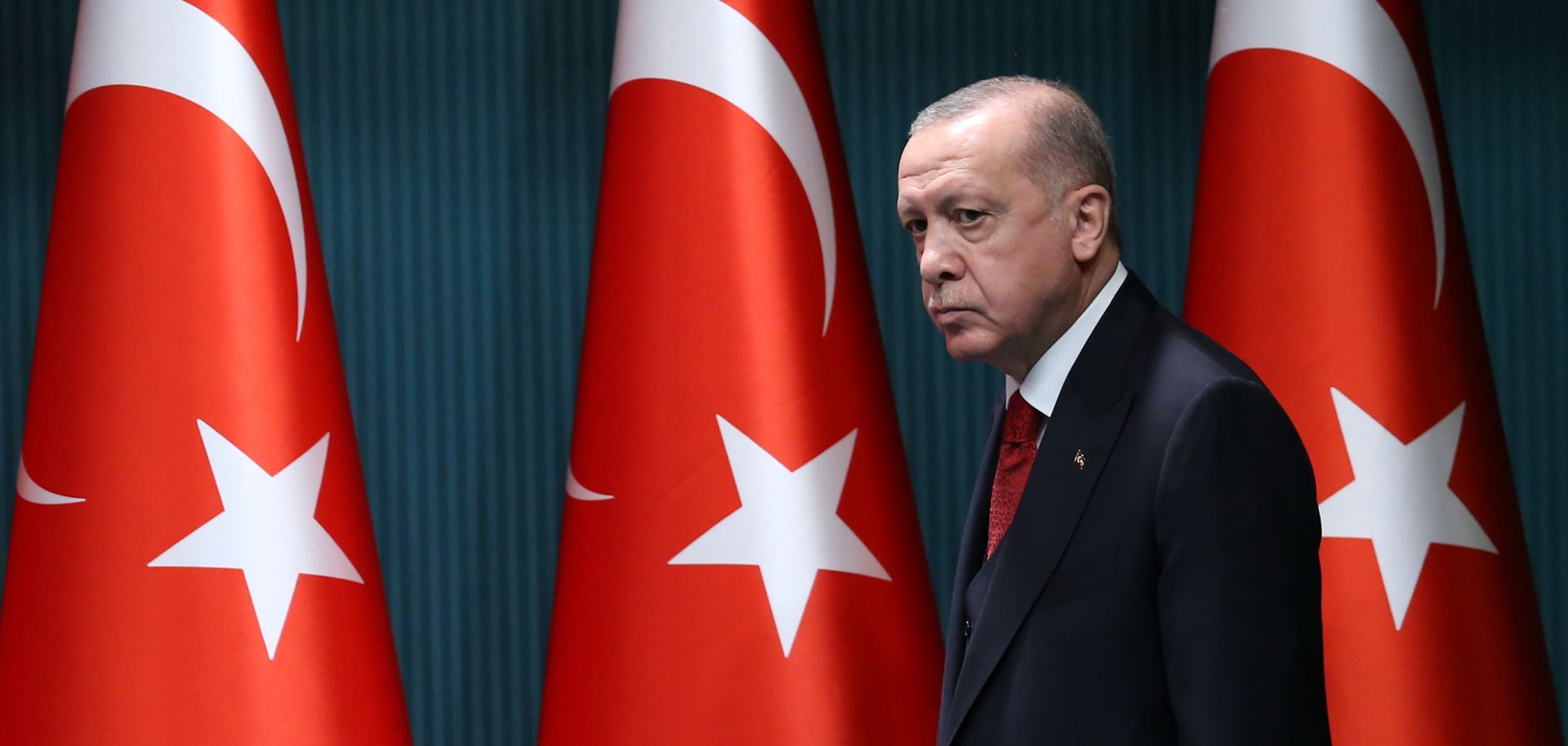
Turkish President Recep Tayyip Erdogan arrives to give a press conference in Ankara on Sept. 21, 2020.
Editor's Note: This analysis is part of a two-part series that looks at Turkey’s seemingly contradictory behavior at home and abroad, as Ankara oscillates between diplomacy and aggression to avoid further rattling its economy without forfeiting its nationalist agenda.
Turkey’s recent diplomatic overtures will help Ankara avoid damaging financial sanctions and punitive measures in the coming year without having to adjust its actual foreign policy actions, earning the Turkish government a much-needed domestic political win during a difficult economic time. In recent weeks, Turkey has been upping its rhetorical charm with the European Union, as well as Arab states where it has acrimonious relationships. Turkey’s fragile financial situation has left President Recep Tayyip Erdogan’s government unable to reproduce the economic miracle of the early 2000s that cemented his Justice and Development Party (AKP)’s place in power. This has compelled Erdogan to pursue a foreign policy that strikes a line between conciliatory and independent in order to retain his ruling party’s dominant political position in the country before 2023 elections.
- Turkey’s resumption of direct talks with Greece in January helped improve its ties with the European Union and avoid previously threatened EU sanctions. On March 25, the 27 governments of the European Union issued a statement that the bloc was “ready to engage with Turkey in a phased, proportionate and reversible manner to enhance cooperation in a number of areas of common interest” following the recent de-escalation of tensions between Ankara and Athens over their maritime dispute in the eastern Mediterranean. A recent April meeting between high-ranking Turkish and EU officials has since yielded an agreement to deepen economic cooperation between the two sides.
- On March 24, Erdogan said that his government sought to help establish peace in the Middle East region and increase the number of “friends” Turkey has around the world. Several days earlier, Al Jazeera reported that Turkish authorities had ordered Turkey-based Egyptian opposition groups to soften their criticism of Egyptian President Abdel Fattah al-Sisi.
- On March 12, Turkey’s foreign minister said Ankara had established contacts with Egypt at the intelligence and foreign ministry levels following a March 3 statement that Turkey could forge a maritime agreement with Cairo — signaling a warming of relations between the two longtime rivals. He also said that Turkey was open to rebuilding ties with political and commercial rivals, Saudi Arabia and the United Arab Emirates.
Turkey is seeking to ease the negative global perception of some of its regional and domestic behavior to protect its economy and government from punitive economic measures and the subsequent political damage. Turkey’s human rights record and relationship with Russia, as well as its aggressive drilling activity in the eastern Mediterranean, and its role in regional conflict zones like Syria, create economic and political friction points with Ankara’s Western and regional partners. These sore spots increase Turkey’s sanctions risk and limit the possibility of greater commercial economic benefit with other countries. To preserve its dominant political position ahead of the 2023 elections, Erdogan’s AKP-led government wants to reduce the likelihood of Turkey incurring more painful economic sanctions from Western partners like the European Union and the United States that could deepen Turkey’s ongoing currency volatility. Reducing political frictions with wealthy Arab Gulf states also holds the promise of commercial opportunity, while positioning Turkey as a regional leader willing to put aside personal grudges for the sake of stability in the Middle East.
- Turkey has faced a fragile financial situation since 2018, and a personnel reshuffle at the central bank in March threw the Turkish lira into a new stage of volatility.
- EU sanctions on Turkey for its human rights behavior and eastern Mediterranean provocations have so far been mostly symbolic, in part because Turkish cooperation on issues like the migrant deal is useful to Brussels. And Turkey will seek to keep in that way in order to avoid harmful punitive sanctions.
- Saudi citizens have unofficially boycotted Turkish products in recent years to protest Turkey’s disruptive regional behavior, including Ankara’s support for political Islamists.
Despite this new willingness to adjust global perceptions of its behavior, Turkey is unlikely to significantly change its overall strategies, meaning Ankara’s relationships with Western states and neighboring Arab countries will remain tense. Amid its new diplomatic charm offensive, Turkey’s government has also made it clear that it will not betray its own national security imperatives, with Erdogan stating on March 24 that Turks “do not have problems that cannot be solved with any country that respects the national interests of our country.” Erdogan’s statement underscores that Turkey will walk a line to achieve what it needs from other countries and to avoid sanctions without sacrificing its own national security demands and needs. Actual deep reconciliation with the European Union and Egypt would require more action on Turkey’s part that would run counter to Ankara’s national security imperative. Despite the potential for deeper coordination with Brussels, Turkey is highly unlikely to budge on recognizing the sovereignty of Cyprus since Ankara views northern Cyprus as full Turkish territory. Turkey is also unlikely to fully withdraw its diplomatic and economic support for political Islamist groups across the region, which would open up significant avenues for cooperation with Egypt and Arab Gulf states.
- On March 2, Erdogan announced a sweeping two-year human rights action plan that promises to strengthen the rule of law, increase judicial transparency and allot more freedoms to Turkish journalists. But just two weeks later, Erdogan announced on March 20 Turkey’s withdrawal from the Istanbul convention on women’s rights, insisting that Turkish domestic law offered enough protection for women. The former won praise from the European Union while the latter sparked critique, underscoring the limits to Turkey’s willingness to align policy with that of its partners and neighbors.
Turkey’s government offering minimal concessions and rhetorical olive branches grants Turkey flexibility to continue foreign policy actions that play well with the AKP’s base at home at a critical political juncture in Turkey. Even minimal rhetorical cooperation with foreign partners keeps Turkey from stoking greater political and economic tensions with its partners and neighbors while still enabling Ankara to continue its behavior as it sees fit.
- On April 6, EU leaders promised to provide Turkey additional funding in exchange for renewing its migration deal with the bloc. Brussels also opened the door to potentially upgrading its customs agreement with Ankara, which would help improve the Turkish economy. More money for Turkey and deft handling of EU ties would offer rich political fodder for the AKP.
- Increased diplomacy with Egypt, the United Arab Emirates and Saudi Arabia will potentially create political goodwill with the United States and European Union, who have both criticized Turkish behavior in recent years as being aggressive, one-sided and destabilizing for regional security — especially in conflict zones like Libya and Syria, where Turkish and Arab interests overlap. This will help protect Turkey from the risk of Western sanctions, even as it continues much of its behavior in those conflict zones in pursuit of national security imperatives that play well with AKP voters.
- Domestically, displaying magnanimity with Egypt will portray Erdogan as the mediator and statesman and rival al-Sisi as the hesitant aggressor prolonging the two countries’ rivalry. Regionally, appearing willing to mediate with Egypt has already proved beneficial on the ground in Libya, with both Ankara and Cairo’s allied partners in the country making progress toward holding long-delayed elections this year.
