
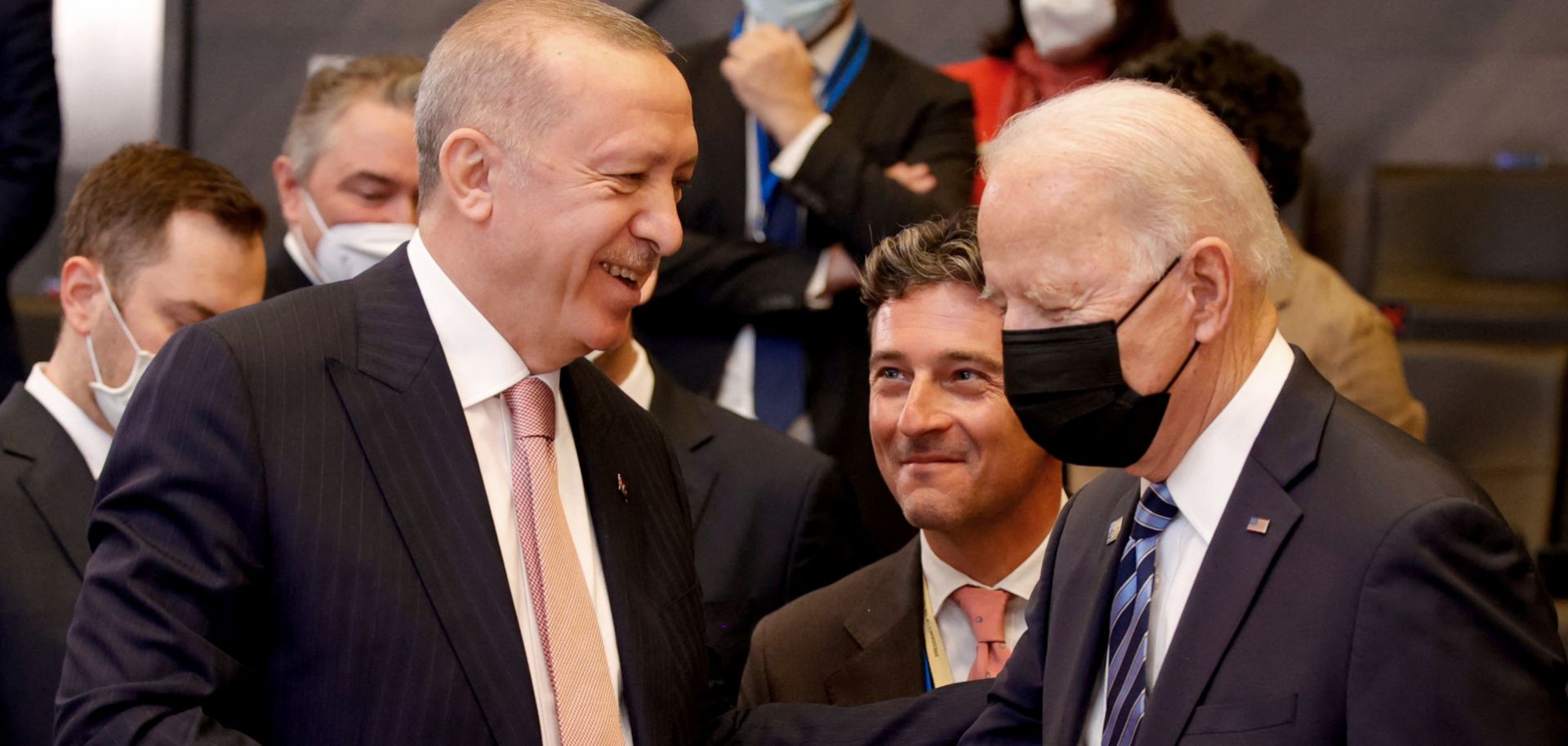
U.S. President Joe Biden (right) speaks with Turkish President Recep Tayyip Erdogan at NATO’s headquarters in Brussels, Belgium, on June 14, 2021.
U.S. President Joe Biden’s first meeting with his Turkish counterpart Recip Tayyip Erdogan indicates bilateral relations will remain strained but pragmatically stable in the near term. But Washington and Ankara’s still many unresolved disputes, combined with Erdogan and his allies’ controversial moves to centralize power, will leave open the potential for future tensions that could escalate into new U.S. sanctions. On June 14, Biden met with Erdogan for the first time since being sworn in as president in January. The meeting, which was held on the sidelines of the NATO summit in Brussels, was widely described as positive and included an agreement in which Turkey pledged to take charge of securing the Kabul Airport in Afghanistan as the United States withdrew from the South Asian country. But despite this, none of the other major points of contention between Washington and Ankara were resolved. For now, pragmatism seems the likely course, but more potential landmines remain as Erdogan’s ruling Justice and Development Party (AKP) attempts to cement its control of Turkey ahead of the national elections slated for June 2023.
Turkey’s domestic and strategic constraints will prevent the resolution of ongoing disagreements, despite the current pragmatic nature of the U.S.-Turkey relationship. These issues include:
The extradition of a U.S.-based Turkish preacher
- The Dispute: Turkey believes a Turkish Muslim preacher named Fethullah Gulen orchestrated a deadly coup attempt in 2016 and has since arrested tens of thousands of people with suspected ties to Gulen and his alleged “FETO terrorist” organization. But the United States, where Gulen lives and where many of his followers have sought asylum, has backed the preacher’s claims that he was not involved in the coup and that the network of charities and companies he oversees is peaceful.
- Prospects for Resolution: The United States is highly unlikely to extradite Gulen, as the White House remains unconvinced that the preacher was the mastermind behind the 2016 coup attempt. Turkey is also unlikely to stop targeting Gulen’s supporters at home and abroad as the AKP tries to maintain the political loyalty of Turks still angry over the coup attempt.
Turkey’s purchase of the Russian S-400 missile system
- The Dispute: Turkey bought the S-400 in 2017, which alarmed Washington by stoking fears of both budding Russo-Turkish defense ties and the potential for the system to be used as a source of intelligence on U.S.-made stealth jets for Moscow. The United States removed Turkey from the F-35 program and imposed sanctions under the Countering America’s Adversaries Through Sanctions Act (CAATSA) in retaliation for the purchase.
- Prospects for Resolution: Turkey has floated the idea of joint monitoring of the S-400 missile system or even shelving it in exchange for sanctions relief. But lifting the CAATSA sanctions would require the oversight of the U.S. Congress, where many legislators have called for hard-line action against Turkey’s purchase of the S-400. There’s a chance Turkey could also compromise by, for example, limiting the frequency of the S-400’s use. But Ankara remains highly unlikely to fully abandon the system without significant U.S. concessions, as Turks see the S-400 purchase as a matter of national independence.
U.S. support of Kurdish militants in Syria
- The Dispute: The United States relies heavily on cooperation with the Syrian Democratic Forces (SDF) for its operations against the Islamic State in Syria. A major component of the SDF, however, is the Peoples’ Protection Units (YPG), which is connected to the Kurdistan Workers’ Party that carries out attacks inside Turkey. For this reason, Turkey wants the United States to cut all ties to the YPG.
- Prospects for Resolution: The Biden administration is highly unlikely to cut ties with the SDF amid growing fears of an Islamic State resurgence in northeast Syria. From an optics standpoint, abandoning the SDF would also risk looking like a repeat Trump-era attempts to rapidly withdraw from Syria.
Turkey’s human rights record
- The Dispute: The Biden White House is refreshing Washington’s diplomatic commitment to human rights — opening Turkey’s AKP to scrutiny, as the religious-nationalist party often views social issues differently than the United States and bristles at criticism from Western powers. In April, for example, Biden became the first U.S. president to formally recognize the 1915-1916 massacre and deportation of Ottoman Armenians as a genocide.
- Prospects for Progress: Cultural and political differences over human rights are also likely unresolvable, as the AKP pursues its ideological goals at home and the Biden administration tries to reaffirm U.S. interest in human rights abroad, as defined by the West.
Ahead of the national elections scheduled for June 2023, the AKP will also increasingly prioritize policies designed to strengthen the party. Turkey’s political parties are currently debating an update to the country’s constitution, and the AKP is likely to pitch a version that will benefit Erdogan and tilt the system in favor of the party’s long-term control of the country. Additionally, the AKP will likely continue to attempt to suppress opposition parties like the Kurdish-dominated People’s Democratic Party (HDP). In response, the United States will probably criticize such policies and might even attempt to pressure Turkey to halt them by either imposing sanctions or threatening to, undermining Ankara’s trust in Washington.
- Turkey’s ruling AKP is in an electoral alliance with the nationalist MHP party, which often opposes concessions to the United States and Europe. Without the MHP, the AKP has no parliamentary majority and would be unable to pass legislation without calling new elections.
- Turkey’s Constitutional Court is also hearing an AKP-led petition to ban the Kurdish HDP party, a prominent opposition party whose elimination from the political spectrum would boost the AKP’s vote share and make a future victory in a national contest easier.
- The AKP is again leading discussions to reform the Turkish constitution. The last reform, which took effect in 2018, shifted the country’s parliamentary system to a presidential system and made it harder to remove Erdogan from power while extending his term limits. Erdogan is currently subject to a term limit of two five-year terms under the current constitution, a condition the AKP may also attempt to change.
Such power grabs will likely widen the ideological gap with the United States by shifting Turkey’s status away from a pluralistic democracy. Turkey’s status as a NATO ally makes its authoritarian drift more controversial in the United States, where politicians and activists openly question if its changing political values align with NATO’s overall mission. The Biden administration will thus likely publicly condemn Erdogan and the AKP’s attempts to consolidate power, and may also even try to pressure Turkey to halt such efforts altogether via actual sanctions or the threat of sanctions. Such retaliation, however, would only further undermine Ankara’s trust in Washington and, in turn, any hopes for resolving the various disputes plaguing the two countries’ broader bilateral relationship.
