
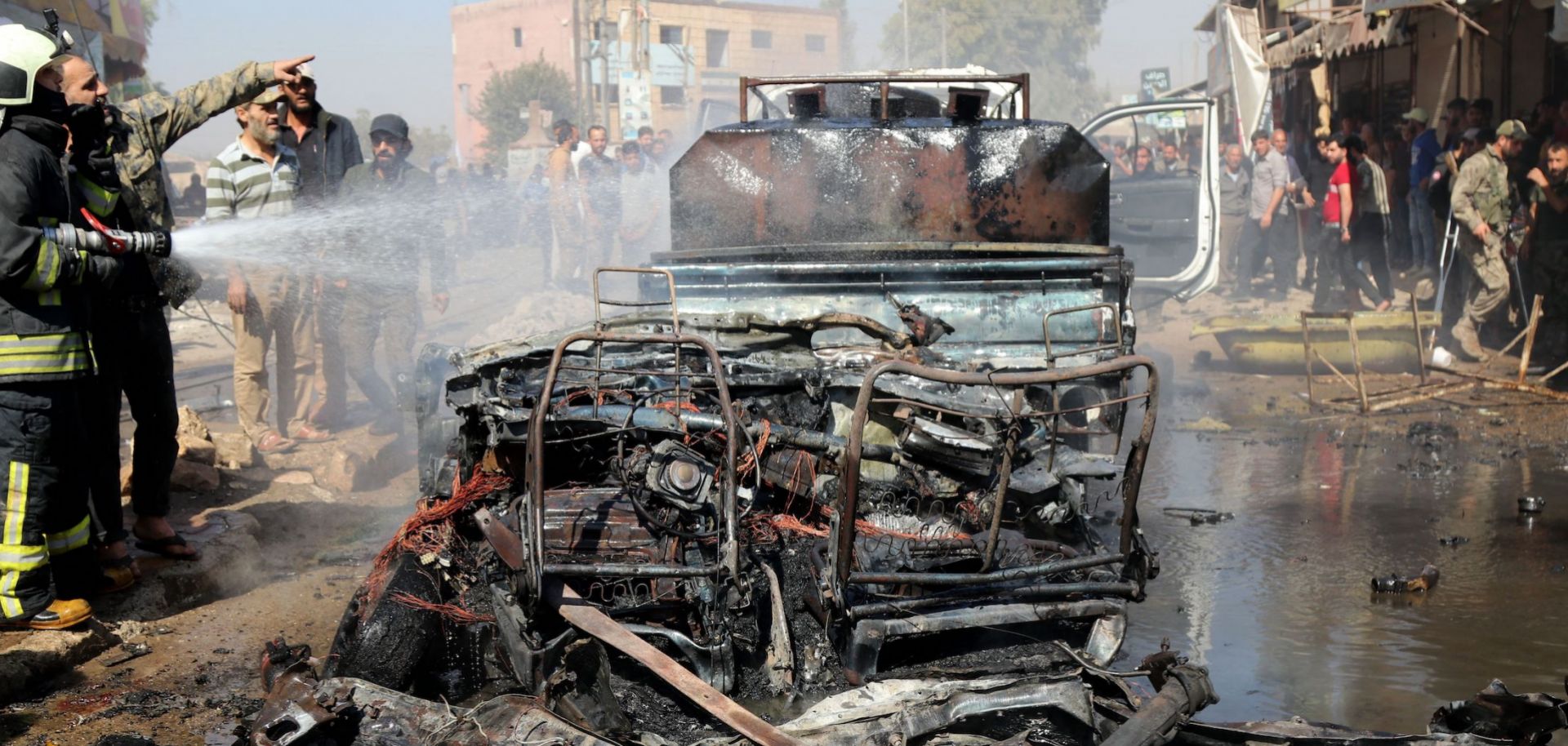
A vehicle destroyed in a bombing is seen in Syria's rebel-held northern city of Afrin on Oct. 11, 2021.
If Turkey follows through on threats to retaliate against Kurdish militants in Syria, it will put Ankara back on a confrontational path with Russia and the Syrian regime, while straining its relationship with the United States. On Oct. 11, Turkey’s President Recip Tayyip Erdogan vowed to retaliate for an alleged Kurdish militant attack in northern Syria that killed two Turkish police officers. Erdogan said Turkey had “run out of patience” and was ready to take matters into its own hands, should other countries (namely Russia and the United States) fail to work with Ankara to deal with the issue. In response to the recent attack on Turkish police, Erdogan also appeared to hint at a potential offensive around the Tal Rifaat region — a pocket of Kurdish militant-controlled territory north of Aleppo that has acted as a buffer between Syria and its allies and Turkish forces for years. While Tal Rifaat is not under U.S. protection, other areas, like Manbij to the east, are.
- Turkey has launched several offensives into Syria to contain the spread of militants aligned with Kurdish People's Protection Units (YPG) in Syria, as well as the Kurdistan Workers' Party (PKK), which has carried out cross-border attacks into Turkey from both Syria and Iraq.
- In 2018, Turkey launched an operation against the northern Syrian city of Afrin to clear out YPG and PKK militants. But Turkish troops did not press into Tal Rifaat, leaving the enclave under Kurdish control.
- Kurdish militants make up part of the Syrian Democratic Forces (SDF), the United States’ key ally in its counterterrorism strategy in Syria. Past offensives against the YPG have stirred anti-Turkish sentiment in the U.S. Congress, especially the October 2019 offensive that saw Turkey carve out an incomplete buffer zone along its border with Syria.
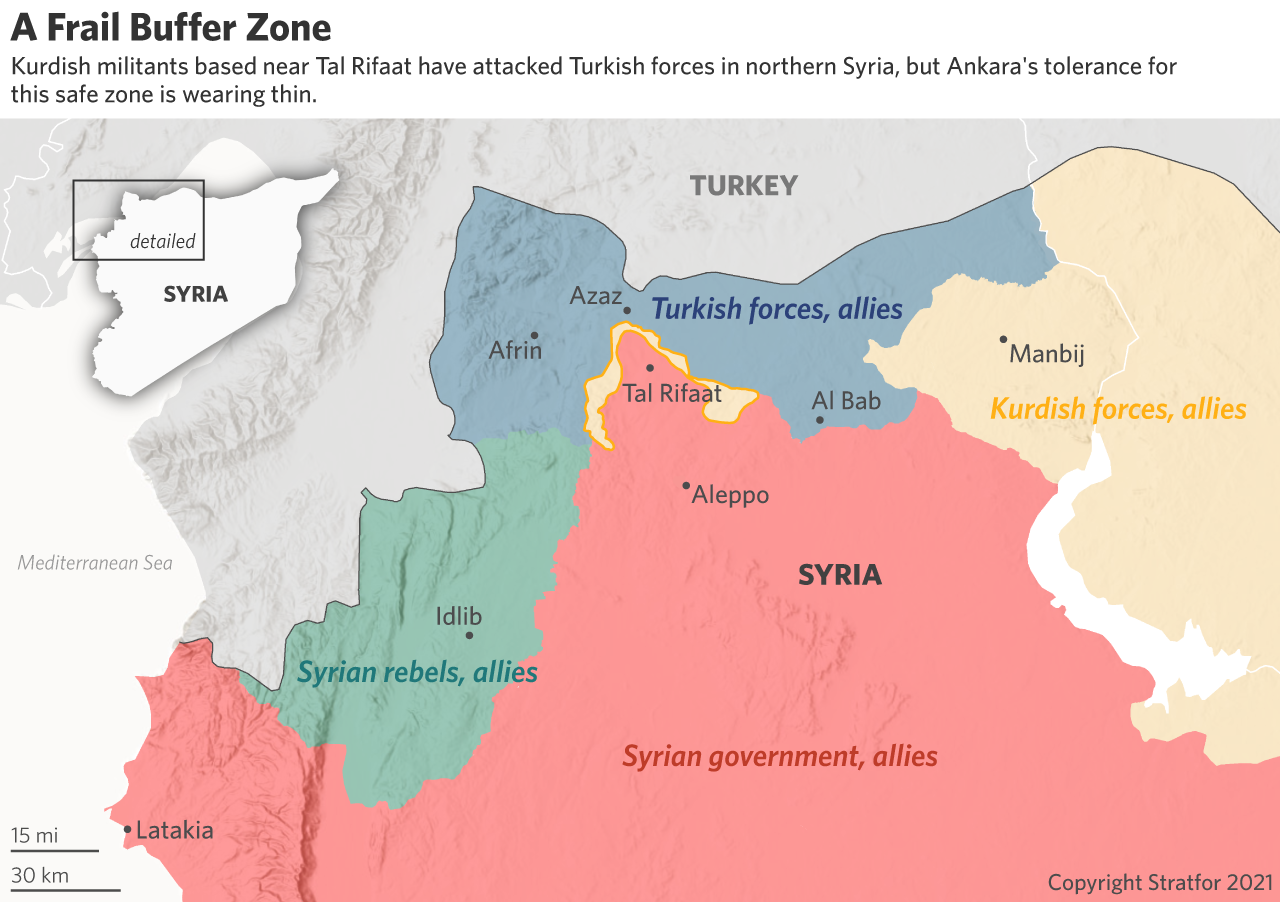
Turkey may risk a military operation in Tal Rifaat, especially as talks with Russia have repeatedly failed to end attacks out of the enclave. Because of the recent casualties and repeated failures for negotiations to end attacks, Ankara is increasingly incentivized to retaliate against militants in the Tal Rifaat buffer zone through limited ground incursions and/or airstrikes. There’s a chance Turkey could also attempt to occupy the entire Tal Rifaat region, which would require Moscow’s acquiescence. But after intense Turkish pressure, Russia allowed Turkey to occupy nearby Afrin in January 2019 in part to avoid a major military confrontation with Ankara over the issue of Kurdish militants — raising the potential for Moscow to do so again.
- In 2019, Turkish-backed forces clashed with YPG militants in Tal Rifaat, but the presence of Syrian and Russian forces prevented a full-scale offensive on the enclave. Syria supports maintaining the buffer zone in part because it wants to see militant attacks on Turkish troops and allies in Syria, as Damascus seeks to eventually eject Ankara from its territory.
- The YPG/PKK militants have largely avoided fighting the Syrian government and its allies throughout the civil war. In response to the October 2019 Turkish offensive, they helped facilitate the arrival of Syrian and Russian troops into the Syrian northeast to put them into positions where they could block Turkish troop movements.
An offensive against Tal Rifaat would increase the risk of Turkish forces clashing with Syrian and Russian troops in the region. Turkey would not directly target Syrian or Russian forces during an operation in Tal Rifaat. But if negotiations cannot secure their withdrawal, even a limited attack creates the risk of accidental casualties that would potentially bring all sides back into a major military escalation. Syria will be particularly difficult to convince to leave the territory, as Damascus wants to undermine Ankara’s buffer zones in Syria as much as possible — creating the possibility that a Turkish military operation might clash with Syrian forces while Russian troops withdraw. YPG/PKK militants, meanwhile, might launch retaliatory attacks inside Turkey itself. They would also try to pull the Syrian regime into the military operation to limit Turkey’s gains in the Tal Rifaat region, building deeper ties between Kurdish militants and Damascus that could pave the way for a deeper reconciliation in the future.
Attacking the enclave would also increase U.S. scrutiny of Turkey’s actions in Syria, fueling calls for Washington to impose sanctions against Ankara. The United States would be critical of another Turkish military operation against the YPG/PKK, strengthening voices in the U.S. Congress that want to see their country distance itself from Turkey over its controversial anti-Kurd push in Syria, Iraq, and Turkey. Such arguments would likely also embolden calls for U.S. sanctions on Turkey over its overall human rights record.
