
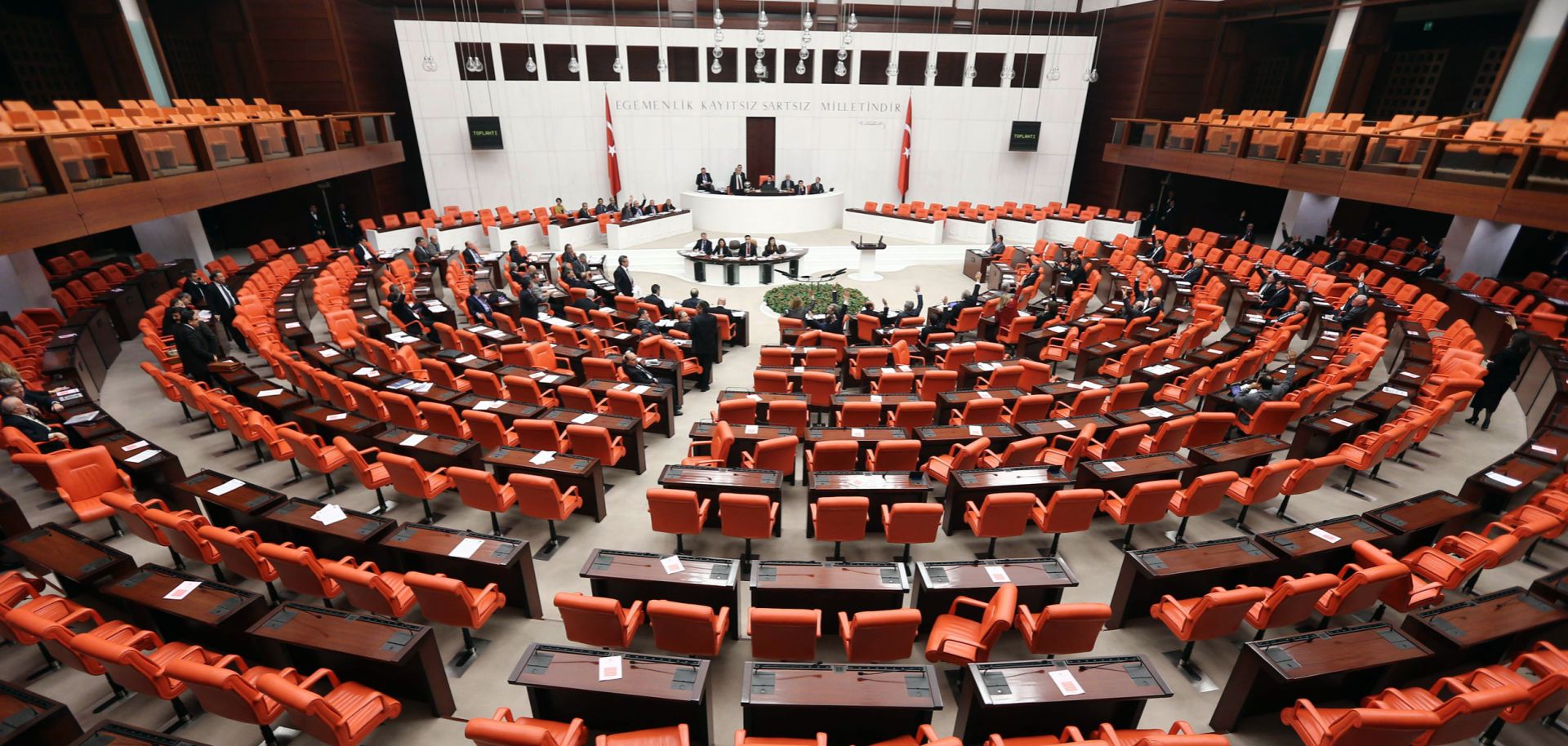
Turkish legislators hold a parliamentary session in Ankara on Feb. 5, 2014.
Turkey’s governing alliance is hoping that lowering the country’s notoriously high election threshold will split the opposition and defuse international criticism of its democratic record. Allowing more parties to enter the parliament, however, could backfire by complicating the policymaking process and empowering extremists. On July 16, Turkey’s governing Nationalist Movement Party (MHP) and the Justice and Development Party (AKP) agreed in principle to legislate an electoral reform that would lower the threshold required to enter parliament from 10% of the national vote to 5% — thus making it easier for smaller parties to secure seats in future national elections. The MHP and AKP are also discussing reforming Turkey’s constituency system and the electoral threshold for alliances — both of which could favor smaller parties as well.
- Turkey’s 10% electoral threshold, established in the 1982 constitution (after the 1980 military coup), is the highest in the world and makes it extraordinarily difficult for small parties to enter parliament. This has helped the AKP-MHP alliance dominate parliament since the AKP takeover in 2002.
- The restrictive electoral threshold has long been a subject of criticism in the United States and Europe by stoking concerns about Turkey’s democratic record. The threshold’s association with the 1980 coup, as well as its potential to cut out smaller parties like the Kurdish-dominated HDP, have contributed to the perception that it is designed to consolidate power for a ruling party and shut out democratic challengers.
The AKP’s control of parliament and sliding polling numbers provides it both the means and motive, respectively, to enact sweeping electoral reforms. Polls in June 2021 suggested that the MHP might fall below the current 10% needed to enter parliament, depriving the AKP of a vital ally and incentivizing reforms that would prevent this. The AKP is also proposing other reforms, like splitting up electoral districts, that might favor AKP candidates, as the AKP’s own polling numbers sag under the weight of recurrent COVID-19 lockdowns, economic malaise, inflation and central bank mismanagement. Abroad, Turkey’s operations in Syria, Libya and the Southern Caucasus have also exposed Ankara to international criticism and undermined much-needed investor sentiment.
If the threshold is lowered before then, Turkey’s 2023 national elections could yield a more diverse parliament, which might undermine the unity of the opposition. Fringe parties might also emerge with greater influence over Turkish policies, complicating policymaking. Much of the Turkish political spectrum is anchored by the 10% threshold, with fewer parties emerging to challenge the mainstream because of the difficulty of entering parliament. Extremists — from far-left Kurdish groups to hard-right ultranationalists like the Grey Wolves — are also compelled to participate in mainstream parties to gain influence in the system. With a lower threshold, however, parliament might experience a greater array of parties across Turkey’s diverse political spectrum, with mainstream parties like the AKP and the Republican People's Party needing smaller parties to gain control of parliament. These parties could pull Turkey in their more extreme direction or paralyze policymaking. Additionally, given Turkey’s first-past-the-post presidential system, a more dynamic parliament might help create an ineffective split government, with one faction controlling parliament and the other the presidency.
