
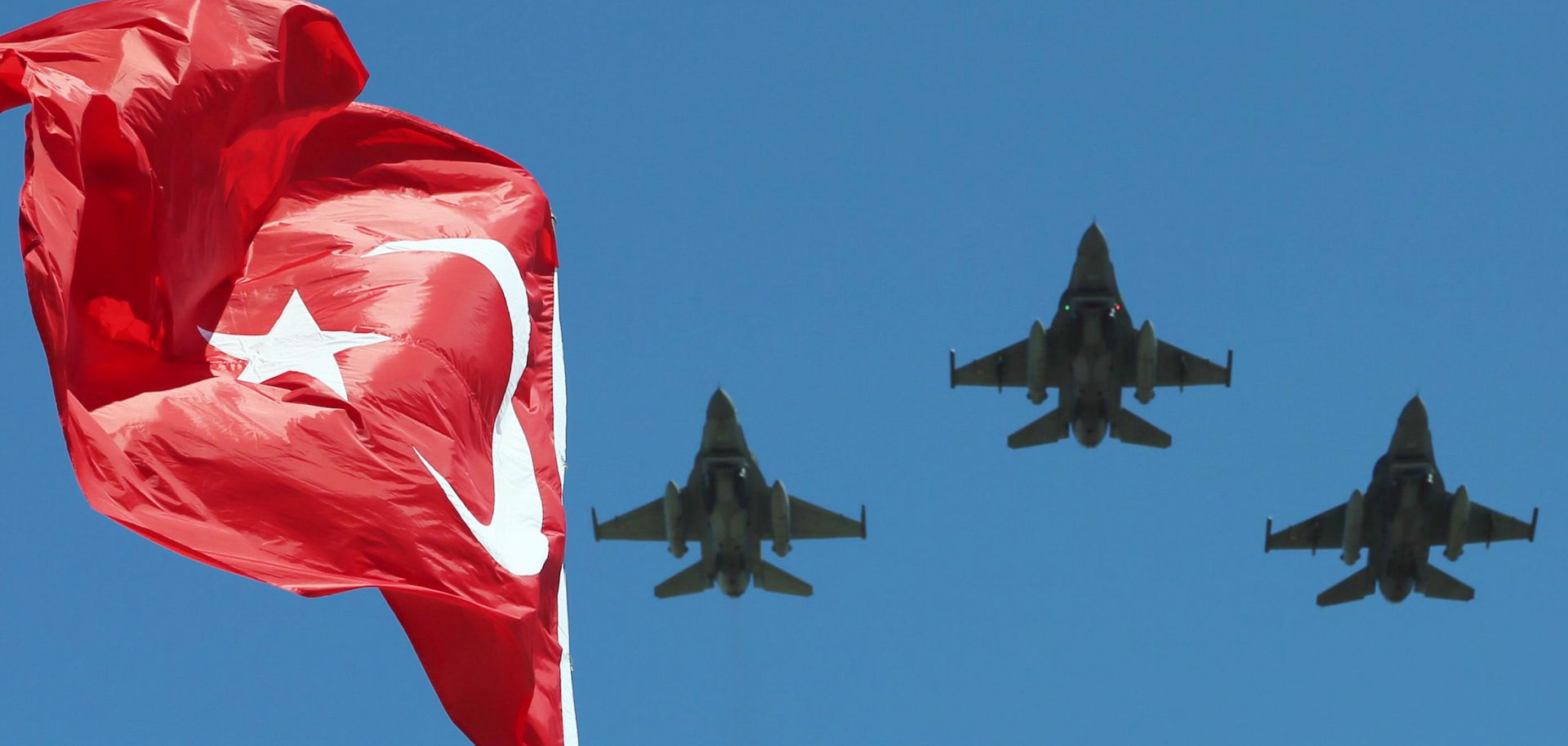
The Turkish Stars, the aerobatic demonstration team of the Turkish Air Force and the national aerobatics team of Turkey, perform Aug. 30, 2015, during the ceremony marking the 93rd anniversary of Victory Day, at Anitkabir, Ataturk's mausoleum, in Ankara.
Confirmation of Turkish F-16 fighter aircraft operating out of Azerbaijan amid conflict in Nagorno-Karabakh illustrates Turkish commitment to challenging Russian hegemony in the Southern Caucasus. Satellite imagery published by The New York Times showed Turkish F-16s at Ganja airbase on Oct. 3, just four days after Armenia claimed that F-16s shot down one of its Su-25 attack aircraft during a mission along the Nagorno-Karabakh frontline. The presence of the Turkish fighter aircraft doesn't prove their involvement in the downing of the jet, but it does demonstrate direct military involvement by Turkey that goes far beyond already-established support, such as its provision of Syrian fighters and military equipment to Azerbaijani forces. Ankara's resolve to support the Azerbaijani offensive on Armenian-controlled Nagorno-Karabakh poses an immediate challenge to Moscow's position in the Southern Caucasus. So far, Russia has sought to manage tensions between Armenia and Azerbaijan to prevent outside powers from stepping into the fray.
July clashes between Armenia and Azerbaijan likely provided the opportunity and cover for Turkey to help prepare an Azerbaijani offensive that supports longer term Turkish ambitions in the Southern Caucasus. Turkey has long sought to increase its influence in Azerbaijan to boosts its foothold in the Southern Caucasus, a region where Turkish and Russian ambitions are in competition. Greater tensions with Armenia likely made Azerbaijan more open to greater Turkish support, and hence more willing to contest Armenia's control over Nagorno-Karabakh. Sustained increased activity along the contact line separating Armenian and Azerbaijani forces may have helped obscure preparations for military operations that began Sept. 27.
- Four days of clashes on the Armenian-Azerbaijani border that started July 12, at the time the most intense escalation between the two countries since 2016 fighting in Nagorno-Karabakh, triggered close interaction between the Turkish and Azerbaijani military.
- On July 16, the Azerbaijani Deputy Minister of Defense and high-ranking military commanders visited Turkey, initiating a conversation that likely led to the planning of currently ongoing operations.
- By July 29, Turkish forces joined their Azerbaijani counterparts for two weeks of military exercises that included the deployment of Turkish F-16s to Ganja airbase.
- Following the July escalation and intensified interaction with the Turkish military, increased back-and-forth artillery fire on the contact line was sustained while Azerbaijan upgraded defensive positions and moved military equipment forward in preparation for current operations.
Turkey has demonstrated a reliable mitigation strategy with Russia over the course of conflicts in Syria and Libya, limiting the potential for a direct sustained conflict between the two powers. While the move will increase Russo-Turkish tensions, these ultimately will prove manageable under Russian and Turkey's existing model for bilateral mediation and deescalation. Direct military involvement in Azerbaijani operations against Armenia risks creating yet another theater where Turkish and Russian forces directly face each other. The current Turkish involvement has not yet prompted a Russian military response in support of Armenia; Moscow has likely been reluctant to do so in a bid to maintain a balance in its relations with Azerbaijan and Armenia. Additional Turkish deployments or direct engagement in combat operations may, however, force Russia to deploy forces to Armenian-controlled territory. Should this come to pass, sustained combat between Russia and Turkey still remains unlikely. As proven in conflicts in Syria and Libya — where Russia and Turkey have each supported opposing sides and have even seen limited direct engagements — the two countries have developed a reliable method for deescalation and stabilization. In this case, direct Turkish and Russian deployments are more likely to stabilize the contact line in Nagorno-Karabakh than they are to erupt into a greater conflict. An expansion of Turkish involvement would thus become more likely only if Azerbaijan were to struggle to hold territory.
In the longer term, sustained economic weakness will limit Turkey's ability to support its external ambitions, but at this point, its capabilities will support its aggressive foreign policy. A Turkish perception of future limited capabilities may in fact even propel Turkey to pursue an aggressive foreign policy while it still can. While making its power plays on its periphery, mounting Turkish economic underperformance continues to threaten its ambitions in the long term. The Turkish lira has continued to weaken, forcing the government to adjust its monetary policy, and the lira took a further hit from Turkish involvement in the Nagorno-Karabakh crisis. Its current economic struggles will not, however, impede an aggressive foreign policy or even military capabilities in the short-term.
- Turkey has conducted multiple military offensives in Syria. It maintains a presence in rebel-held areas of Idlib and along the northern border of Syria despite direct confrontations with the Syrian and Russian militaries.
- In response to the Libyan National Army's offensive on Tripoli in April 2019, Turkey deployed military assets to support the Tripoli-based Government of National Accord, prompting increased Russian military support for the Libyan National Army.
- In the Eastern Mediterranean, Turkey has ratcheted up territorial disputes with Greece and Cyprus as it furthers its ambitions to develop offshore energy resources, leading to a wider standoff with the European Union.
- Turkey has also challenged the European Union directly on other issues, using its ability to increase or lower refugee flows for leverage.
- In the Southern Caucasus, Turkey has sought to expand its influence through its relationships with Azerbaijan and Georgia, and is now doing so by military involvement in the Nagorno-Karabakh conflict.
