
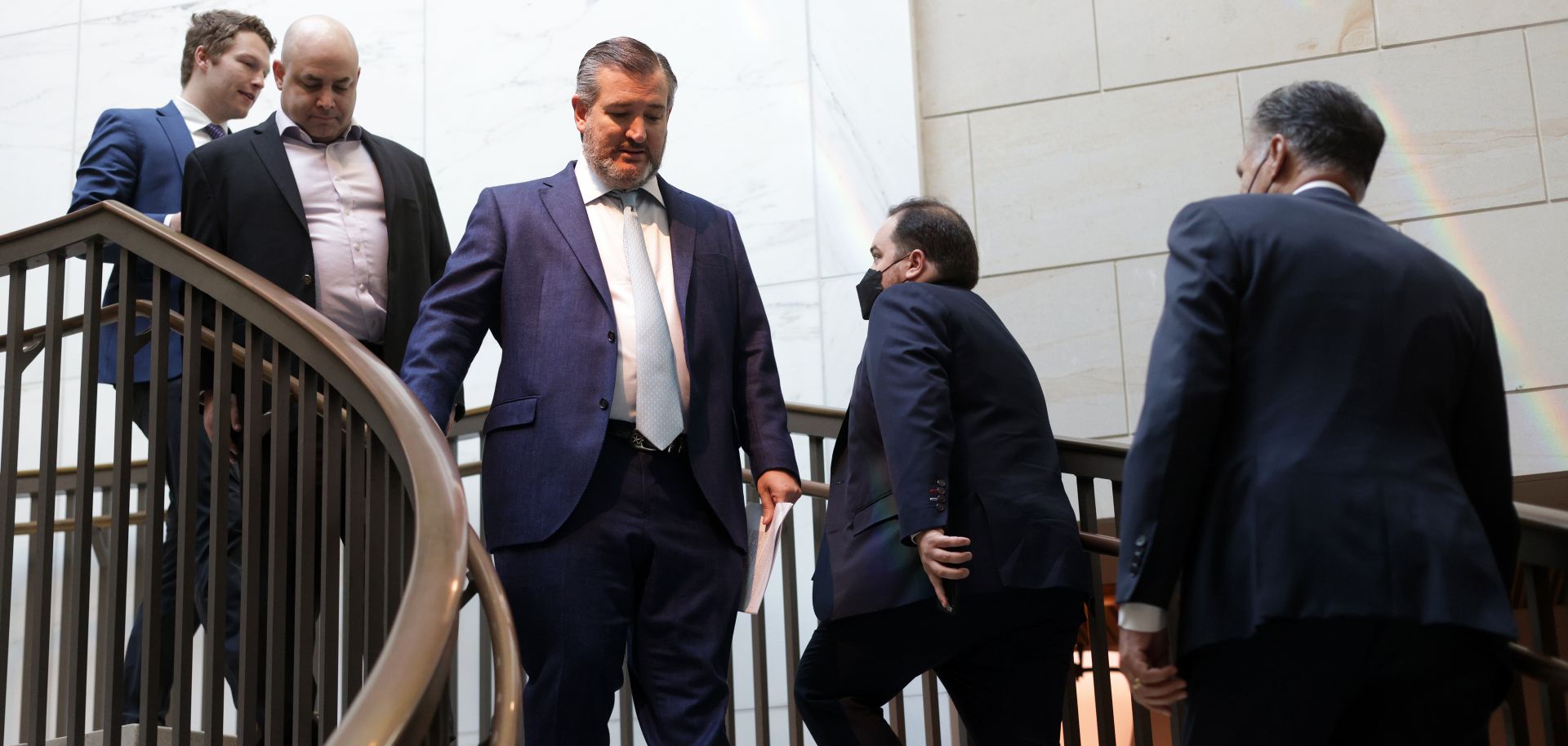
U.S. Senator Ted Cruz (R-TX) arrives at the U.S. Capitol before a classified Senate Foreign Relations briefing on Iran on Feb. 9, 2022.
Iran, the United States and major world powers appear to be inching toward a deal to resume compliance with the 2015 Joint Comprehensive Plan of Action (JCPOA), but an agreement is not assured nor would it necessarily survive past the U.S. presidential election in 2024. Western, Russian and Chinese officials have suggested that a new U.S.-Iran nuclear deal could soon be reached as talks, which resumed in Vienna on Feb. 8, enter what many Western diplomats have described as the final stage. For the West, time is of the essence due to the rapid advancement of Iran’s nuclear program.
- Russian Ambassador Mikhail Ulyanov said talks had made “significant progress” on Feb. 13 after meeting with officials from Iran and the P4+1 countries (China, France, Germany, Russia, and the United Kingdom). That same day, a reporter with The Wall Street Journal said there was “firm consensus” between the United States and the P4+1 countries on the final shape of a deal that would see both Washington and Tehran return to compliance with the original nuclear agreement.
- Following the latest round of talks, a Western diplomat told Reuters that the United States and Iran could reach a deal by “around early March, if all goes well,” which Iranian officials have also said was a realistic timeline. But on Feb. 14, Iran’s foreign minister said Western officials should stop “playing with time” in negotiations — noting that Tehran was in hurry to reach a deal, but only one that’s in its interests.
The United States and Iran both have a strategic interest to reach a deal, which means that an agreement is possible in the coming weeks or months. For Iran, the suspension of U.S. sanctions on its oil exports would provide much-needed financial relief and enable the country to capitalize on crude prices nearing $100 per barrel. Although Iran’s economy has endured U.S. sanctions, annual inflation in the country is hovering around 40% and the youth unemployment rate is around 16%. For the United States, having Iran return to compliance with the 2015 nuclear deal would enable the White House and its partners in the Middle East to focus on Iran’s other regional activities, like Tehran's support of Houthi rebels in Yemen and its transferring of missile technology to such proxies. It would also free the United States to focus on more pressing foreign policy issues — namely, the ongoing Russia-Ukraine standoff and China's global ascent. Adding more Iranian oil back to the global market would help stabilize rising fuel prices as well, which have become a political liability for U.S. President Joe Biden and the Democratic Party ahead of November’s midterm elections. And finally, for Western and regional countries wary of Iran’s nuclear advancement, the reinstatement of the JCPOA would also make it easier to detect whether Iran was moving toward developing a nuclear bomb by enabling the United Nations’ nuclear watchdog, the International Atomic Energy Agency, to continue monitoring Iranian nuclear activity.
- According to a Feb. 3 report in The Wall Street Journal, the United States assessed in late 2021 that a return to the JCPOA would still leave Iran capable of stockpiling enough enriched uranium to build a nuclear bomb within a year — abandoning a key selling point of the JCPOA made by the administration of U.S. President Barack Obama in 2015. The Biden administration’s decision to still move forward with nuclear talks after making this assessment reflects a pragmatic approach to pursuing a new deal with Tehran despite such limitations.
- The United States also appeared to extend an olive branch on Feb. 4 when it reinstated sanctions waivers for Iran’s civilian nuclear program to allow Chinese, European and Russian companies to collaborate with Iran on certain projects. Former U.S. President Donald Trump reinstated the sanctions in 2020 as a part of his maximum pressure campaign on Iran.
While there are still significant obstacles to a U.S.-Iran deal, none are insurmountable. Critical issues that remain unresolved include the scope of sanctions the United States would suspend, what to do with many of Iran’s more advanced centrifuges that have become operational over the last four years, and Iranian guarantees that the United States will not simply re-exit the deal again in the future.
- Scope of U.S. sanctions relief: Iran has demanded that all punitive measures be “lifted,” including the sanctions imposed on more than 300 Iranian individuals and entities since 2015 for both nuclear and non-nuclear reasons. The United States plans on suspending all of the sanctions imposed under the JCPOA, including those targeting Iran’s oil exports. But when it comes to removing additional sanctions designations, Washington has suggested it will only lift those inconsistent with the 2015 nuclear deal. Many of the sanctions designations that the United States has imposed against Iran in recent years, however, are over terrorism or human rights issues, not Iran’s nuclear program. In 2019, for example, the Trump administration sanctioned current Iranian President Ebrahim Raisi (who was then the head of Iran’s judiciary) for various human rights abuses, and also formally designated the Islamic Revolutionary Guard Corps (arguably Iran’s most important military branch) as a foreign terrorist organization.
- Iran’s nuclear program: Since accelerating its nuclear program in retaliation for the United States leaving the JCPOA, Iran has installed a number of more advanced centrifuges for nuclear enrichment, including more efficient IR-2m and IR-4 centrifuges at its Natanz enrichment plant and IR-6 centrifuges at its Fordow enrichment facility. Western negotiators have pushed for Iran to dismantle and transfer the advanced centrifuges abroad, but Iran has demanded that they be stored in Iran. This is probably the West’s stickiest outstanding issue with Tehran as it’s key to slowing Iran’s nuclear development and the pace at which it would be able to ramp back up enrichment if the JCPOA falls apart again. For Iran, domestic storage would provide insurance that it could quickly increase nuclear activity again if the United States abandons the JCPOA.
- Guarantees against another U.S. exit: Iran is looking to protect itself from signing another deal that a future U.S. president could again abandon. Iran has demanded the Washington promise not to leave the JCPOA in the future, but the Biden administration cannot speak for future administrations and thus far has only provided assurances that, barring a major escalation with Iran, the United States will not leave the deal as long as Biden remains in office. While Iran will probably weaken this demand, it will want the United States and Europe to offer some concessions that would make it more likely for financial institutions to be comfortable working with Iran and not be as concerned about a future breakdown of the deal. One of Tehran’s criticisms of the original 2015 deal is that companies and financial institutions were hesitant to work with Iran despite the JCPOA over concerns about future sanctions and compliance risks. Iran is likely going to want Washington to issue waivers, FAQs and letters to financial institutions to help convince them that doing business with Iran will not incur sanctions or compliance risk. But even if this happens, many institutions will continue to perceive the deal as fragile.
Iran will likely continue nuclear research and retain key technology to quickly reactivate its nuclear program for fear that a deal with the United States may not survive if a Republican candidate wins the 2024 presidential election. U.S. Republican lawmakers have criticized the Biden administration’s Iran policy. In the wake of the positive atmosphere surrounding negotiations, a group of 31 Senators led by Texas Senator Ted Cruz also sent Biden a letter demanding any new U.S.-Iran deal be reviewed by Congress. Without control of either the Senate or the House of Representatives, however, Republicans do not currently have enough power in Congress to block such a deal, which would require passing legislation — likely with a filibuster-proof majority. But if they regain control of both houses after midterm elections in November (which they are well-positioned to do), Republicans could pass legislation that imposes mandatory sanctions on Iran, and could also attach that legislation to annual must-pass bills, like the annual defense budget bill. While it could add enough stress that the White House reimposes a limited amount of sanctions on Iran in the short-to-medium term, such legislation is unlikely to force the Biden administration to exit a new nuclear deal entirely. A Republican victory in the 2024 presidential race, however, would increase the likelihood of another U.S. withdrawal, depending on how Iran-U.S. relations evolve over the remainder of Biden’s current term and U.S. foreign policy priorities vis-a-vis China and Russia. Ironically, the threat of a Republican administration retaking the White House in January 2025 may only reinforce Iran’s desire to reach a deal with Biden, which would at least give Iran a couple of years of financial relief before the potential return of a more hawkish U.S. leader with whom securing any deal would be nigh impossible.
