
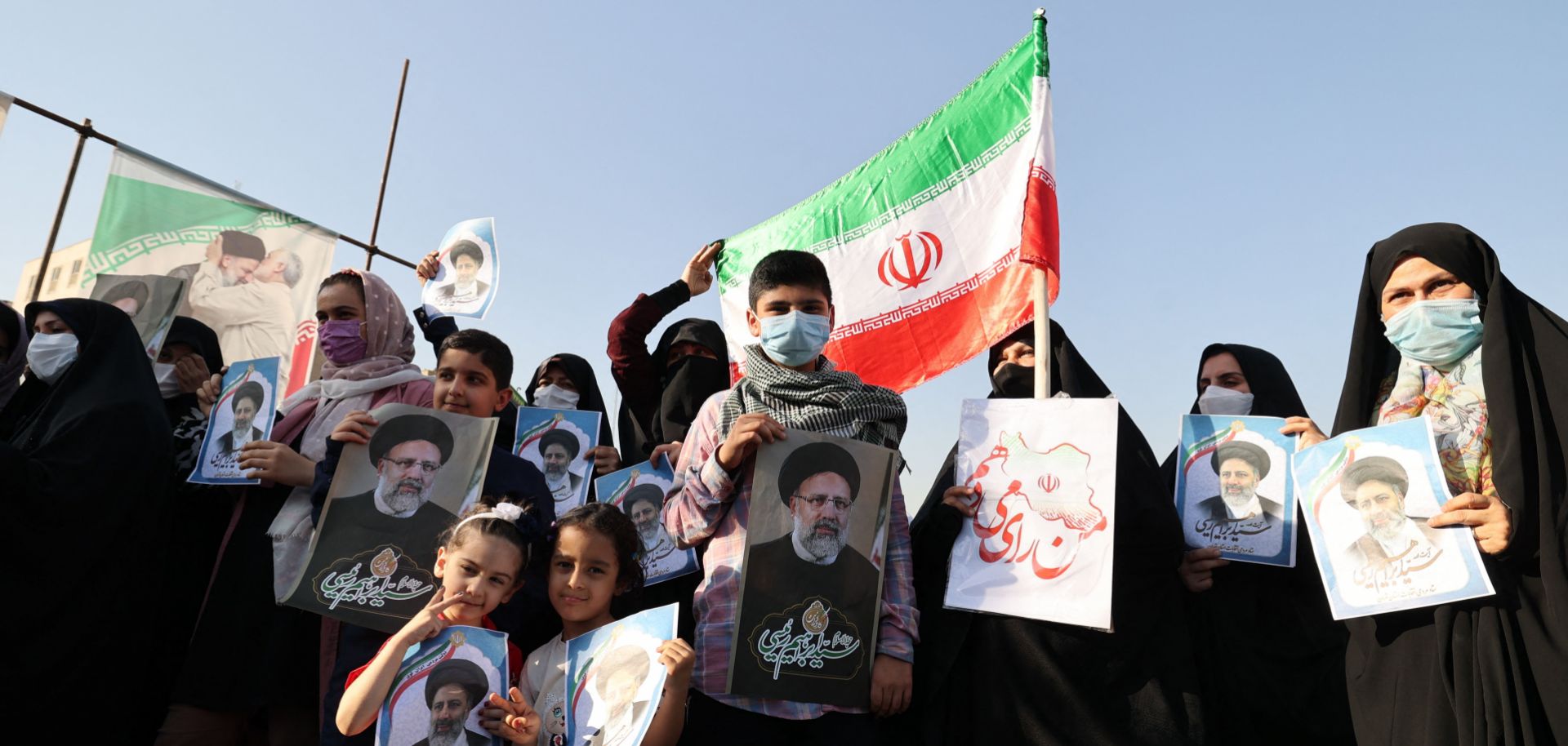
Supporters of Iranian presidential candidate Ebrahim Raisi hold campaign posters at a rally in Tehran on June 14, 2021.
Iranian politics are poised to become more conservative after the upcoming presidential election, likely resulting in more populist economic policies at home and tenser negotiations with the West — and potentially an overhaul of Iran’s system of governance. Most of the candidates that Iran’s hard-line-dominated Guardian Council approved to run in the June 18 presidential election are conservative. This suggests a coming shift from President Hassan Rouhani’s more moderate, negotiation-friendly government that has led Iran the last eight years to one that prioritizes preserving Iranian sovereignty and independence from the West.
- Current polling widely suggests that Ebrahim Raisi, the politically conservative head of Iran’s judiciary and close ally of Supreme Leader Ali Khamenei, is heavily favored to win the presidency. Raisi won 38% of the vote in the 2017 presidential election, and conservative, moderate and reformist press alike hail him as the likely shoo-in winner of the upcoming election.
- The six other candidates approved to run by the Guardian Council, which is Iran’s constitution-interpreting and election-supervising body, include one reformist, one moderate and four other conservatives. The moderate candidate Abdolnasser Hemmati, former head of the central bank, has been a viewer favorite during the televised debates. But polling suggests he still lacks the support needed to win the election.
- The Guardian Council’s requirements to qualify for the June 18 election were tougher than ever, and followed the 2020 parliamentary elections in which a similar disqualification sidelined moderate and reformist candidates. This vetting reinforces the importance of the clerical system in Iran, and reveals the preferences of the unelected establishment that largely controls the country’s political system.
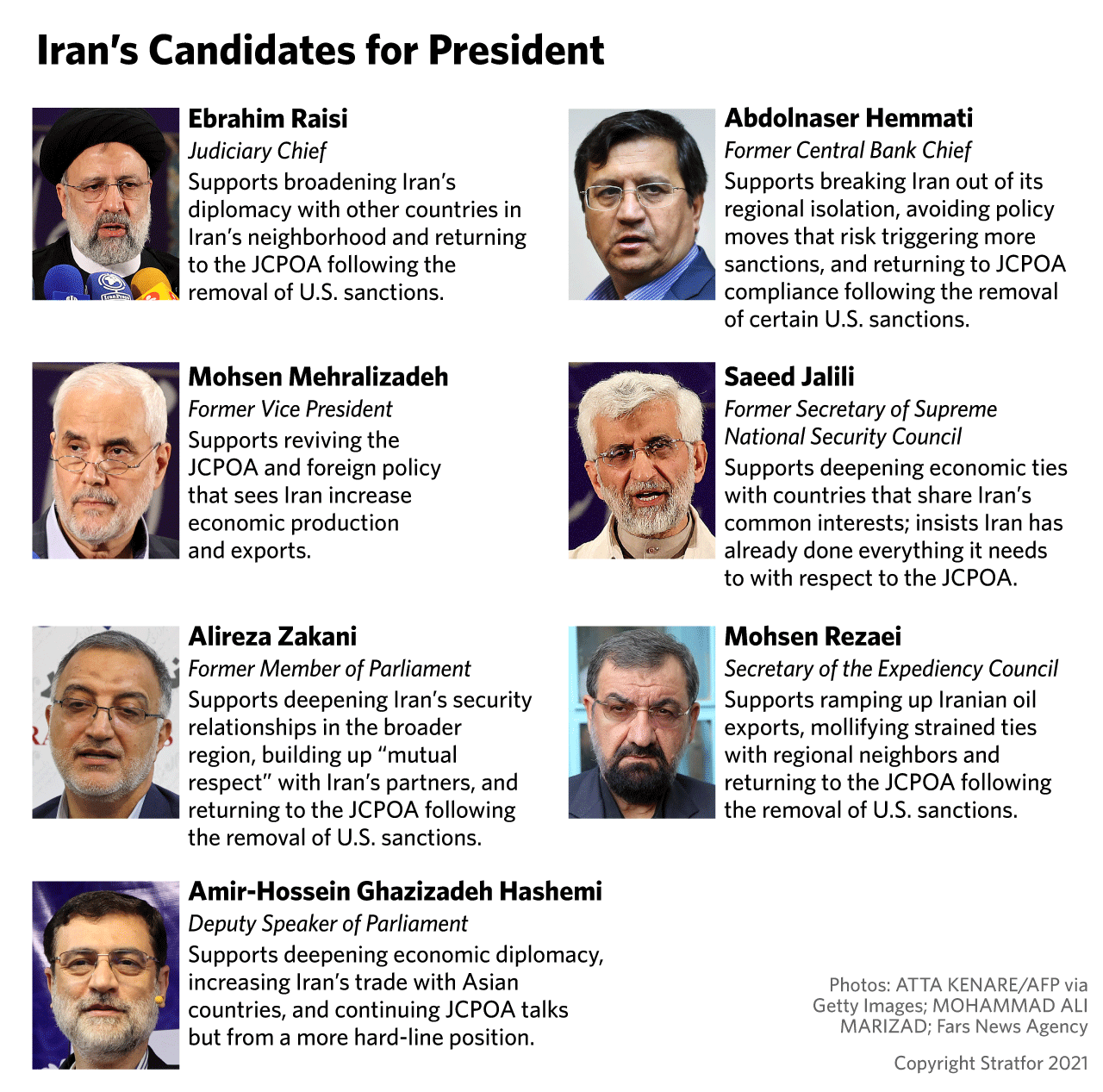
All of the candidates on the ballot have expressed a desire to break with Rouhani’s more moderate policies. The strong focus on repudiating Rouhani’s record indicates popular- and elite-level frustration with the outgoing president, and is a key reason why the political tides are shifting toward conservatism.
- The Joint Comprehensive Plan of Action (JCPOA)’s failure to secure sanctions relief for Iran has made many Iranians skeptical of reformists’ and moderates’ ability to deliver on their promises, given that the nuclear deal was Rouhani’s landmark project.
- In addition to continued sanctions pressure, the Iranian government’s intolerance for political dissent in recent years, along with various military mishaps that have embarrassed Iran on the global stage, has also tarnished Rouhani’s popularity.
- Frustration with the government has led to broad expectations that voter turnout in the upcoming polls will be low; the Iranian Student Polling Agency (ISPA)’s polling over the last year indicates a likely turnout under 40%, which would be the lowest in Iran’s modern history.
One of the next president’s main priorities will be improving Iran’s sanctions-burdened economy, regardless of who wins or what happens with JCPOA talks. Although unelected institutions and leaders guide most of Iran’s foreign and national security policy, the president plays a critical role in guiding the country’s domestic economic and social policies. All of the presidential candidates have focused on breaking with Rouhani’s economic record. Each of the five conservative candidates has also expressed support for more populist economic measures, including increasing cash transfers.
- The president will seek to promote economic growth and job creation, as well as tackle issues like high inflation, capital flight and budget deficits and budget reform. There are limits to what any president can do in the face of significant sanctions, which is why all candidates agree on the need for some negotiations for sanctions relief.
- Because economic concerns are so critical to Iranians, candidates who have any affiliation with economic scandals, or that have a close alignment with the economic record of outgoing president Rouhani, face an uphill battle appealing to voters. Strong anti-corruption rhetoric will help candidates accrue votes as well; Raisi supporters have argued that his time leading the judiciary would help him crack down on corruption as president.
Iran’s next president is also more likely to embrace a more conservative foreign policy that promotes Iranian sovereignty above all else. The candidates differ in their embrace of conservative foreign policy, ranging from hard-line isolationist policies to broader engagement with the world. But all of their foreign policy platforms stress placing Iran’s interests first.
- Conservative candidate Mohsen Rezai made headlines in early June when he expressed support for kidnapping Westerners at ransom to obtain foreign currency.
- Frontrunner Raisi has also promoted a broader policy of “economic diplomacy” with a wider range of partners to build Iran’s regional position and reduce the country’s vulnerability to sanctions and the Western financial system.
This will reduce the chances of a broader political and economic rapprochement with the West. A compliance deal that sees the United States lift some sanctions in exchange for Iranian compliance with the JCPOA is likely in the months after the election. But under the leadership of a conservative president, parliament and unelected establishment, a broader deal with the West over non-nuclear issues like regional proxies and missiles will become all the harder to reach.
A more conservative Iranian president portends a return to more hard-line social policies as well, creating more points of friction with the West. Social issues like women’s rights are often where moderates and reformists differ the most from their conservative counterparts. If reformist groups throw their weight behind Hemmati, it could provide a small boost in turnout from moderate and reformist voters who do not want to vote for a more conservative candidate. Even if this doesn’t turn into a victory for a moderate candidate, higher voter turnout would provide more popular legitimacy to the election and, in turn, the overall Iranian political system.
The likely election of a conservative president will open the door to deep reforms in Iran’s political system that could consolidate the role of the unelected establishment. A more conservative president reflective of a more conservative broader establishment will factor into Iran’s political and government structure, which will impact how Iran deals with the outside world over the long term, including in issues such as:
- The selection of a new Supreme Leader. Running for president and especially winning the presidency grants unparalleled name recognition with the Iranian public and political experience. It also exposes them to potential scandals that can damage their reputation. It is widely believed that Raisi could succeed Supreme Leader Ali Khamenei, which will become all the more probable if he wins the June 18 vote.
- Civil-military relations in Iran. IRGC-affiliated businessmen and leaders are increasing their influence in Iranian politics. How the future president contends with that influence in things like anti-corruption drives and budget discussions will show how some of Iran’s establishment views the military’s deepening political role.
- The structure of Iran’s government. With a greater ally in the presidential office, Iran’s unelected establishment could transform the very structure of the country’s political system. The possibility of moving to a parliamentary system is frequently debated in Iran. And with conservative parliament, president and like-minded political elite, it could be more easily achieved. Such a shift would eliminate the risk of a single person (the president) using their popular mandate to go against the wishes of the unelected establishment.
- Power of the clerics and the clerical education system. The press and other candidates have focused on frontrunner Raisi’s relative paucity of secular education compared to his many years of seminary education. If Raisi wins, the respectable nature of a clerical education will be reaffirmed, helping potentially boost the popularity of clerical education vis-a-vis secular education as a viable path to success.
