
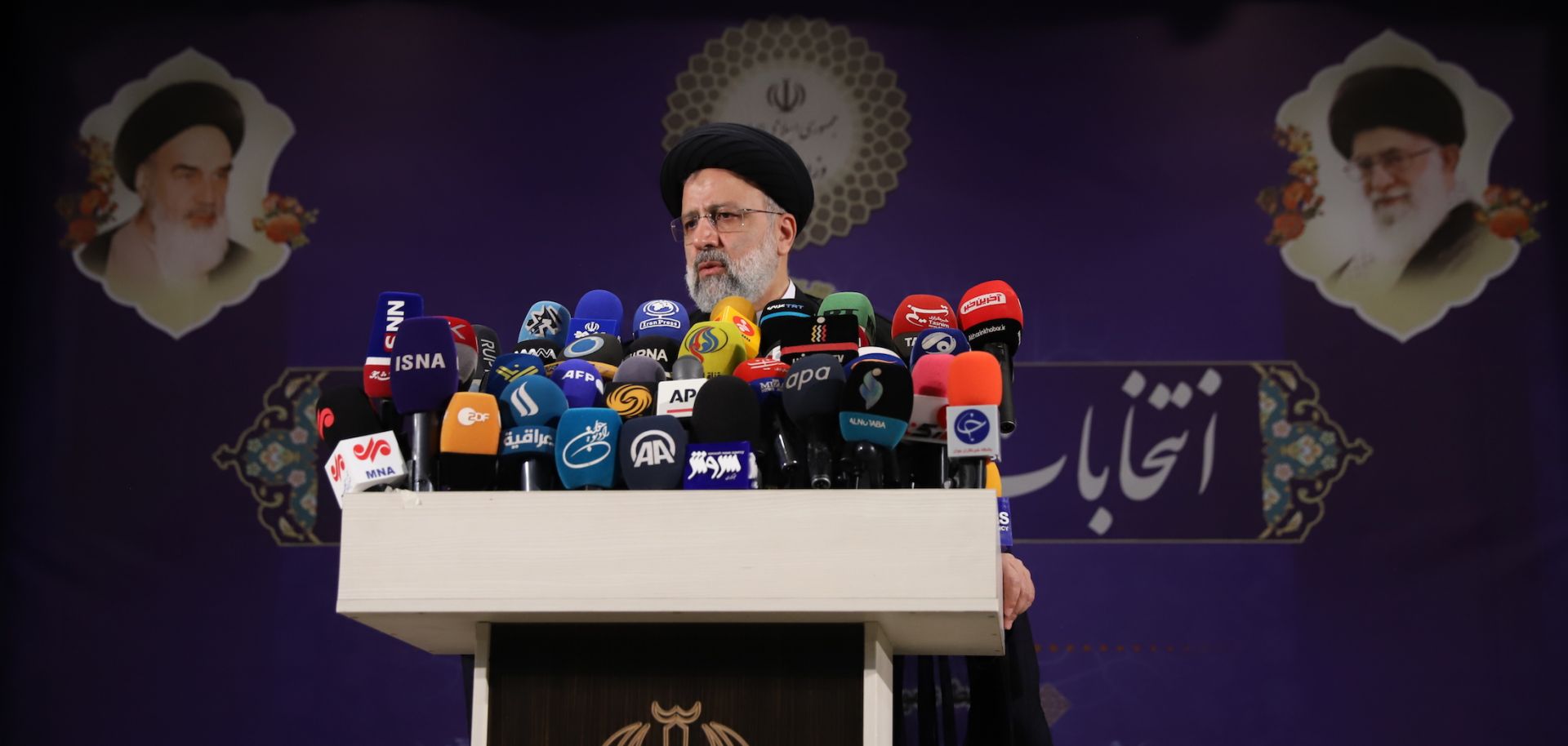
Ebrahim Raisi greets journalists in Tehran on May 15, 2021, upon arriving at Iran's Interior Ministry to submit his candidacy for the presidential election.
Iran’s unelected institutions are clearing the path for Chief Justice Ebrahim Raisi to win the June 18 presidential election and possibly succeed Supreme Leader Ali Khamenei. As president, Raisi would be less apt to pursue domestic reforms, leaving little room for consensus with the West on issues that go significantly beyond the current scope of nuclear talks. On May 25, Iran’s Interior Ministry announced that the hard-line-dominated Guardian Council had approved Raisi and six other candidates to run in the election, kicking off the formal campaign season. Of the approved moderate and reformist candidates, none appear to be popular or high-profile enough to seriously challenge Raisi, who finished second to President Hassan Rouhani in the 2017 election. Several of the conservatives approved to run in the race are also expected to drop out in favor of Raisi before the election is held. Notably, the Guardian Council did not approve former Parliamentary Speaker Ali Larijani, a moderate-leaning conservative widely thought to be Raisi’s top challenger in the election, which has since sparked significant public outcry.
- There are rumors that Raisi is also being groomed as a possible successor to Khamenei after Raisi shot up Iran’s political ranks immediately ahead of 2017 elections.
- The main moderate candidate approved to run in next month’s election is Central Bank Governor Abdolnaser Hemmati, a technocrat who has become synonymous with Iran’s economic crisis and is thus unpopular.
- Khamenei can theoretically step in to reverse Larijani’s disqualification, which the Supreme Leader has done in the past. But Larijani’s own reaction to the Guardian Council’s decision has so far been muted and respectful.
By clearing the path for Raisi, Iran’s hard-line conservatives and security establishment appear to be ensuring they have control over all elected and unelected positions of power over the next decade. Iran’s next president will oversee two major but delicate shifts: potential sanctions relief amid improved ties with the West, and the election of a new Supreme Leader for the first time since 1989. Iran’s most recent three presidents each clashed with Iran’s unelected institutions, including the powerful Islamic Revolutionary Guard Corps (IRGC). Raisi, however, would likely break this mold by working in lockstep with the Supreme Leader and the clerical establishment as president. Raisi has been courting the population with grassroots-appealing populism ahead of next month’s election, but a similar election strategy in 2017 did not stop him from losing to Rouhani by nearly 20 points. By eliminating prominent moderate figures similar to Rouhani (like Larijani), Raisi’s backers are trying to ensure that he’s not outflanked again.
- Over the last two decades, Iran’s elections have been intensely competitive without a clear predetermined outcome, fomenting intense factionalism between rivals.
- Rouhani formed an alliance with reformists that pushed social and political reforms aimed at reducing the influence of the IRGC and other unelected institutions in the country, despite Rouhani being a cleric and a product of the system himself.
- Rouhani’s predecessor, Mahmoud Ahmadinejad, was a populist president who backed Khamenei’s nationalism, but also clashed on numerous occasions with Iran’s clerical establishment.
As president, Raisi would probably continue negotiations with the United States over sanctions relief, but broader talks on issues beyond Iran’s nuclear program would be unlikely. The economic and social forces currently pushing the Rouhani administration to seek the lifting of U.S. sanctions would remain in place. This will keep U.S.-Iran nuclear talks on track for now, but if a deal is signed, a Raisi-led government would be less likely to engage in broader follow-up talks on other issues like Iran’s regional strategy or its ballistic missile program, given the IRGC’s backing of such programs and the limited benefits Tehran would gain from doing so. Compared with Rouhani, Raisi would likely also have more specific demands for what U.S. sanctions need to be lifted in exchange for scaling back Iran’s nuclear activity. The United States personally sanctioned Raisi in 2019 and Raisi’s IRGC backers would demand more sanctions named against it and its members being lifted as a part of a deal.
Under Raisi’s leadership, the prospects for broader economic, democratic and social reforms in Iran would also decline, limiting the extent to which Tehran’s overall relations with the United States and other Western countries could warm further.
- Economic reforms: A Raisi-led government would introduce some reforms to boost Iran’s sanctions- and pandemic-rattled economy, but at a much smaller scope compared with the slate of reforms Rouhani had originally planned to pursue. Many of Rouhani’s economic reforms targeted stripping down the dominance of quasi-state businesses tied to the IRGC and the clerical establishment, both of which back Raisi.
- Political reforms: A Raisi-led government may also back some limited political reforms at the Supreme Leader’s direction, such as a recreation of a prime minister position. But such changes would likely be aimed at reducing the power of the elected government and the president, which Raisi would back to solidify his power and influence after his presidency ends, either as Supreme Leader or in another high profile position.
- Social reforms: A Raisi-led government would likely curtail some of the small social liberalizations implemented by the Rouhani administration as well. This would lead to Iran taking a more hard-line position on issues like media freedom, human rights and women’s rights, comparatively.
