
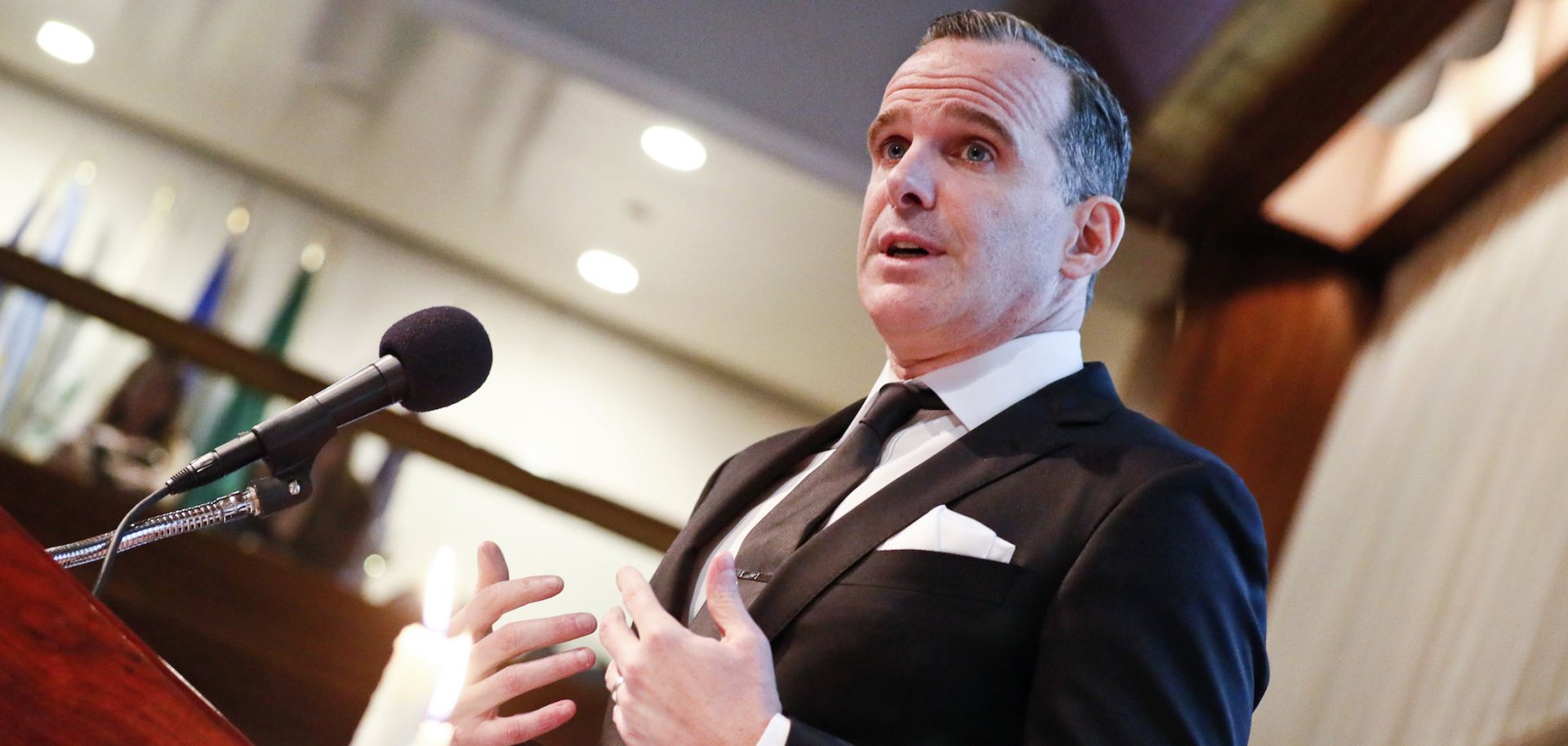
U.S. diplomat Brett McGurk accepts an award recognizing his service in senior national security positions under several White House administrations on April 2, 2019.
As it ramps up outreach to Iran, the United States will reassure its traditional Arab Gulf allies that their national security concerns are still being considered via continued diplomatic efforts and military cooperation. Over the next week, a team of U.S. Pentagon and State Department officials is to visit Saudi Arabia, the United Arab Emirates, Jordan and Egypt. The delegation will be headed by the Biden administration’s Middle East coordinator, Brett McGurk, with the objective of de-escalating tensions in the region and addressing concerns about U.S. President Joe Biden’s push to re-join the 2015 Iran nuclear deal, formally known as the Joint Comprehensive Plan of Action (JCPOA).
- On April 27, U.S. Representative for Iran Robert Malley also held a video conference with U.S. partners in the Gulf Cooperation Council (GCC) to discuss the Iran nuclear deal before he headed back to Vienna for further talks with the JCPOA commission.
U.S. regional partners are wary of the Biden administration sidelining their national security concerns and objectives as the White House’s nuclear talks with Iran progress, creating a difficult balancing act for Washington. Iran’s rivals like Saudi Arabia and the United Arab Emirates would welcome the imposition of limits on Tehran’s nuclear development — whether it’s through Iran returning to JCPOA compliance or signing onto an entirely new deal. But Iran is highly unlikely to reduce its nuclear activity without the removal of U.S. sanctions, which Abu Dhabi and Riyadh also fear could result in additional Iranian funding for regional militias and a ballistic missile program. This dilemma is, in turn, forcing the United States has to balance the needs of its Arab state partners against its desire to ease regional instability by brokering a deal that could slow or freeze Iranian nuclear proliferation.
While some of its other regional priorities are shifting, the United States will seek continued coordination with its traditional Arab Gulf partners on counterterrorism operations. Containing the actions of U.S. adversaries (including Iran) and promoting regional stability via counterterrorism and economic support remain Washington’s primary strategic objectives in the Middle East. This will compel the United States to remain in close coordination with its Arab Gulf partners so as long as anti-government and jihadist militancy are regional threats. But over time, alienation on issues of national security like Iran could risk straining those key relationships, which Washington will seek to mitigate by working to reassure its Middle East partners of its continued commitment to their concerns.
- Both the U.S. and Iraqi governments have reiterated the goal of withdrawing all combat troops from Iraq in the near future. But Washington and Baghdad continue to cooperate on strategic advisory and training initiatives, with the latter still reportedly welcoming ongoing U.S. military cooperation with Iraqi security forces.
- Egypt and Jordan are two of the biggest recipients of U.S. military and economic aid globally and regionally, which is unlikely to substantially change under the Biden administration.
U.S. arms sales will also help keep U.S.-Arab relations close and preserve the White House’s political influence in the region. The U.S. delegation’s upcoming tour will reportedly also involve discussions on the United States’s F-35 sale to the United Arab Emirates. Aside from the clear commercial interest, arms sales preserve the U.S. political influence in the region and contribute to military cooperation and coordination. The increase of Chinese arms sales and commercial inroads into GCC economies in recent years has also become a national security concern in Washington, given its growing desire to pivot to Asia and contain Chinese global influence.
- On April 13, the Biden administration announced it was proceeding with a $23 billion arms sale to the United Arab Emirates after an initial review of the arms deal. The deal remains controversial in the U.S. Congress, where lawmakers have voiced concerns about Abu Dhabi’s alleged misuse of American weapons in Yemen.
