
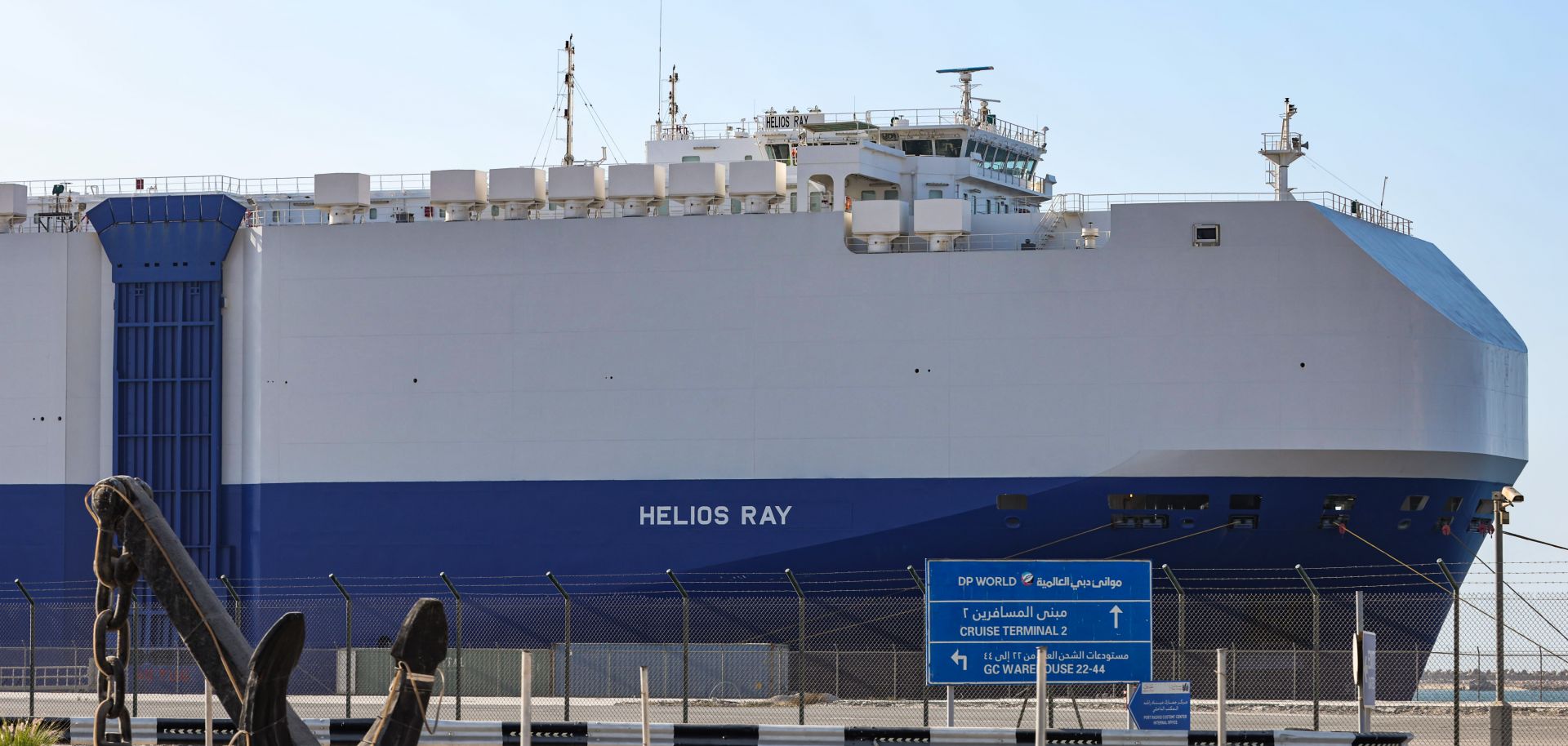
The Israeli-owned Helios Ray cargo ship is seen docked at a Dubai cruise terminal.
The recent uptick in maritime attacks between Israel and Iran risks triggering a broader escalation that leads to more attacks on Israeli commercial interests. Israel’s Channel 12 News reported on March 25 that an Iranian missile hit an Israeli-owned container ship in the Arabian Sea while it was traveling from Tanzania to India. The television station did not provide further details, but subsequent reporting suggested that the Israeli-owned Lori cargo ship was targeted. Shipping transponder data from the Lori, which has since arrived in a port in India, also showed a sharp, sudden deceleration in the Arabian Sea before resuming normal speed.
- If confirmed to be an Iranian-linked attack, this incident would mark the second suspected Iranian attack against an Israeli ship in recent weeks, following the attack on the Helios Ray vehicle carrier in the Gulf of Oman in late February.
Iranian attacks against Israeli commercial vessels would likely be in retaliation for the frequent number of reported Israeli attacks against Iranian ships since 2019. The Wall Street Journal reported on March 11 that Israel carried out “at least a dozen” strikes against ships heading to Syria since 2019, primarily carrying Iranian oil. The report added that at least one attack operation happened in February 2021 suggesting that Iran’s attack on the Helios Ray could have been a response to those Israeli strikes. Iranian officials also recently accused Israel of conducting a terrorist attack against an Iranian containership transiting the eastern Mediterranean, after the vessel suffered an explosion on board on March 12. Israel is unlikely to stop targeting ships carrying Iranian cargo and supplies to Syria and has, on a number of occasions, conducted airstrikes against land-based supply chains in both Syria and Iran.
The most recent strike suggests that Iran’s range and scope of operations targeting Israeli interests could expand beyond the Middle East. Iran has been linked to a number of attacks and seizures of commercial vessels over the last two years. But past Iran-linked explosions on vessels have so far only been attributed to limpet mines attached to the hulls of ships, and have been confined to waters relatively close to Iran’s coastline (like the Gulf of Oman and the Persian Gulf). Iran’s connection to attacks on Saudi Arabia that involved cruise missiles and unmanned aerial vehicles (UAVs), however, means it has the potential to also use such systems against ships, which would enable Tehran to expand the geographic reach of its attacks into the Arabian Sea.
Should the tit-for-tat dynamic between Israel and Iran continue apace, attacks are likely to expand beyond Iran’s immediate borders to target commercial shipping in the Arabian Sea, as well as potentially Israeli commercial presence in places like India, Pakistan, East Africa and Southeast Asia. Despite ongoing normalization between Israel and several Arab Gulf states, the number of Israeli targets near Iran’s borders is relatively limited. In the past, Iran has used its overseas intelligence and security apparatus to target Israel’s diplomatic presence in East Africa, South Asia and Southeast Asia in response to Israeli assassinations of Iranian scientists. It is thus possible that Iran would be willing to target Israel’s commercial presence in those countries. This would significantly open up the number of possible targets, which would be softer than Israeli diplomatic targets and easier for Iran or Iranian-backed operatives to hit.
Israel’s response is likely to be calculated in order to limit the risk of significant escalation or international blowback. Israel will be under pressure to maintain some level of deterrence and retaliate against Iranian action beyond covert attacks by conducting overt strikes against Iranian targets in Syria and Iraq, just as it did in response to the Helios Ray attack. At this point, direct retaliation against Iran, such as an airstrike against the Iranian military or nuclear target, cannot be ruled out. Such an attack, however, would lead to a significant escalation that Israel will likely seek to avoid for fear of damaging its relations with the administration of U.S. President Joe Biden ahead of the White House’s anticipated talks with Tehran over its nuclear program. A more likely response, if Israel wants to target Iran directly, would be covert activity akin to the suspected Israel-linked fires and explosions seen at an Iranian missile complex and the Natanz fuel enrichment facility in 2020. Such covert activity gives Israel a layer of plausible deniability that limits the probability of significant escalation.
