
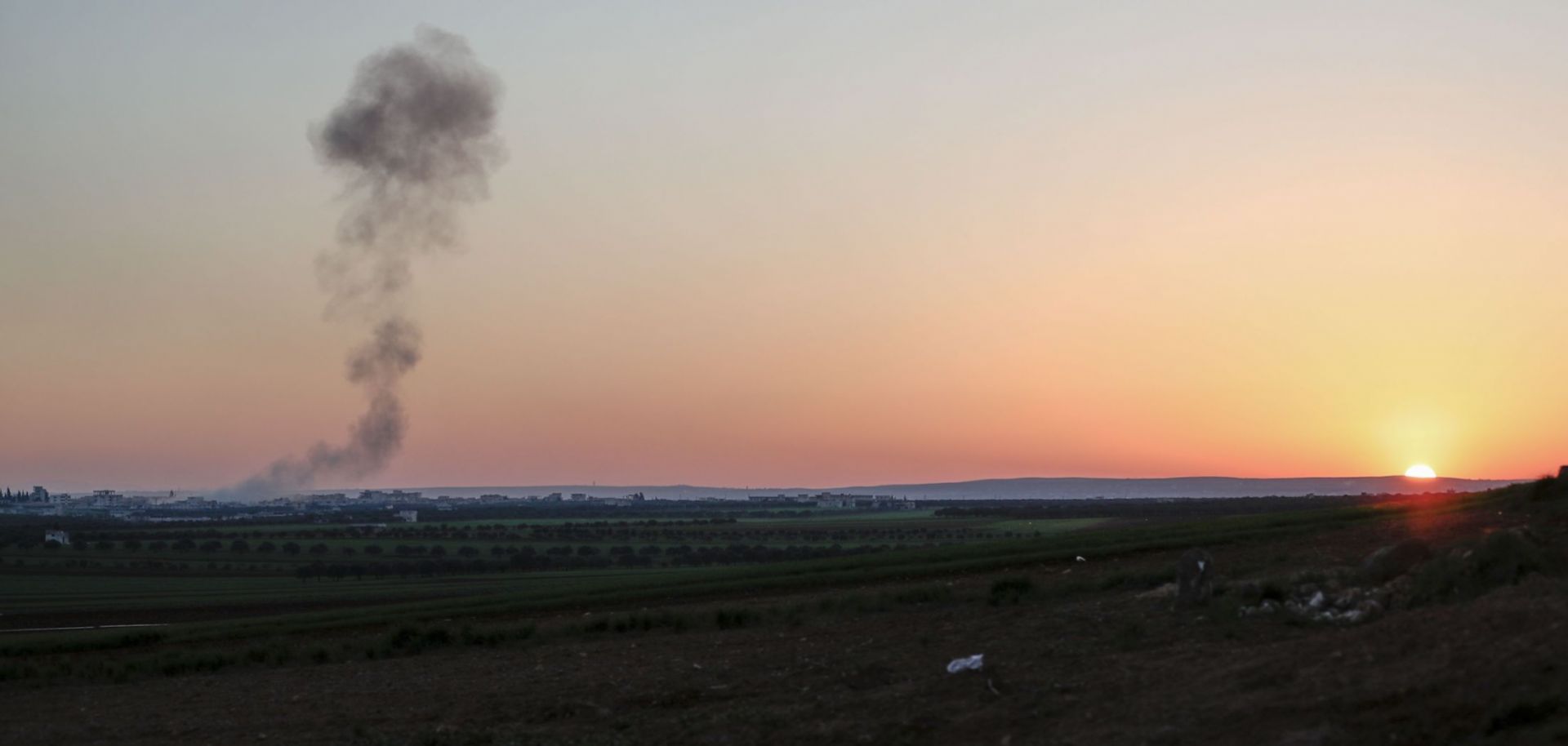
Smoke billows above a Syrian village following an airstrike raid on March 3, 2020.
Iran is using its proxies in Iraq, Syria and Yemen to increase pressure on U.S. interests in the Middle East as it seeks to build leverage before renewing negotiations with Washington. But even if U.S. talks yield sanctions relief, Tehran remains unlikely to abandon its powerful militia network. On Feb. 26, the administration of U.S. President Joe Biden launched airstrikes against Iranian-backed Iraqi militias in Syria. The strikes, which were the Biden administration’s first military action since taking office, were intended to send a message to Iran as the two governments approach possible negotiations on U.S. sanctions and Iran’s nuclear program. Biden even told reporters that the airstrikes sought to communicate to Iran that it could not act with “impunity.” But the airstrikes also functioned as a direct response to the growing threat Iraqi militias pose to U.S. forces in the Middle East, underscoring how proxy theater activity is both a facet of the many layers of U.S.-Iran tensions, as well as a serious regional security issue in and of itself.
- The Feb. 26 airstrikes targeted facilities used by Kataib Hezbollah, an Iraqi militia group with operations in Syria that was founded under the guidance of the Quds Force of Iran’s Islamic Revolutionary Guard Corps (IRGC) in 2007. Kataib Hezbollah has become an important political and military force in Iraq.
Iran’s support of regional proxies is a cornerstone of its asymmetric national security strategy, which also provides Tehran leverage against the United States. Equipping, training and politically supporting a militia network serves valuable offensive and defensive functions for Iran, which is a weaker conventional military power than its peers due in part to Western sanctions preventing defense purchases. Iran’s ties to allied militia groups function as a sort of forward deployment in theaters like Syria and Iraq, where Iran wants to preserve access to key territory. Tehran’s militia ties have also long bolstered its regional clout by nurturing its connections to Shiite and Sunni groups alike. Aside from these core functions, supporting allied militias creates a security pressure point in places where U.S. and Iranian interests overlap, offering Tehran a way to project regional power that Washington lacks, as well as a lever that it can push and pull against the United States.
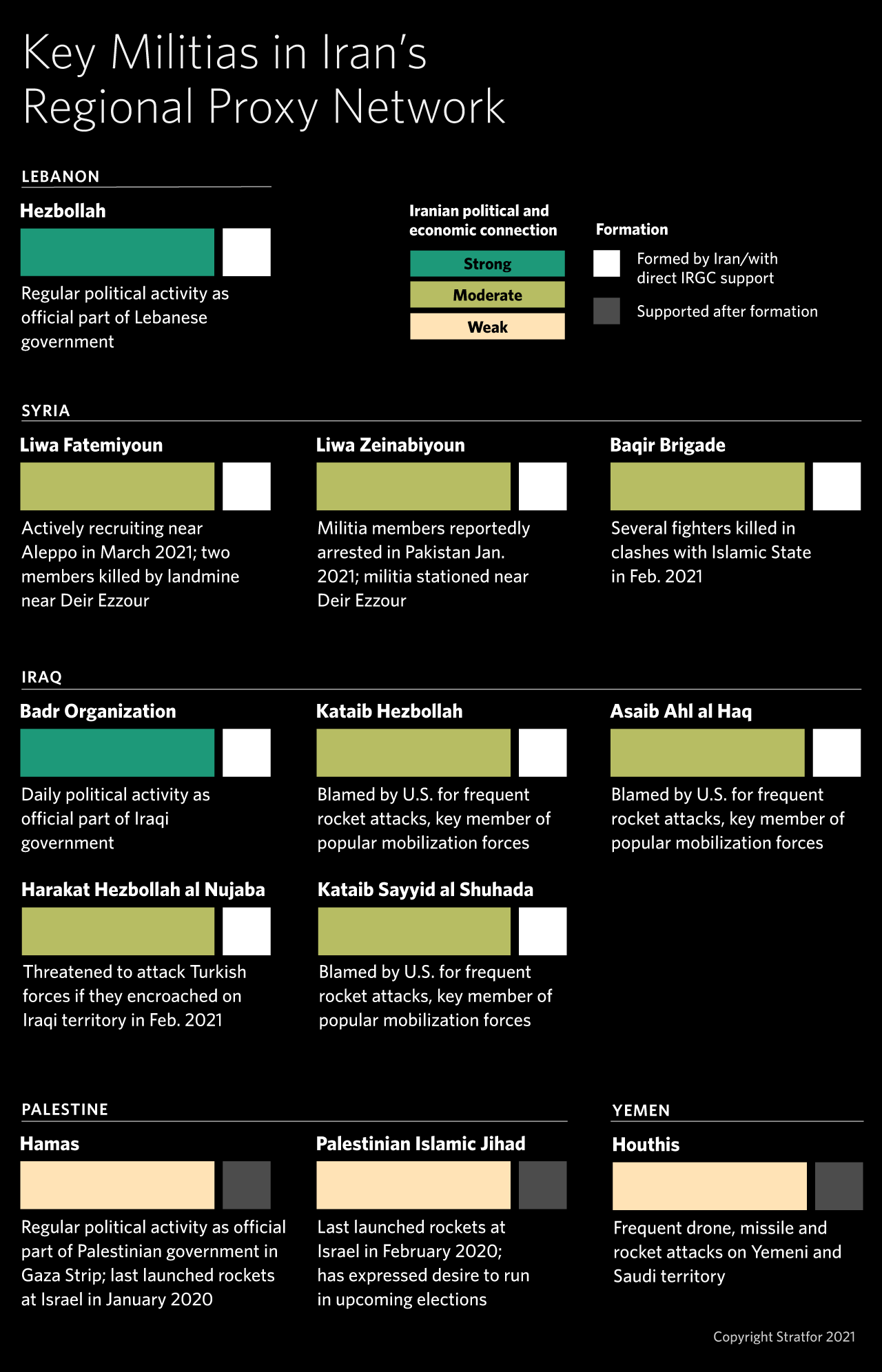
Iran, however, lacks complete control over its allied militias, meaning violence in proxy theaters will continue regardless of what happens in its negotiations with the United States. Iran-backed militias all have their own interests, domestic constituencies and ideologies that motivate their behavior. Houthi rebels in Yemen, for example, hold their own anti-American and anti-Saudi sentiments that are unrelated to their links with Iran. Tehran’s allied militias also all operate in different regional conflict zones, which makes each theater a security threat in its own right. This reality grants Iran some plausible deniability to distance itself from militias attacks against U.S. or U.S. partners’ interests.
- When Iran-backed militias conduct attacks on U.S. targets, the United States ultimately blames Iran but targets the militia itself in its retaliation. This was most recently evidenced in the Feb. 26 strikes in Syria against the Iran-backed Iraqi militia Kataib Hezbollah, which the U.S. Pentagon said were a “proportionate military response” to the group’s recent attacks on U.S. forces in Iraq. For Tehran, this mitigates the immediate risk of militia attacks triggering a U.S. escalation against Iran directly.
As it pressures the United States to offer sanctions relief, Iran will likely support its closest regional proxies maintaining an aggressive stance against Washington. This, however, will risk deepening the U.S. push to address Iran’s regional behavior in addition to its nuclear program. Iran’s government wants to keep sanctions relief negotiations focused on its nuclear program and not on Iran’s regional behavior, including proxy militia activity. Iran can direct and accelerate some proxy theater violence against U.S. targets to remind the United States of the leverage it has going into negotiations, as well as the amount of regional clout Iran enjoys. But this is a risky strategy for Iran because violent activity against the U.S. and/or U.S. partners in the region could make Washington more likely to demand Iranian concessions on its regional behavior, not just nuclear activity. Iran, however, will reject any U.S. demands to abandon its regional proxy strategy, which serves multiple functions beyond just granting Tehran negotiating power vis-a-vis the United States.
- In Lebanon and Syria, Iran’s ties to the Lebanese militia Hezbollah are unlikely to be easily weakened or ever feature as a point of potential negotiation for Iran. In addition to serving as a critical pressure point on Israel, Hezbollah’s influence in Syria also helps Tehran maintain a valuable territorial link to its closest Arab ally.
- Iraq remains the most likely theater for potential military escalation due to the sheer volume of U.S. military forces and Iran-linked militias in the country, along with the importance Iran places on maintaining ties to Iraqi militias and the strong political incentive those militias have to attack the United States. Militias are thus likely to continue conducting rocket and missile attacks against U.S. and U.S.-allied targets in Iraq ahead of U.S-Iran talks.
- Supporting militias in theaters like Afghanistan and Yemen is valuable to Iran, but more peripheral compared to places like Syria. Iranian support to Yemen’s Houthi rebels is one of Iran’s least important regional relationships and thus could factor into future U.S.-Iran negotiations. But the Houthis will maintain their fight against the Yemeni government (and the United States, Israel and Saudi Arabia) regardless of the level of Iranian support they maintain.
