
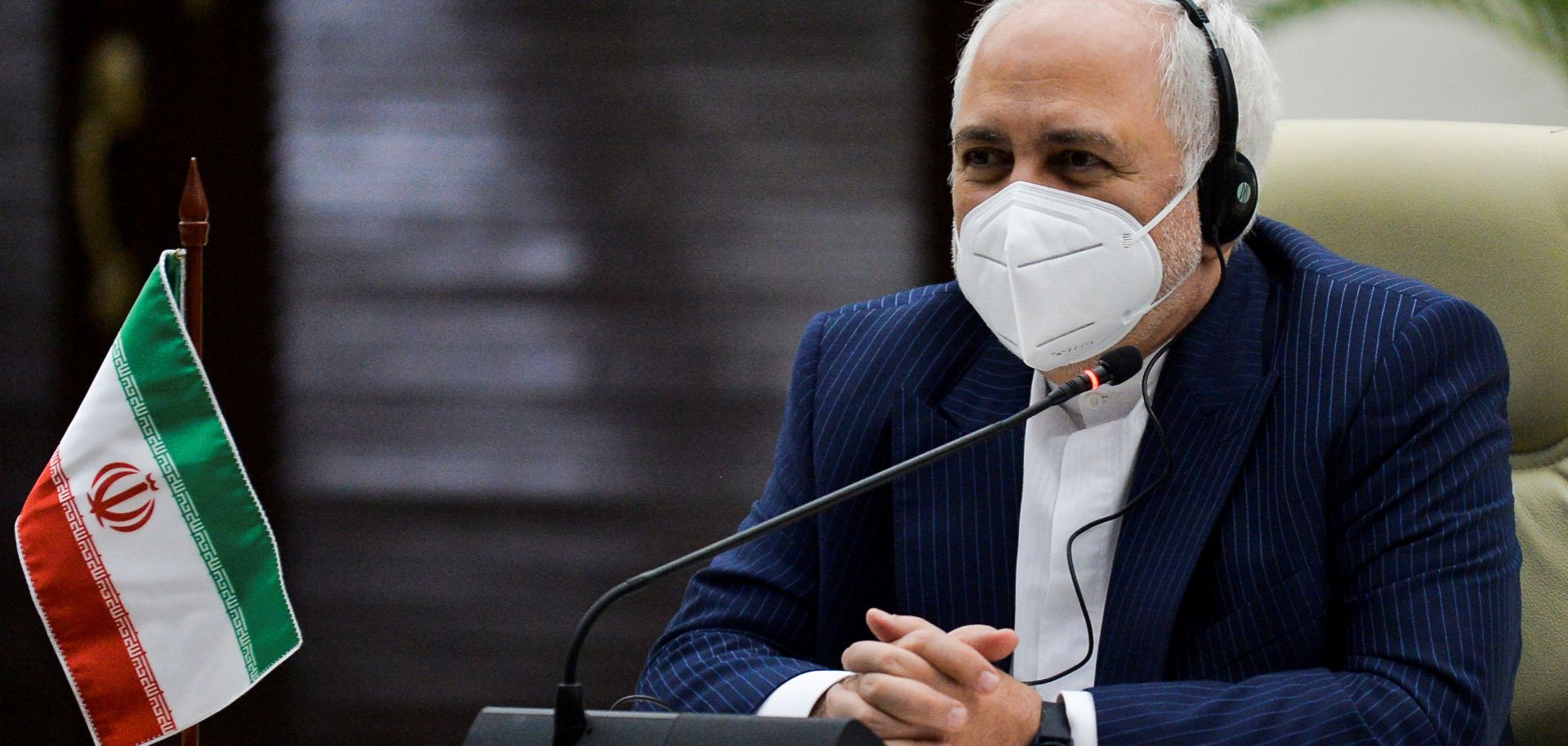
Iranian Foreign Minister Javad Zarif speaks during a meeting in Havana, Cuba, on Nov. 6, 2020.
The United States does not appear to be rushing into negotiations with Iran, which will keep short-term security risks in the Middle East high by testing Tehran’s patience. But once Washington does eventually come to the table, the European Union may have the opportunity to usher the two sides toward a deal. On Feb. 2, U.S. State Department spokesman Ned Price said it was still too early to consider engaging directly with Iran or entertaining any of its proposals, citing the need to first consult with the United States' domestic stakeholders and global partners on how to move forward. Price's comments followed Iranian Foreign Minister Javad Zarif’s Feb. 2 interview with CNN, in which he suggested that the European Union foreign could “choreograph” actions taken by Washington and Tehran to return to compliance with the Iran nuclear deal, formally known as the Joint Comprehensive Plan of Action (JCPOA). According to an unnamed U.S. official cited in a recent Reuters report, Price’s comments were not meant to be taken as a rejection of Zarif’s proposal.
Multiple factors indicate that the White House’s timetable for consultations with Iran could be lengthy:
- The Biden administration is currently in the process of shifting U.S. foreign policy under a new national security team. This process could take months given the wide-ranging scope of Biden’s desired policy changes, which will all need to move through the interagency review process before being implemented.
- In his first few weeks in office, Biden has already signed dozens of executive orders reviewing U.S. policy on certain issues. But when it comes to foreign policy, it appears the president’s largest focus will be U.S.-China relations. The White House is in the process of reviewing its bilateral relationship with Saudi Arabia, but it has otherwise shown it’s in no hurry to hold conversations with Middle Eastern partners.
- The Biden administration intends to coordinate aspects of its Iran policy with Israel and the Gulf Cooperation Council (GCC), which both remain uncomfortable with a fast-paced negotiation process.
The European Union could play a key role in organizing and implementing an eventual U.S.-Iran agreement, though any such deal would likely take months or even years to materialize due to Washington and Tehran’s opposing timelines for resuming compliance with the JCOPA. The Biden administration has expressed it’d be open to granting Iran sanctions relief in exchange for Tehran resuming compliance with the JCPOA. The two sides, however, disagree on the sequencing of that exchange. Prior to Zarif's interview, Iranian officials had demanded that the sanctions needed to be suspended first since the United States was the party that left the JCPOA. Washington, however, has maintained it will not lift any sanctions until Iran starts scaling back its nuclear activity. Politically, it is difficult for either Tehran or Washington to completely back down from their opposing stance on timing. But Zarif’s suggestion in the recent CNN interview may open the door for a parallel process in the future, where the United States and Iran take synchronized steps back to JCPOA compliance by reducing sanctions and nuclear activity, respectively, at the same time.
- In 2019, France and the European Union tried to bridge a deal where Iran would get some sanctions relief in exchange for freezing its nuclear program.
- In addition to timing disputes, Iranian elections in June may also complicate talks with the United States, as the vote could yield a more conservative or hardline government in which Zarif is no longer Iran’s lead negotiator.
Any delay in starting negotiations or reaching an interim agreement would raise security concerns in the Middle East by pushing Iran to take increasingly aggressive steps in the hopes of pressuring the Biden administration. In the coming weeks and months, Iran is planning to further ramp up its nuclear activity, which could involve the removal of International Atomic Energy Agency (IAEA) inspectors from key sites, potentially sparking a U.S. or Israeli reaction. Iran will also maintain a strong cyber posture in the Middle East, targeting U.S. allies such as Saudi Arabia, the United Arab Emirates and Israel. Iran may also decide to target regional oil and gas targets, including tankers, but direct attacks on Saudi oil and gas infrastructure (like those seen in 2019) are less likely. In Iraq, Iranian-backed militias will remain a consistent threat to U.S. troops and bases as well.
- In December, Iran’s legislature passed a law that calls on its government to further reduce compliance with the JCPOA. The IAEA recently reported that Iran started feeding uranium hexafluoride into a cascade of advanced IR-2M centrifuges that it had installed as a part of the new law.
- For Iran, increasing its nuclear activity enables it to offer concessions to secure sanctions relief without necessarily having to scale back its other controversial activity in the region. It also keeps the door open for weapons development in case its negotiations with the United States collapse.
