
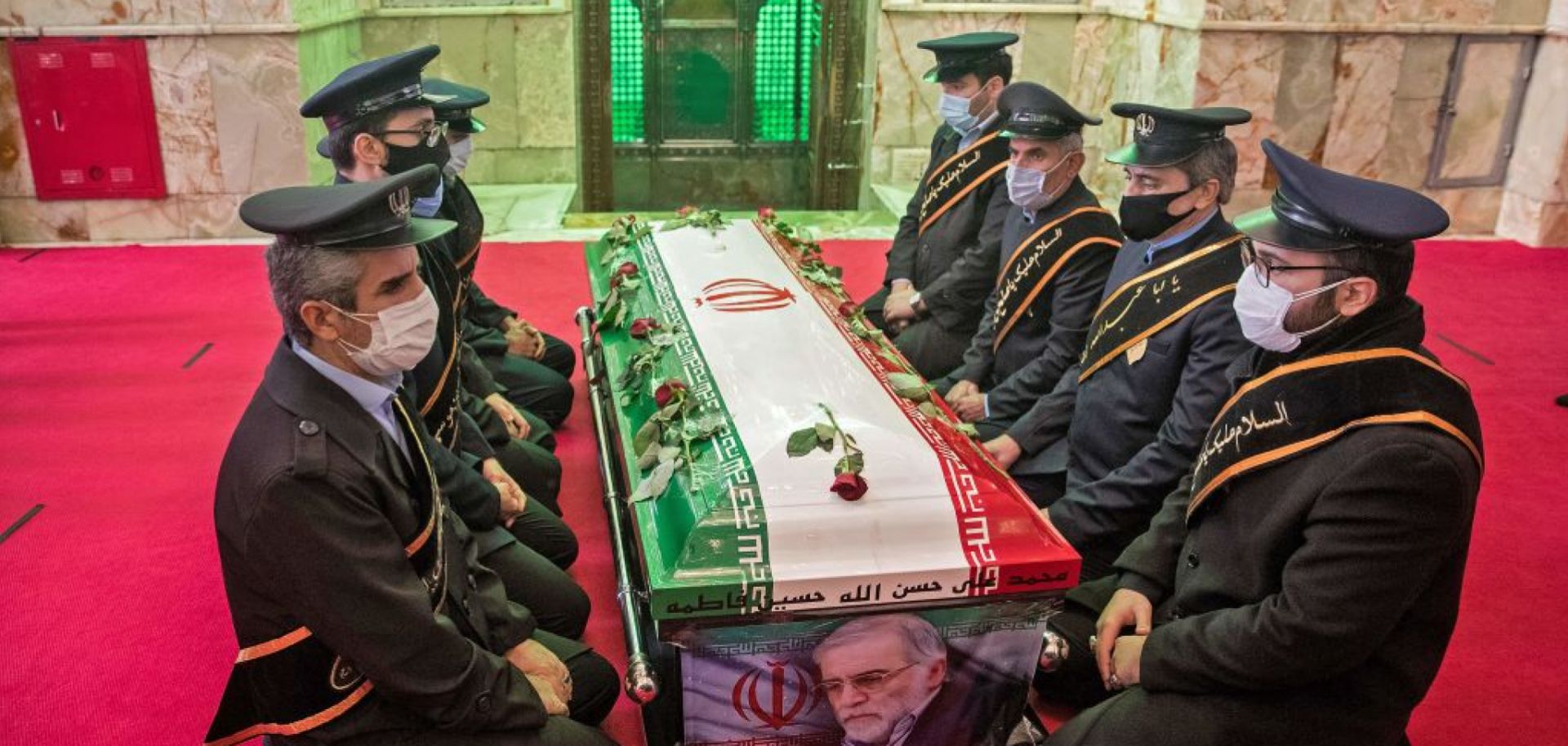
Members of Iranian forces pray around the coffin of slain nuclear scientist Mohsen Fakhrizadeh during his burial ceremony at Imamzadeh Saleh shrine in northern Tehran on Nov. 30, 2020.
The Iranian parliament's ratification of a new bill expanding Iran's nuclear program reflects growing pressure by Iranian hawks on Iranian President Hassan Rouhani and their expectation of early engagement with the incoming Biden administration to address bilateral issues. Conservatives and hard-liners who have led parliament since February 2020 elections secured passage of the bill less than a week after the assassination of Mohsen Fakrizadeh, but its rapid approval and minor modifications by the Guardian Council suggest that conservative factions are seeking to weaken their moderate rivals ahead of June presidential elections, assessing that any suspension of long-standing sanctions will demonstrate to voters that a more hard-line strategy was successful. Nonetheless, ambiguities in the law and political options available to the powerful Supreme National Security Council and Supreme Leader Ali Khamenei suggest that Tehran will choose how to exercise provisions of the law depending on progress with the United States and Europe over the sanctions impasse.
- Elements of the legislation call for an increase in nuclear activities such as renewed efforts to increase uranium enrichment beyond the 20 percent threshold while denying International Atomic Energy Agency inspectors access to Iranian nuclear sites should talks not meet Iranian expectations.
- During a Dec. 2 Cabinet meeting, Rouhani said that the bill was "harmful to diplomatic efforts."
- Iran is slated to hold presidential elections on June 18, 2021; Rouhani cannot run due to term limits.
If the law is implemented entirely it would bring the Iran nuclear issue on the cusp of a crisis within the first 100 days of the Biden administration because the moves that Iran makes under the law would be aimed at significantly reducing Iran's nuclear breakout, the time Iran would need to produce enough weapons-grade material for one device.
- Most of the more time-consuming and difficult work in producing enriched uranium that could be used in a nuclear bomb is done in the initial enrichment up to 20 percent. After uranium is enriched to 20 percent, getting to higher enrichment levels needed for a device, such as 90 percent, can be done relatively quickly. Under the Joint Comprehensive Plan of Action, Iran's enrichment was capped at 3.67 percent and thus far it has only moderately exceeded that by boosting enrichment to 4.5 percent.
- Installing more advanced centrifuges will increase the throughput capacity and reliability of Iran's enrichment program. The JCPOA allowed Iran only to use older first-generation centrifuges with smaller capacities prone to failures.
- Under the JCPOA, Iran was converting the Arak Heavy Water Reactor to a light-water reactor; reversing that redesign would alarm the West because the original design would have produced plutonium as a byproduct that could be used in a nuclear weapon.
- The production of uranium metal would also be alarming because uranium metal's main application is in nuclear warheads — bringing into question whether Iran would restart the weapons side of its nuclear program, which Fakhrizadeh had headed and which by all publicly available information has been largely suspended for nearly two decades.
- The suspension of the Additional Protocol would also leave the United States and Europe unable to monitor all of these developments, making the situation very reminiscent of 2011 and 2012, when a strike on Iran's nuclear facilities was a very realistic possibility before talks between Iran and the United States began.
The Biden administration will likely try to negotiate with Iran for an initial 'compliance-for-compliance' deal in early 2021 to avoid a crisis, but escalation is likely if Biden is unable to quickly enter talks and offer concessions. The incoming Biden administration has said that it wants to open talks with Iran, but it will be under significant pressure from the Republican Party — which will want to maintain oversight of any sort of sanctions relief akin to the review act it had over the JCPOA — not to negotiate with Iran under threat. Even a deal that sees Iran reenter the JCPOA will be controversial because Iran hawks want to use sanctions leverage to extract other concessions, such as on Iran's missile program and support for regional proxies. Those issues have become more critical in their eyes due to Iran's expanded use of that strategy over the last five years. Nevertheless, Iran has made it clear it will not negotiate on nonnuclear issues without a U.S. suspension of sanctions. The dramatic increase in Iran's nuclear program is designed to increase the number of concessions Iran can make on its nuclear program so that it does not have to make as many concessions on other issues that Iran views as more critical to its national security. If the Biden administration does not, or is unable, to prioritize negotiations with Iran despite increased nuclear activity, the Islamic Revolutionary Guard Corps and other hard-liners in Iran will likely push for an even more aggressive regional strategy akin to incidents seen in 2019 to make the Iran question a higher U.S. priority.
The strategy is inherently risky, as moving forward with enrichment to 20 percent and starting the production of uranium metal are the types of moves that will not only push the European Union, France, Germany and the United Kingdom's — all members of the JCPOA — position closer to that of the United States, it would also increase the potential for military and covert actions against Iran. Even China and Russia would express some level of concern. Iran's moderates and reformists fear the provocative moves will do just that, unite Europe with the United States against Iran. The moves would also result in Israel — and possibly the United States — pumping even more resources into covert actions designed to degrade Iran's nuclear program. While the assassination of Fakrizadeh may have had only a limited impact on Iran's nuclear program right now, the June and July explosions at the Khojir missile complex and Natanz Fuel Enrichment Plant — likely carried out by Israel — had a more direct impact on actual operations, and are examples of how deep into Iran's missile and nuclear programs Israeli covert capabilities have penetrated. If Iran starts implementing aspects of the bill before Jan. 20, outgoing U.S. President Donald Trump could also sign off on a preemptive strike on an Iranian facility such as Isfahan, Natanz or Fordow to stop it.
