
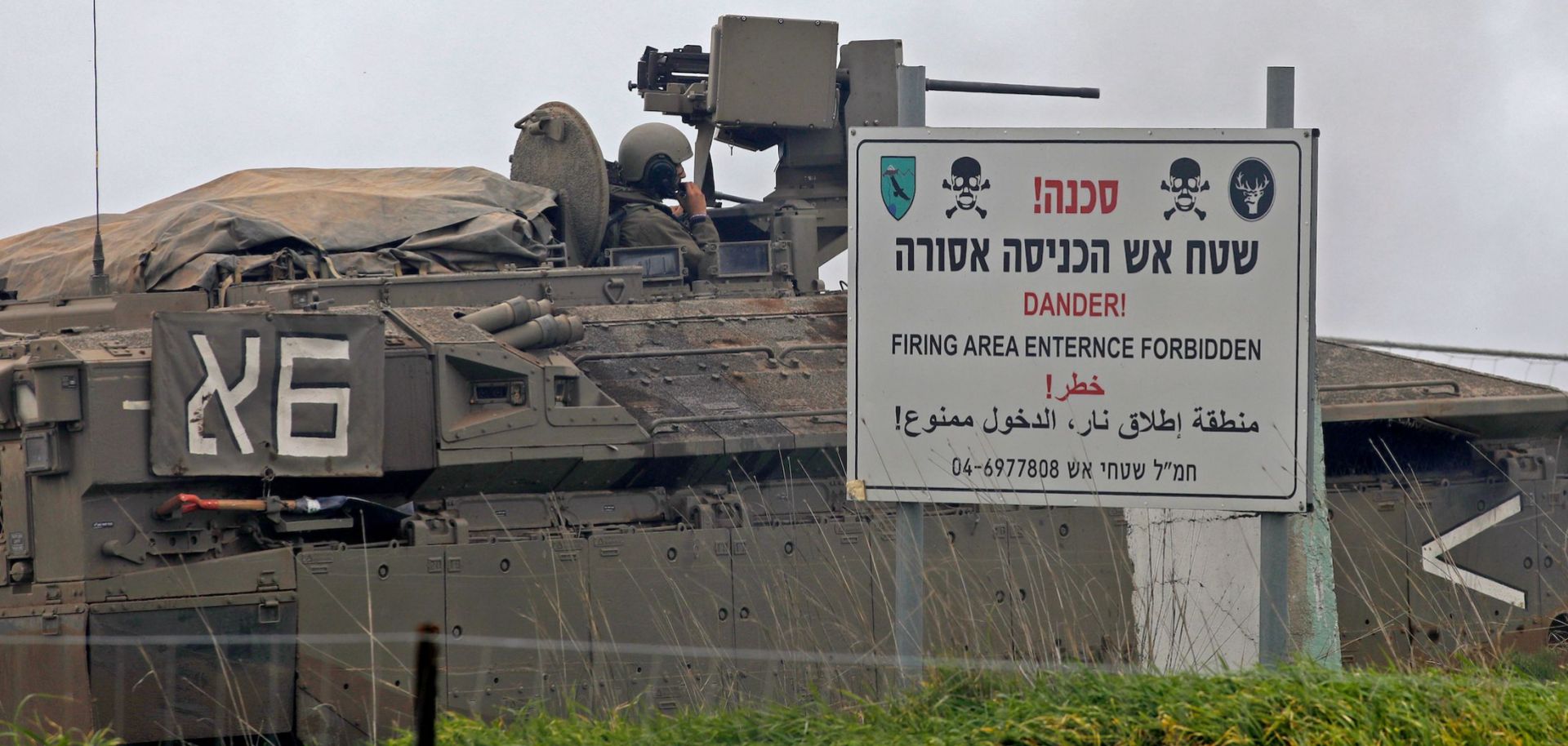
Israeli troops are pictured during a military drill in Golan Heights on Jan. 13, 2021.
Israel will escalate pressure on Iran in the final days of the administration of U.S. President Donald Trump, increasing the risk of Iranian retaliation — particularly in proxy theaters like Syria, Lebanon, Iraq and potentially Yemen. On Jan. 12, Israel conducted a widespread series of strikes against at least 15 Iranian-linked targets along the Iraqi-Syrian border, reportedly killing at least 23 people and injuring dozens more. A senior U.S. intelligence official said that Israel conducted the strikes based on intelligence provided by the United States. The strikes targeted facilities that stored Iranian weaponry, which the U.S. official claimed served as a pipeline for components of Iran’s nuclear program. The Iranian-linked, Afghan-dominated militia Fatemiyoun was also one of the targets.
- Israel has conducted hundreds of strikes against Iranian-linked targets in Syria in recent years. But it’s been years since a single raid has reportedly had such a high death toll and hit such a wide range of targets.
- This is also one of the very few times Israel has conducted such strikes in public coordination with the United States, as well as one of the first times Israel reportedly targeted aspects of Iran’s nuclear program in Syria.
- Israel also deployed Patriot missile batteries to southern Israel in early January as a precautionary move before the anniversary of the assassination of Qassem Soleimani on Jan. 5. The batteries were reportedly in place in case of a Houthi strike from Yemen, though no such attack ever materialized. Iran has reportedly deployed new, longer-range drones to the Houthis in Yemen, though the group has not yet demonstrated the capability of striking distances as far away as Israel.
Thanks to its close relationship with Trump, Israel currently has political backing from the United States to carry out covert and military action against Iran and its proxies. But it is not yet clear if it will receive the same level of support from the incoming administration of U.S. President-elect Joe Biden. Likewise, Israel and the Trump administration have both shown they wish to undermine any upcoming rapprochement between the incoming administration and Iran. Covert action against Iran and its proxies may undermine trust between Tehran and Washington ahead of the administration changeover.
- Under the administration of U.S. President Barack Obama, Israel carried out numerous strikes against Iranian forces and proxies in Syria. But its military strategy was tempered by Washington’s need for Iranian cooperation in negotiating the eventual nuclear deal, formally known as the Joint Comprehensive Plan of Action (JCPOA). Since Trump’s withdrawal from the deal in 2018, Israel has scaled up its strikes inside Syria and even expanded them to attacks, albeit far less frequent, in Iraq and Lebanon.
- Israel has conducted fewer attacks in Lebanon and Iraq in its regional proxy campaign against Iran. Lebanon still hosts Hezbollah, Iran’s most capable proxy, while Iraq’s government is able to leverage its relationship with both Iran and the United States to ward off overt Israeli military action.
Israel’s military and political leaders are also attempting to signal that Israel is prepared to escalate amid uncertainty about the incoming Biden administration’s commitment to pressuring Iran, especially in the face of Tehran’s advancing nuclear program. On Jan. 13, Tzachi Hanegbi, the Settlement Affairs Minister from Israeli Prime Minister Benjamin Netanyahu’s Likud party, said Israel could attack Iranian nuclear sites directly if the Biden administration rejoined the JCPOA. That same day, the U.N. nuclear watchdog also announced that Iran had begun installing equipment to produce uranium metal to provide fuel for its Tehran Research Reactor, marking another violation of the JCPOA.
- Uranium-based fuel can be utilized in the production of nuclear weapons. Iran’s move to begin producing such fuel is designed to further ramp up pressure on the United States to renegotiate the nuclear deal.
- Iran has also said it would develop enrich uranium up to 20% at its underground Fordow Fuel Enrichment Plant — a level that Netanyahu cited as a red line for military action in 2012.
Israel’s overall willingness to use force and Iran’s willingness to undermine its commitments to the JCPOA increases the risk of another Israeli-Iranian military confrontation. Ahead of the changeover to Biden, both Israel and Iran are signaling they are prepared to increase tensions in an attempt to influence the U.S.-Iranian negotiation process. Israel wants to signal to Iran that its covert and military campaign against it could still escalate. The increase in tensions has the potential to create escalation ladders that produce a higher degree of conflict than in the past.
- Israeli strikes on Iranian forces and proxies often provoke harsh rhetorical responses from Iran, whose regional legitimacy is eroded by such attacks among its allies, including most recently Israel’s suspected assassination of Iranian nuclear scientist Mohsen Fakhrizadeh in November.
- To maintain a level of deterrence and credibility, Iran has retaliated against Israel for attacks on its forces in Syria, as exemplified by the direct clashes between Iranian and Israeli forces in Golan Heights in May 2018 that involved rockets and missiles.
