
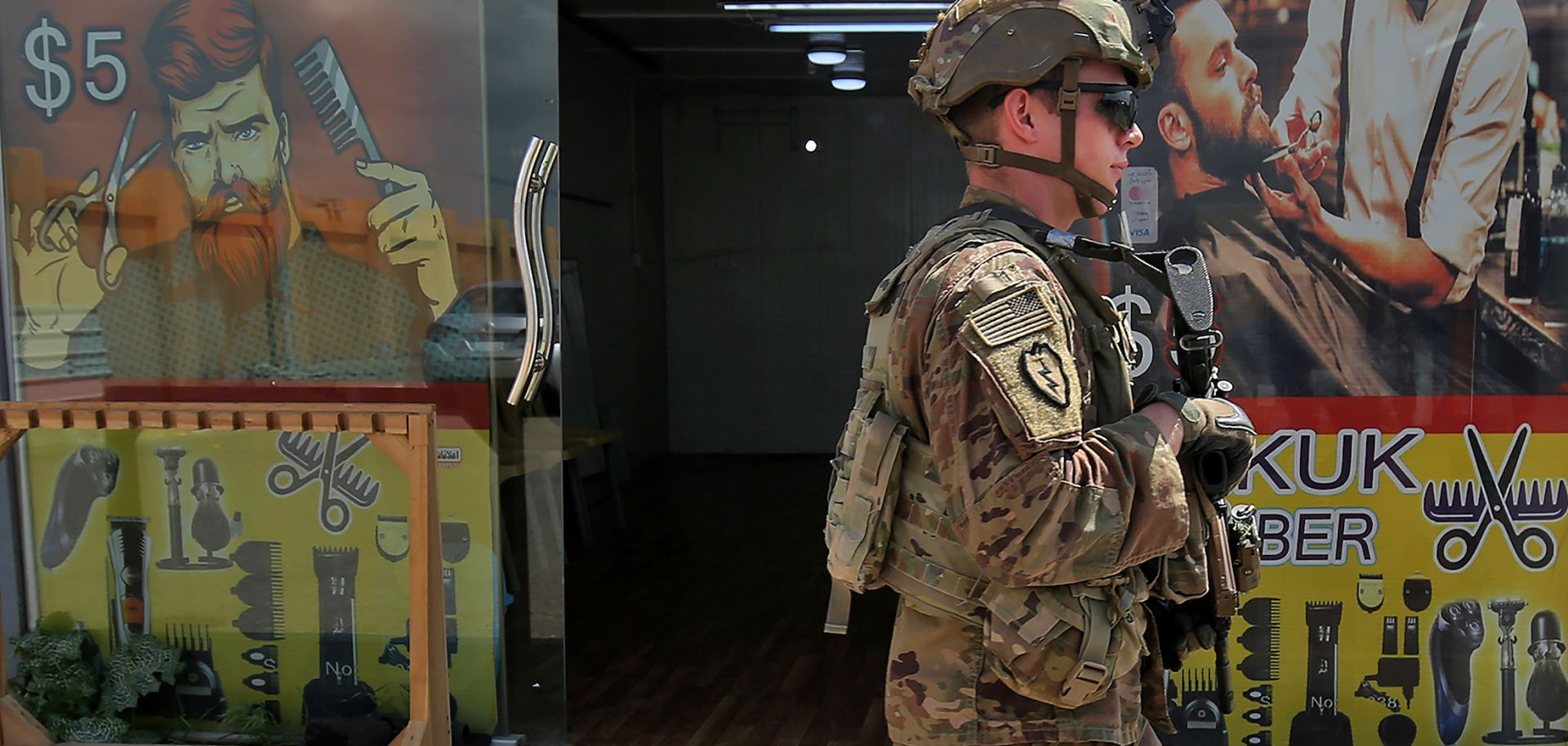
A U.S. soldier at the K1 Air Base northwest of Kirkuk in northern Iraq before a planned U.S. pullout on March 29, 2020.
President-elect Joe Biden will seek to draw down the U.S. presence in Iraq due to long-standing domestic political pressure, shifting the foreign policy focus to other objectives such as near-peer competition with China and Russia. This will create room for Iran, its proxies and others to gain more influence in Iraq. After the U.S. troop surge in Iraq in 2007, the Bush, Obama and Trump administrations all subsequently decreased the U.S. presence in Iraq to a degree. (The notable exception being when the Obama administration was forced to reverse course from its 2011 withdrawal following the rise of the Islamic State.)
- Biden faces long-standing pressure from the left wing of the Democratic Party to deprioritize Iraq as a foreign policy objective, and the president-elect himself has a record of calling for the U.S. to draw down its presence in Iraq — most notably when he served as vice president. Likewise, U.S. Central Command has a stated goal of drawing down the U.S. presence in Iraq by 2023, during Biden's term.
- Biden's current foreign policy platform focuses on other issues such as competition with China, reestablishing ties with European allies in NATO and the European Union, and addressing climate issues as more important foreign policy objectives. In fact, Iraq does not even appear in Biden's published foreign policy plan, which only indirectly refers to the issue in saying that the administration intends to "end forever wars."
- Iraq's parliament passed a nonbinding resolution in January 2020 demanding Iraq expel all foreign troops, a resolution whose timing in the wake of the targeted killing of Iranian Gen. Qassem Soleimani in Baghdad by the United States indicated it was clearly aimed at the United States.
The Biden administration will have more leeway to draw down because it does not face the same factors that constrained the previous two administrations, but will not completely withdraw in an attempt to maintain some influence in the country. The Obama administration did withdraw from Iraq, but had to reverse when the country faced an existential security crisis in 2014 from the Islamic State. The Trump administration then helped Iraq to complete a campaign to retake all Islamic State-controlled territory, while also taking a more aggressive military posture toward Iranian-backed militias in the country as a part of its wider maximum pressure campaign on Iran.
- Biden faces a weakened Islamic State which, unlike in the Obama administration, no longer exercises territorial control over parts of Iraq and does not pose the level of threat that required a larger U.S. military presence.
- In contrast to the Trump administration's aggressive approach, Biden has signaled he will take a far less confrontational military posture toward Iranian-backed militias in Iraq as a part of a broader policy of reducing tensions with Tehran.
- The U.S. view of Iraq as a regional partner on counterterrorism and other issues means it will not completely withdraw from the country. The Biden administration understands the potential dangers of a complete U.S. withdrawal and will seek to avoid those by maintaining a limited military presence. Absent another existential security crisis in Iraq, however, the United States is unlikely to completely reverse course and increase its military presence.
Iran is the external power with the greatest incentive and ability to expand its power and influence in Iraq, which it will be able to do more extensively given a diminished U.S. presence. Geopolitical imperatives have always driven Iran to seek more influence in Iraq, while its already extensive political, economic and security links to Iraq have put it in a prime position to capitalize on any U.S. withdrawal.
- Iran's proximity to Iraq gives it the incentive and capability to exert more pressure in the country. One of Iran's main strategic objectives is to prevent Iraq from becoming the independent, strong and hostile neighbor it was under Saddam Hussein.
- Iran also has preexisting economic, religious and political ties to Iraq that it has built up significantly since 2003. Iran played an important role in preventing the Islamic State from seizing Baghdad in 2014, and Iranian-backed militias still hold significant sway within the country.
- These factors give Iran an advantage over other regional powers such as Turkey or Saudi Arabia, which have various incentives to expand their influence in Iraq, but lack the advantages Iran enjoys.
Although it will not completely withdraw, the drawdown of the U.S. presence in Iraq will weaken its influence in the country, make it more difficult for the U.S. to achieve additional future policy objectives in Baghdad and contribute to further political instability. Various Iraqi groups have opposed the U.S. presence in Iraq and called for the full withdrawal of American troops, while elements of the country's ties with Iran and Russia have caused tensions between Washington and Baghdad.
- A less significant U.S. presence in Iraq means Baghdad will look for other external powers for additional economic and political support, opening up the door for major players outside of the Middle East like China and Russia to expand their influence in the country.
- Other Iraqi actors will also seek to fill the vacuum of U.S. influence, creating even more political friction points between competing groups in an already-fragmented and -fraught domestic political environment. This could compound Iraq's economic problems.
- Concrete U.S. moves to draw down its military presence will also likely embolden Iraqi factions that have called for a complete U.S. withdrawal. More emboldened opposition to the U.S. presence in the country will make it more difficult for Washington to achieve other policy objectives in Iraq.
- Iraqi factions hostile to the U.S., including Iranian-backed militias, will be incentivized to accelerate this withdrawal by launching attacks and driving up the cost for continued U.S. involvement in the country — a strategy they saw as successful in the run-up to the 2011 withdrawal.
- Beyond 2021, a more significant Iranian influence in Iraq will also set the stage for the country to reemerge as a hotspot for a potential resurgence in U.S.-Iranian tensions.
