
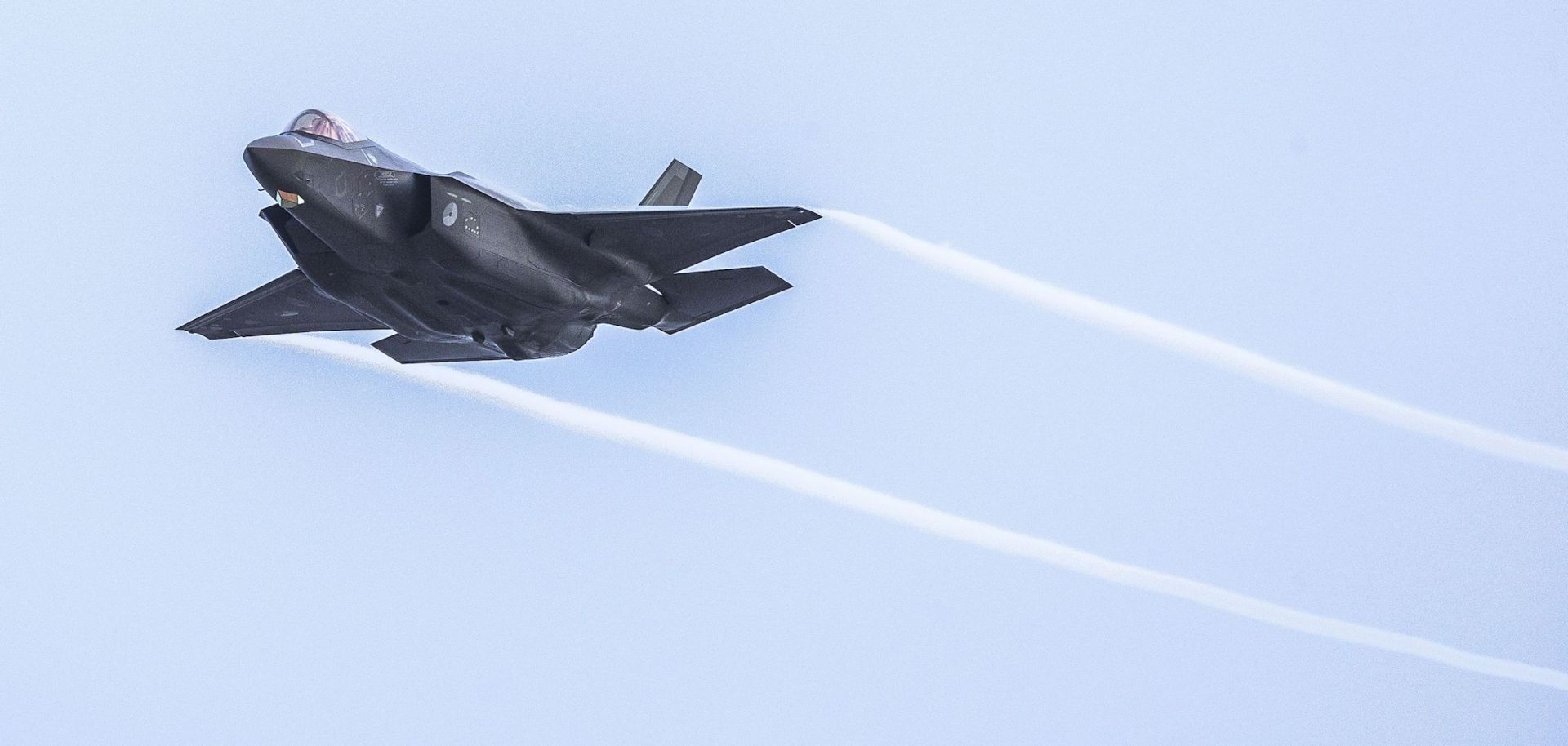
An F-35 military aircraft participates in a NATO training exercise.
The U.S. decision to authorize the first stage of the most advanced arms sale yet to the United Arab Emirates indicates Washington may be less willing to pressure its Arab Gulf allies, as both Abu Dhabi and Saudi Arabia pivot to less confrontational foreign and domestic policies. The White House could, however, revert to a more hard-line position again if these governments deviate from U.S. regional goals. On April 13, a U.S. State Department spokesman said the United States would proceed with a controversial $23 billion arms sale to the United Arab Emirates after an initial review of the sale. The spokesman said the sale would likely see delivery in 2025 or later, and that reviews of Emirati human rights and usage of weapons would continue, along with consultations with Emirati officials. The sale, which was approved by the administration of former U.S. President Donald Trump in January 2020, includes 50 F-35s, 18 MQ-9B Reaper drones and munitions, but was controversial because of the United Arab Emirates’ foreign policies in Yemen, Qatar and Libya.
- The Biden administration pledged to increase Washington’s focus on human rights as part of its foreign policy, which prompted an arms freeze of weapons to Saudi Arabia and the United Arab Emirates. The White House has also said it would end “offensive” weapons sales to Saudi Arabia, though it has not defined exactly what systems would qualify as such. For the United Arab Emirates, the Biden administration has only promised to review rather than end arms sales
- The United Arab Emirates’ aggressive foreign policies are highly contentious in the U.S. Congress, where lawmakers have accused Abu Dhabi of misusing American weapons in Yemen, breaking the U.N. arms embargo to support its allies in Libya, and undermining regional security by blockading U.S.-allied Qatar. But the United Arab Emirates has recently drawn down its military involvement in Yemen and ended the blockade of Qatar.
The United Arab Emirates’ foreign policy changes are helping reduce tension with the United States, better positioning it to receive advanced military hardware so long as it remains aligned with Washington’s regional goals. With a less direct military role in Yemen and the easing of fighting in Libya, the White House now appears less concerned these weapons systems will be used offensively abroad, and that they may instead serve U.S. goals as more of a deterrent to Iran while providing the U.S. defense industry with contracts worth thousands of American jobs. The Biden administration also wants to solidify Abu Dhabi’s Trump-era normalization deal with Israel, in which the F-35 was an implied reward for taking the risk of improving ties to Israel.
Saudi Arabia’s still-frozen U.S. arms sales may now have stronger prospects as well, as Riyadh tries to switch to a less aggressive foreign policy and manages U.S. perceptions of its human rights record. Saudi Arabia’s move to end the Qatar blockade and strong interest in the U.S.-led diplomatic push in Yemen will likely bode well for how the kingdom’s foreign policies are perceived during the Biden administration’s strategic review of U.S.-Saudi ties, improving the chances of the arms sales being allowed to go forward. Additionally, further attacks by Yemeni Houthi rebels, both on Saudi Arabia and in Yemen, may prompt more U.S. military support to ward off the militants. Saudi Arabia will also likely continue to release human rights activists and dissidents in a way that will help improve U.S.-Saudi ties.
- As it attempts to end its five-year military intervention in Yemen, Saudi Arabia has closely aligned with the U.S. diplomatic push to end the country’s ongoing civil war. But the Houthi movement has responded to this push with a major offensive on the energy-rich province of Marib and attacks on Saudi cities, prompting renewed U.S. pledges to help defend Saudi Arabia from attacks on the kingdom. Saudi air support, largely supplied by the United States, has been critical in the battle for Marib.
- Saudi Arabia released women rights activist Loujain al-Hathloul in February along with several other prominent feminists, after serving nearly three years on charges that sparked intense international criticism. However, other high-profile Saudi activists remain behind bars, including blogger Nouf Abdelaziz al-Jerawi and aid worker Abdulrahman al-Sadhan. On April 6, the U.S. State Department expressed concern about al-Sadhan’s 20-year sentence.
The United States will likely make the delivery of advanced weapons contingent on the United Arab Emirates and Saudi Arabia not purchasing weapons from countries like Russia and China, as well as avoiding foreign policy decisions that could resurrect concerns about how U.S. weapons may be used. With the delivery dates years away (and the example of Turkey’s removal from the F-35 program in mind), this could present a challenge for the United Arab Emirates and Saudi Arabia.
- Should Islamist parties or governments gain political ground in the region — particularly in Libya, Yemen, Jordan, Tunisia or Morocco — the United Arab Emirates might risk more aggressive countermeasures against them that could run afoul of the U.S. desire for regional stability. Ideologically, the United Arab Emirates remains committed to an anti-Islamist strategy that pits it against more pro-Islamist countries like Qatar and Turkey, triggering conflicts that often play out in proxy theaters like Yemen and Libya.
- The United Arab Emirates has purchased Chinese and Russian weapons in the past, but none of these sales have caused serious concern in the United States. Rumors of a joint Russo-Emirati fifth-generation fighter jet project, however, could generate concern in Washington about Russian influence in the Arab Gulf. In June 2019, the United States also removed Turkey from its F-35 development program because of Ankara’s purchase of the Russian S-400 missile system.
