
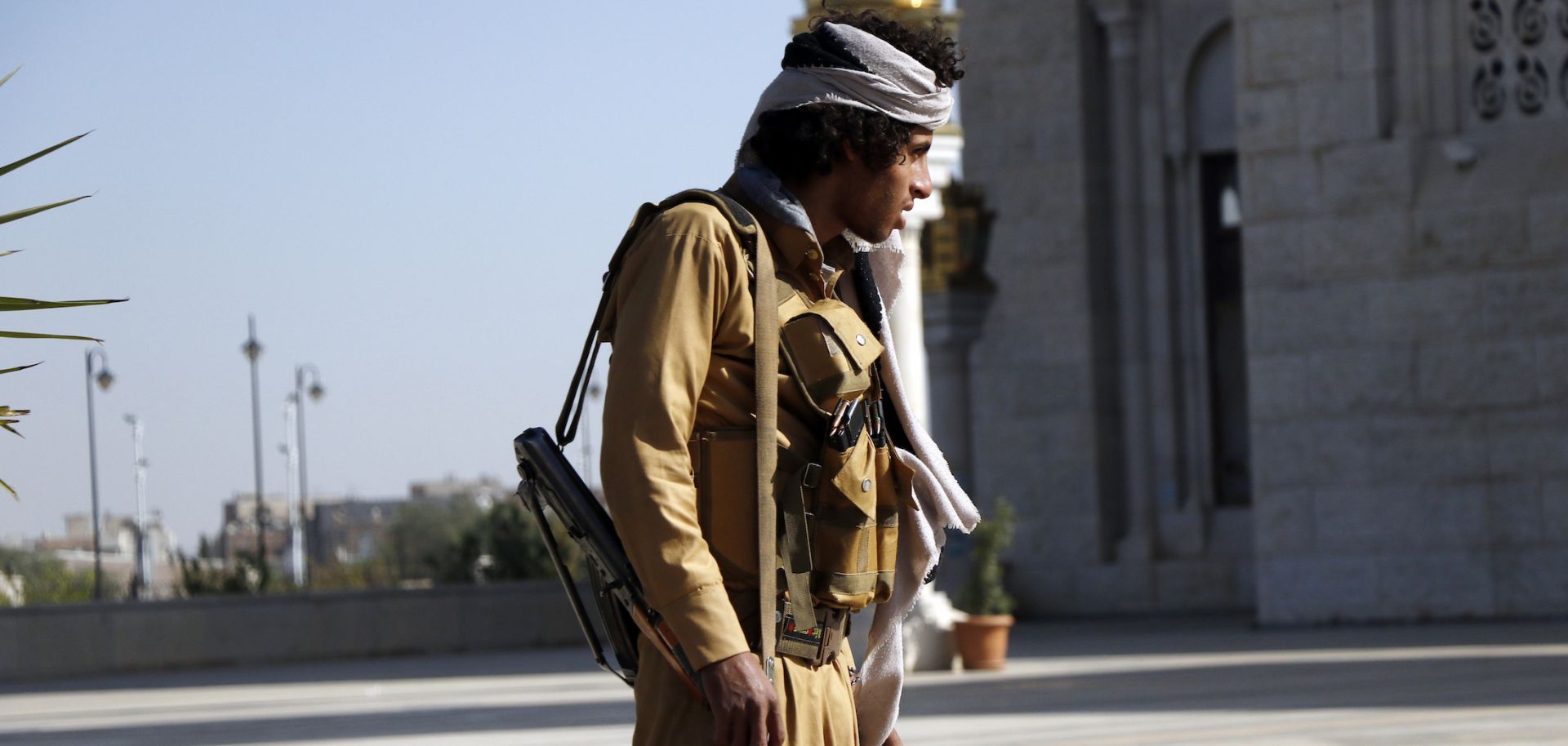
A Houthi fighter stands outside at a funeral for rebels killed in Marib, Yemen, on Feb. 28, 2021.
An ongoing battle in the heart of Yemen could become a major setback in U.S.-Saudi efforts to end the country’s civil war, should it leave the resource-rich city of Marib in Houthi hands. Talks reportedly took place in Oman between U.S. and Houthi officials on Feb. 26 as part of U.S. President Joe Biden’s renewed diplomatic push to facilitate a cease-fire in Yemen and ease the country’s humanitarian crisis, which includes 2 million refugees in the surrounding Marib province. But fighting has nonetheless continued apace in Marib, with Houthi rebels making unprecedented gains in its offensive — stoking fears that President Mansoor Hadi’s Saudi-backed, internationally recognized government could soon lose control of the strategic central city for the first time in Yemen’s nearly seven-year-long civil war.
- Marib and the surrounding central Yemeni province have seen intense fighting since the Houthis renewed their offensive on the province in early February 2021, pulling forces away from other frontlines in an attempt to seize the region.
- Yemeni Houthis have also continued to launch routine attacks on Saudi Arabia itself, including drone, missile and rocket strikes on the kingdom’s southern border.
The Saudi-backed but domestically weak Yemeni government has so far managed to hold control of Marib, but the city and surrounding region’s oil, gas and agricultural resources have made it an increasingly attractive target for Houthi rebels.
- The Marib Dam is the largest water reservoir in Yemen and is essential to the region’s agriculture. In a hot and dry country where access to food and clean water is increasingly scarce, and gaining control of the dam would grant Houthis significant negotiating leverage.
- Marib is home to Yemen’s largest natural gas power plant as well. It’s also the starting point of one of Yemen’s largest energy pipelines that runs to Houthi-controlled Hodeida on the Red Sea. After being largely out of service throughout the civil war, the pipeline’s production has been steadily returning in recent months.
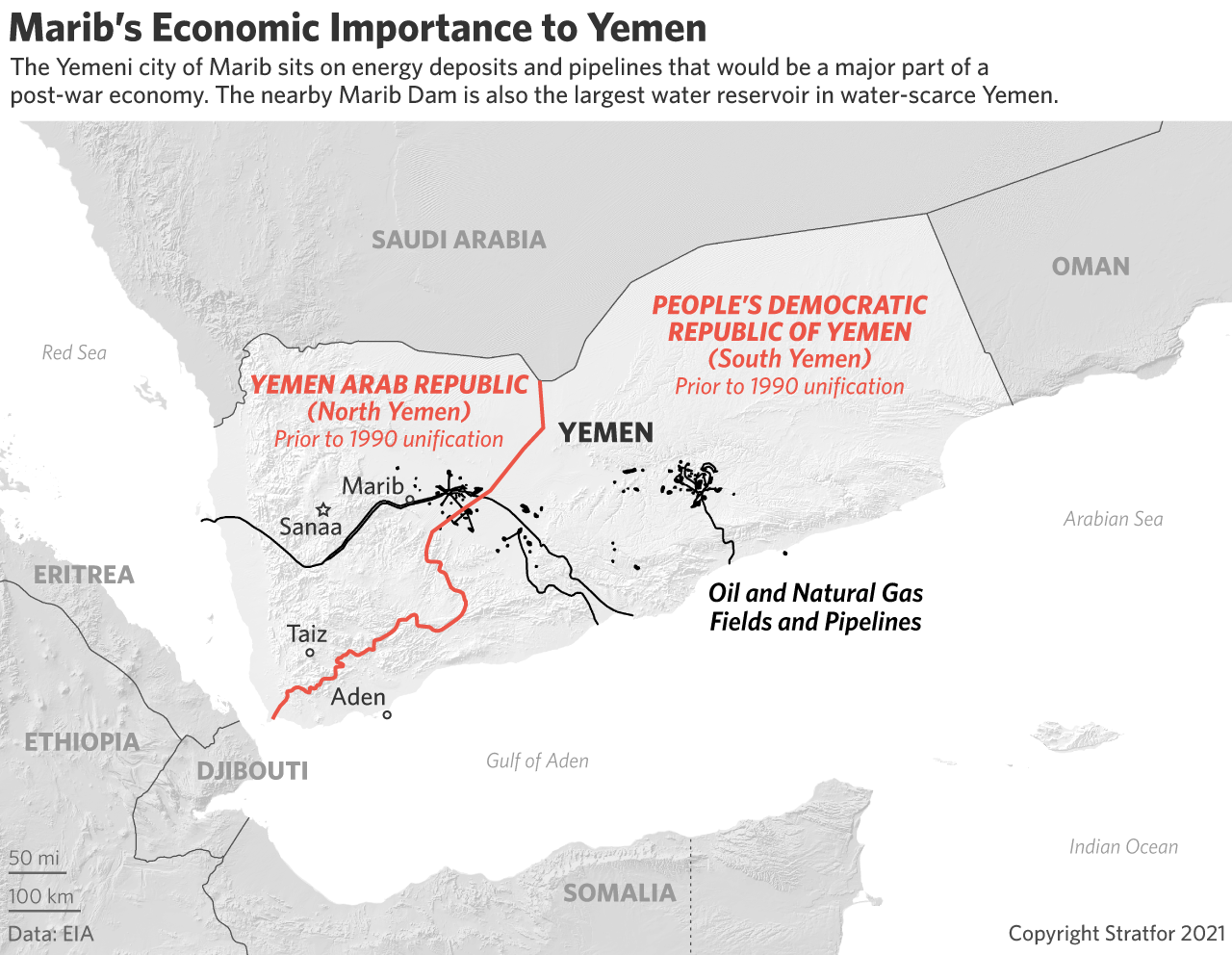
In order to entrench its control of northern Yemen, the Houthi movement is attempting to gain leverage against the Hadi government and its backer, Saudi Arabia. By increasing pressure on the battlefield, the Houthis are trying to demonstrate the military weakness of the Yemeni government. In doing so, the rebel group is also hoping to force concessions in political negotiations that could include more revenue sharing, control of new territory and key water and energy resources, as well as favorable prisoner swaps.
The United States, meanwhile, has been pressuring Saudi Arabia to restrain its military campaign in Yemen, leaving the Hadi government with less direct support on the ground. Over the course of its five-year military intervention in Yemen, Saudi Arabia has sought to keep its troops out of the direct line of fire by relying on airpower, proxies and special forces. Such tactics, however, have resulted in allegations of human rights abuses and civilian casualties, including perhaps most notably the 2018 Saudi airstrike on a school bus that killed 26 Yemeni children that prompted international outrage. For that reason, the Biden administration has applied diplomatic pressure to restrain Saudi airstrikes that could affect the military balance around the frontlines in Marib and elsewhere in Yemen.
The loss of Marib city before the start of substantial peace talks would likely further weaken the Hadi government while emboldening Houthi military action against Saudi Arabia and the United Arab Emirates. Such a significant Houthi victory could splinter the Hadi government further, propelling elements such as the Southern Transitional Council (STC) to assert their secessionist impulses. Al Qaeda in the Arabia Peninsula (AQAP) and the Islamic State in Yemen could seek to take advantage of a weaker Yemeni government as well.
- The STC has previously seized territory in the borders of former South Yemen. In 2020, the group withdrew from its 2019 power-sharing agreement with the Hadi government, only to return later that year after making further territorial gains in its quest to restore an independent South Yemen.
- Yemen’s ongoing civil war has undercut joint counterterrorism operations between the Hadi government, STC, the United States and the United Arab Emirates. The war also continues to create the social conditions ripe for extremism, as the country’s humanitarian crisis becomes increasingly dire.
