
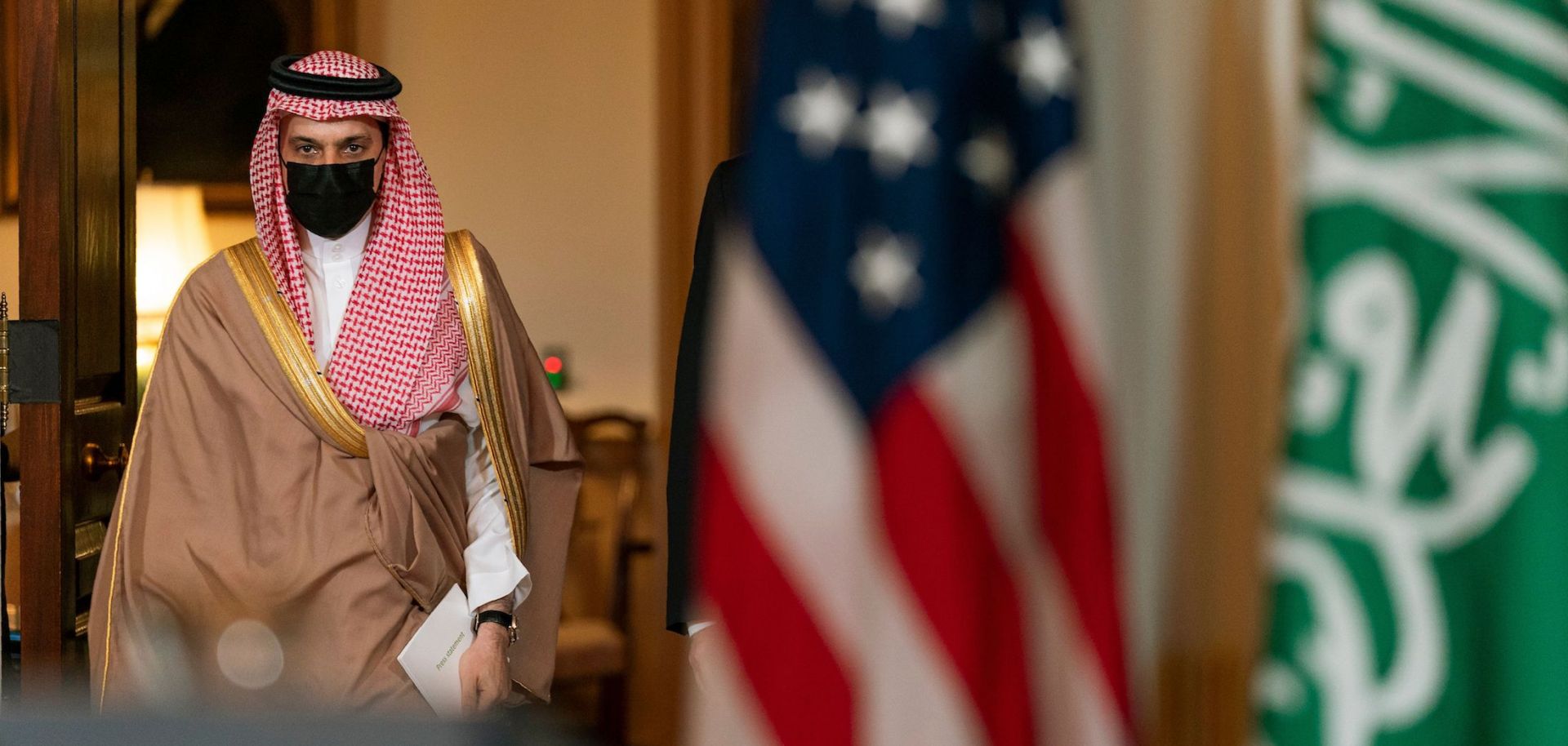
Foreign Minister Prince Faisal bin Farhan Al Saud walks the halls of the U.S. State Department in Washington D.C. after meeting with then-U.S. Secretary of State Mike Pompeo on Oct. 14, 2020.
As the drivers bringing them together weaken, the United States and Saudi Arabia will become more conservative in deepening their strategic ties and more critical of one another’s differences. On Feb. 26, the administration of U.S. President Joe Biden released a report publicly blaming Saudi Crown Prince Mohammed bin Salman for the 2018 assassination of journalist Jamal Khashoggi, and imposed visa bans on 76 Saudis associated with the act under a new so-called “Khashoggi Policy.” This, along with other recent public statements and arms freezes, indicates Biden preparing to shift U.S.-Saudi ties away from his predecessor’s close personal relationship with the kingdom. The White House appears ready to press Saudi Arabia to engage in more restrained foreign policy, emphasizing U.S. human rights objectives in its Saudi dialogue. That pressure will undoubtedly clash with several of the kingdom’s own deeply set imperatives, creating pushback from Riyadh and turbulence in long-standing U.S.-Saudi ties.
- On Jan. 27, the Biden administration moved to freeze arms sales to Saudi Arabia as the White House conducted a strategic review of its relations with the kingdom. The review is designed to provide a roadmap for policymakers during Biden’s term and includes a notable human rights component that is a break from former President Donald Trump’s approach. Biden has also singled out Saudi Arabia’s intervention in Yemen as an issue of concern, ending formal U.S. support for the campaign.
- Trump shielded Saudi Arabia from congressional action during his term, delaying a public report on the Khashoggi assassination that would have implicated the crown prince. The Trump administration also directed U.S. sanctions on the kingdom to be largely symbolic rather than overly punitive.
- The Saudi crown prince has become a lightning rod for U.S. criticism of Saudi Arabia since the Khashoggi assassination. But numerous other issues have been turning U.S. political sentiment against the kingdom for much longer, including concerns about Saudi Arabia’s nuclear program, broader human rights record, accused links to terrorism and previous close relationship with the extremist Sunni Wahhabi movement. An FBI memo released last year that said the Saudi government "almost certainly" helped its citizens accused of serious crimes flee the United States has also fueled calls among U.S. lawmakers to ensure Saudis studying and living in the United States are held criminally accountable.
Under multiple administrations, the United States has been de-emphasizing a close strategic relationship with Saudi Arabia, driven by the declining need for Saudi oil, Americans’ weariness with Middle Eastern conflicts, and a global desire to focus U.S. resources on great power rivals with China and Russia.
- Under President Barack Obama, the United States publicly asserted it would pivot out of the Middle East toward Asia to confront a rising China, urging regional allies to become more responsible for their own security. Obama also broke with Saudi Arabia over signing the Iran nuclear deal, which Riyadh strenuously opposed for what it saw as failing to address the kingdom’s concerns with Iran’s other foreign policies.
- During his term, President Trump established a close personal relationship with Crown Prince Mohammed bin Salman, pursuing high-profile arms deals while blocking congressional attempts to halt weapons sales and other forms of cooperation with Saudi Arabia. Fears of being pulled into another Middle Eastern war, however, restrained the Trump administration’s military response to Iranian-linked attacks on Saudi soil in recent years, including the 2019 strikes against Saudi Aramco’s Abqaiq and Khurais oil facilities launched from Iran, along with multiple Houthi attacks against Saudi cities and infrastructure launched from Yemen.
- Domestically, U.S. developments in alternative energy sources and increased shale oil production have also helped decrease the United States’ overall economic and political sensitivity to the security of Saudi Arabia’s oil security.
The Biden administration will be more overtly critical of Crown Prince Mohammed bin Salman’s leadership, as well as any of the kingdom’s domestic and foreign policies that appear to undermine the U.S. view of human rights. But in part thanks to Saudi Arabia’s economic influence in the United States, Riyadh is unlikely to feel the need to respond with policy changes that go beyond symbolic appeasement. As The United States calibrates its policies, it is unlikely to risk its still-substantial economic and strategic ties with Saudi Arabia by attempting to go beyond rhetorical and diplomatic pressure on Saudi Arabia to modify its behavior. Bolstered by a growing nationalist domestic base, Saudi Arabia will be open to changing some policies and engaging in symbolic concessions on issues like human rights, but will be reticent of allowing foreign pressure to define its overall political agenda.
- Saudi Arabia’s internal politics are resilient to external pressure, with no history of foreign coups and no elections that outside forces might manipulate. The kingdom’s tight tribal and family structure has historically made it difficult for outsiders to make inroads in the country. A rising tide of Saudi nationalism has also made ordinary Saudis more skeptical of foreign influence.
- In 2015, the U.S. Commerce Department estimated that 165,000 American jobs were created through exports to Saudi Arabia. In 2019, Saudi Arabia’s foreign direct investment (FDI) to the United States was $13.2 billion, with 8,500 workers at Saudi-owned companies. Saudi Arabia’s Public Investment Fund also holds around $12.8 billion in U.S. stock as of February 2021.
Increased U.S. tensions will dampen investor and commercial sentiment toward Saudi Arabia, driven by concerns that the kingdom could become embroiled in another human rights violation that would further strain its ties with Washington and the West, more broadly. Both Biden and the U.S. Congress have the power to take action against Saudi Arabia over any new human rights violations or crackdowns on dissent in the kingdom — both of which remain possibilities, given that Saudi activists now feel more emboldened to publicly criticize the government after Riyadh released high-profile dissidents in a bid to improve its human rights record. The possible ascension of Crown Prince Mohammed bin Salman to the throne could exacerbate tensions with Washington as well, particularly if his reign sees Saudi Arabia return to high-risk behaviors at home and abroad.
- King Salman and his close supporters have served as a check on some of Crown Prince Mohammed bin Salman’s influences and policies, despite the crown prince running much of the kingdom’s daily affairs. But the king is 85 years old and reportedly in poor health. And although there are rumors of succession-related tensions within the ruling family, there is currently no clear back-up for the controversial crown prince.
- Saudi Arabia’s Vision 2030 plan partially relies on foreign investment to help achieve development goals in tourism, construction, manufacturing and other diversification schemes [LINK: The Saudi Aramco IPO Will Hit Its Valuation Goal but Fail to Fund Vision 2030]. FDI in Saudi Arabia has been hampered by ongoing reputational risks for certain firms, which the Khashoggi assassination has only exacerbated. In 2019, Saudi Arabia failed to hit its $10 billion FDI goal, reaching $4.6 billion that year, despite the kingdom’s increased rankings in the World Bank’s Ease of Doing Business report in 2020.
