
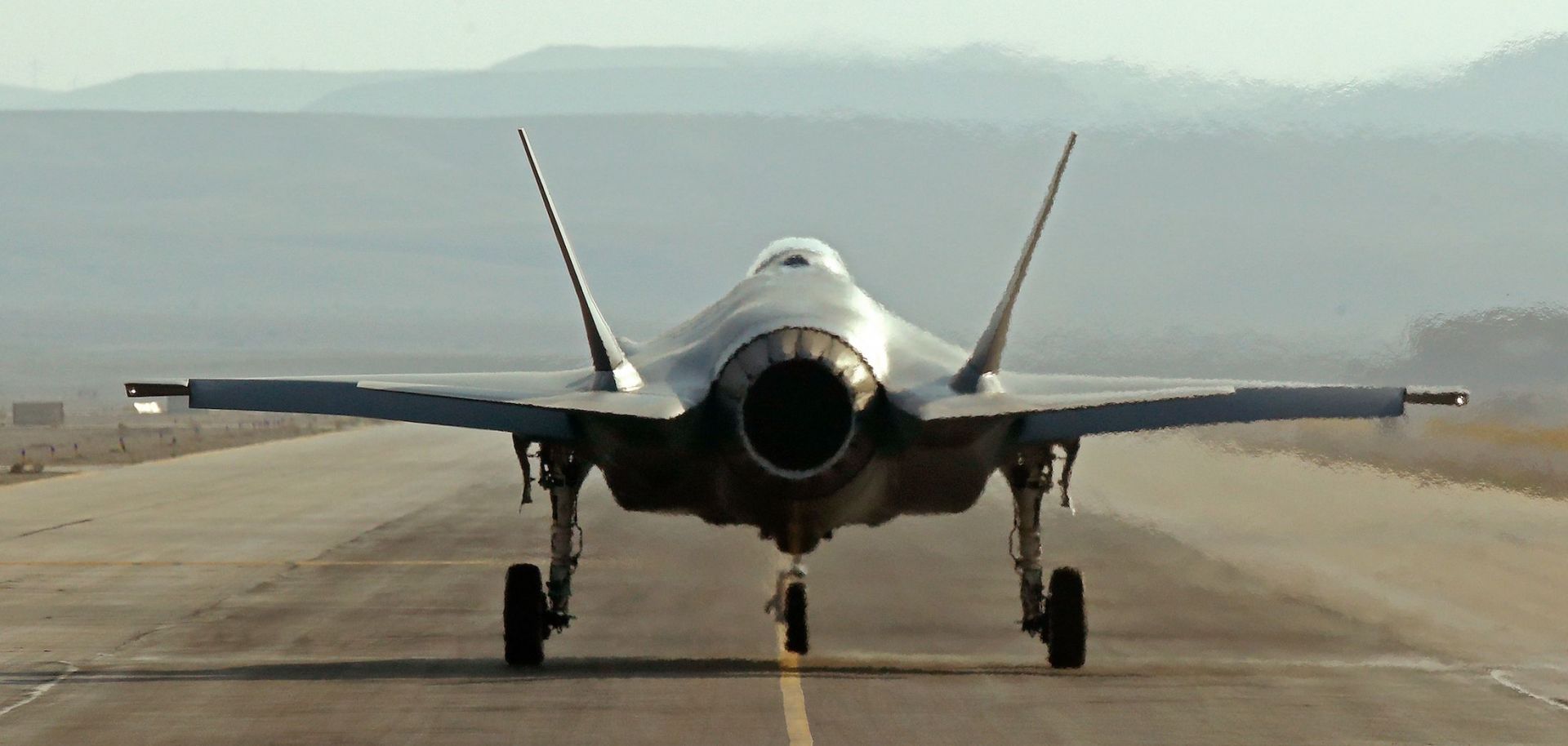
An American-made F-35 jet takes part in an air defense exercise in Eilat, Israel, on Nov. 11, 2019.
The administration of U.S. President-elect Joe Biden is unlikely to upend the latest UAE-U.S. arms deal upon taking office, though it may restrict the use of American weapons in Abu Dhabi’s controversial regional operations. The United Arab Emirates will be the first Arab state to acquire the U.S.-made F-35 jets — an advanced stealth fighter Washington previously reserved for NATO and its close allies in Asia, such as Japan — after a Dec. 9 vote in the U.S. Senate failed to block a $23 billion sale of advanced F-35 stealth jets, drones and armaments to Abu Dhabi. Upon taking office in January, Tony Blinken, Biden’s nominated Security of State, has said that the incoming White House will take a “hard look” at the UAE arms deal, given the concerns voiced by U.S. lawmakers that the Emirates may use such weapons in Yemen and Libya. But while such a review raises the potential of stricter U.S. controls over the use and deployment of the advanced weapons systems, the Biden administration has yet to signal that it has any plans to reverse the UAE-U.S. arms deal.
- Members of Congress have criticized Abu Dhabi’s operations in Yemen and Libya’s ongoing civil wars, as well as its blockade in Qatar, for undermining regional stability and empowering extremists.
- In Libya, the United Arab Emirates has reportedly deployed U.S.-supplied equipment to Khalifa Hiftar’s rebel Libyan National Army in violation of a U.N. arms embargo, while in Yemen, U.S.-built equipment has reportedly also been transferred to Emirati-backed southern separatists.
- In May 2019, during a period of heightened U.S.-Iran tensions, the White House bypassed opposition in Congress by using an emergency arms sale to provide $8 billion worth of weapons to the United Arab Emirates, Saudi Arabia and Jordan.
The United Arab Emirates, meanwhile, will continue to reconsider some of its controversial regional strategies to amend its sliding reputation in Washington. The United Arab Emirates has recently drawn down its forces in Yemen and softened its stance on the three-year-old blockade in Qatar, as Abu Dhabi tries to signal it will shift its regional priorities to be more in line with the Biden administration’s values. The Emiratis’ decision to normalize its relations with Israel earlier this year was also partially driven by a desire to boost its image among American politicians, who widely supported the move.
To protect its budding defense ties with Washington, Abu Dhabi will likely also reduce its arms sales and cooperation with U.S. rivals in China and Russia, using the backlash Turkey encountered for its 2019 purchase of the Russian S-400 system as a cautionary tale. The United States has used its F-35 jets as leverage to push back against Russian defense influence in Turkey, and could also do the same with the United Arab Emirates. This will deter Abu Dhabi from purchasing advanced Russian or Chinese equipment, impeding Russia and China’s ability to secure a foothold in the wealthy Arab Gulf state’s defense market.
- Turkey’s purchase of the Russian S-400 system in July 2019 led the United States to eject Ankara from its F-35 program and revocate the delivery of American jets already built for Turkey. The S-400 controversy has since spurred calls in Congress for sweeping U.S. sanctions on Turkey under the Countering America’s Adversaries Through Sanctions Act (CAATSA).
- The United Arab Emirates has purchased Russian and Chinese arms to help diversify its suppliers, including Russian small arms, anti-tank missiles, Chinese drones and Chinese self-propelled multiple rocket launchers. Abu Dhabi is also currently working with both Beijing and Moscow to set up its own indigenous defense industry, though this effort involves less advanced systems and have thus not produced notable U.S. objections.
