
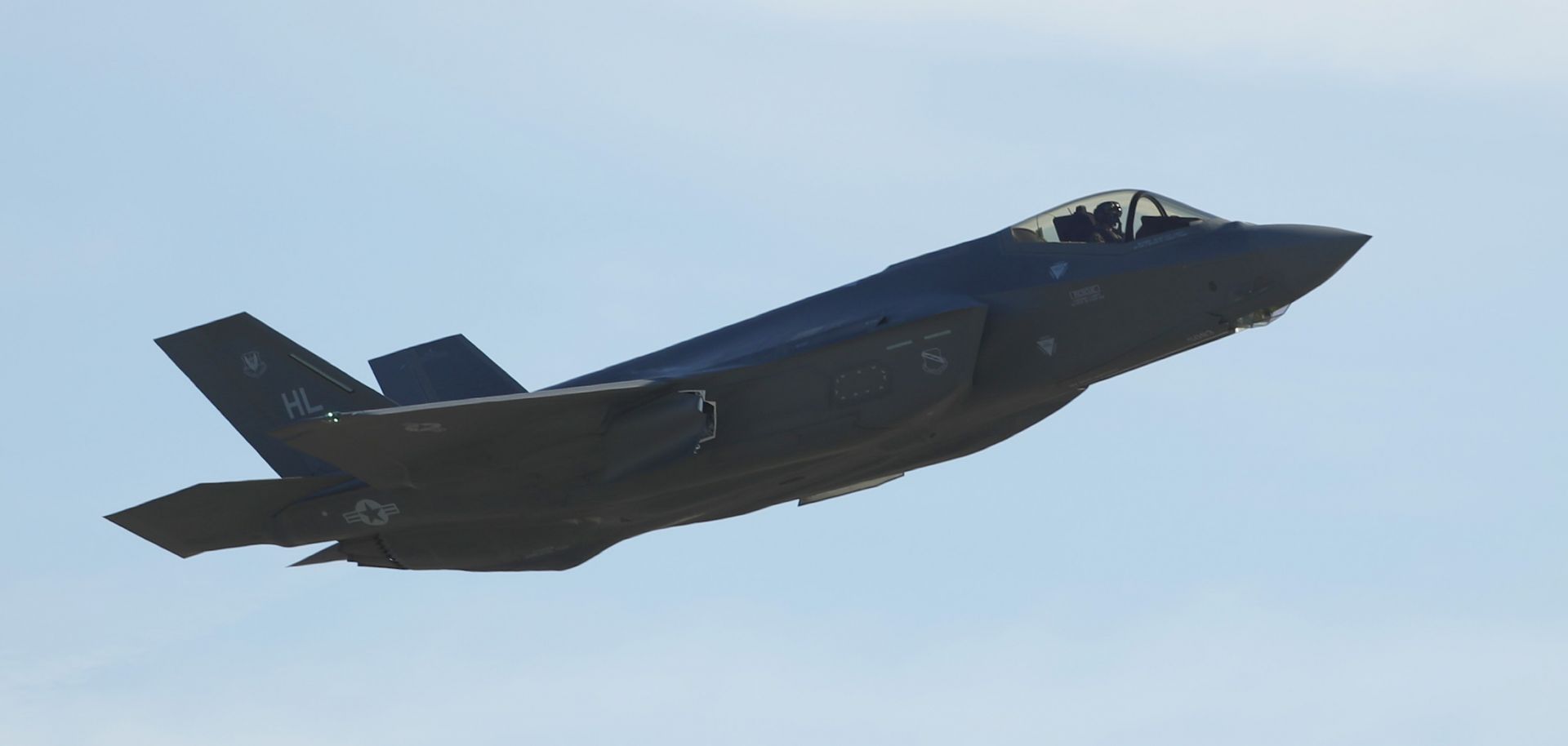
An F-35 fighter jet participates in a training mission at a U.S. military base in Ogden, Utah, on March 15, 2017.
A new U.S.-UAE arms deal will deepen Washington's defense ties with Abu Dhabi, complicating Russian and Chinese attempts to make further inroads in the wealthy Arab Gulf country. On Nov. 10, the administration of U.S. President Donald Trump formally notified Congress that it intends to sell $23 billion worth of arms to the United Arab Emirates. The deal includes 50 F-35 jets and 18 MQ-9 Reaper drones, as well as air-to-air and air-to-ground munitions.
Though the United Arab Emirates’ regional policies will face greater scrutiny under U.S. President-elect Joe Biden, the arms deal is still unlikely to collapse entirely once he takes office in January. Compared with Trump, Biden has been more critical of Arab Gulf states’ human rights records and regional behavior, which could affect future arms sales to the region. Biden’s transition team, however, has yet to indicate he would go so far as to withdraw from this particular arms deal with Abu Dhabi. But Biden may decide to alter the conditions of the deal as his administration works to shift away from Trump’s more transactional approach to the Middle East.
- The UAE arms deal can only be blocked during the lame-duck legislative session in Washington if both chambers of Congress object, which is unlikely given the Republican Party’s current control of the Senate.
- As part of its normalization deal with Abu Dhabi, Israel dropped its objections to advanced arms sales to the United Arab Emirates. Promises of future U.S. aid and a desire to reward Arab Gulf states who move to normalize their Israeli ties helped convince Israel’s leaders not to use their still-substantial influence in the U.S. Congress to upend the deal.
- Arms deals take considerable time to complete, meaning Biden will take over the process when he is inaugurated on Jan. 20.
The United States may use its leverage with advanced arms sales to deter the United Arab Emirates from purchasing weapons from China or Russia. But as Abu Dhabi continues its strategy of diversifying arms suppliers, the UAE government will likely test how far it can develop its defense relationships with Moscow and Beijing without serious U.S. repercussions. The United States’ disinterest in creating a crisis with Turkey over its purchase of Russia's S-400 missile system may embolden the United Arab Emirates to test how much it can diversify without direct consequence from Washington. For its part, the United States is also likely to continue seeking arms exports to bolster its politically and economically important defense companies.
- The United States is opposed to advanced Chinese and Russian arms sales to its key allies in the Middle East for fear that such sales will both weaken U.S. influence in the region and potentially give Moscow and Beijing a backdoor to spy on U.S. military technology.
- When Turkey accepted the delivery of Russia’s S-400 missile system in July 2019, Washington removed Turkey from its advanced F-35 program in retribution. But the Trump administration has delayed imposing wide sanctions on Ankara under the Countering America’s Adversaries Through Sanctions Act (CAATSA) as it attempts to negotiate a solution to the S-400 impasse.
