
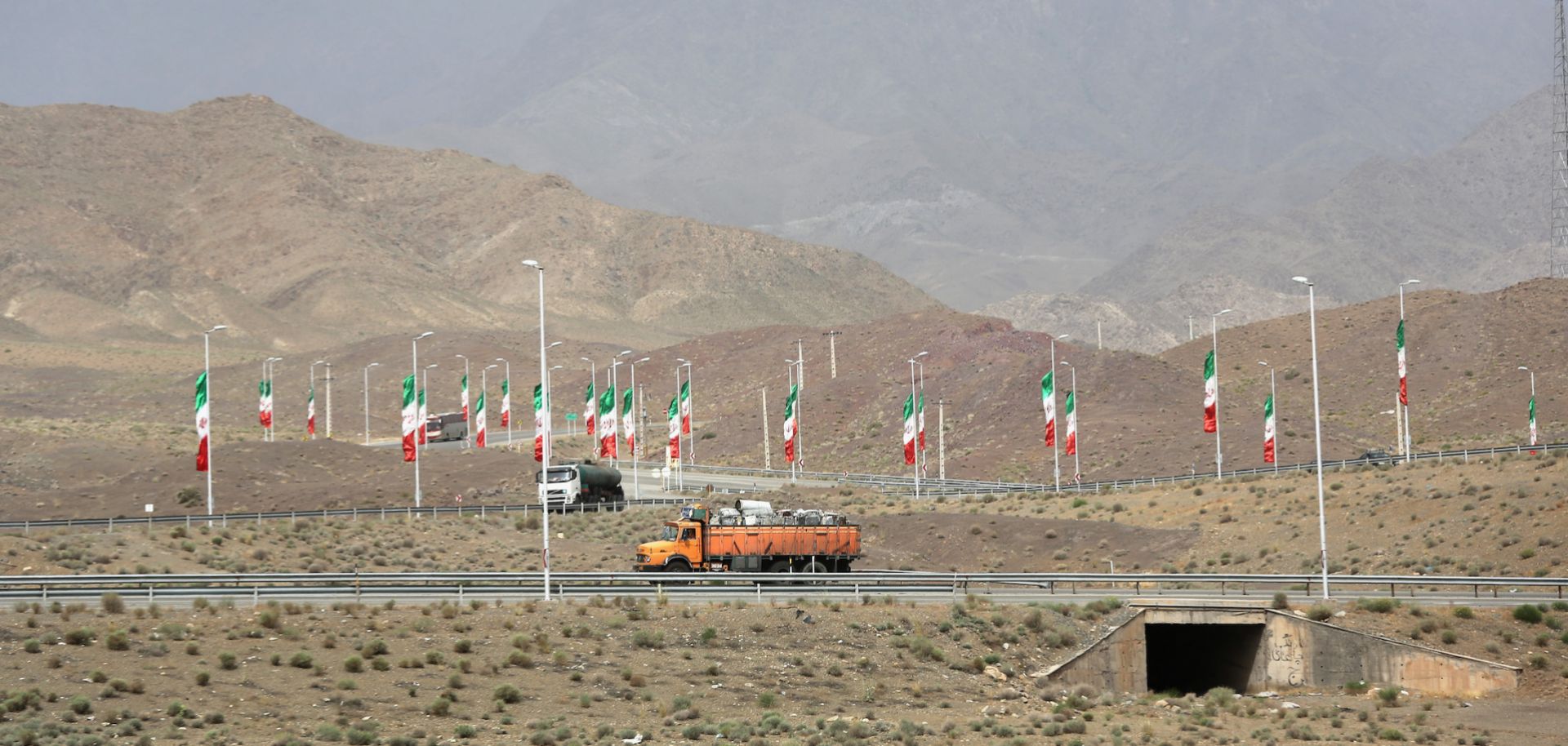
Iranian flags fly along a highway in Natanz in June 2014.
Iran’s need to secure sanctions relief in newly restarted nuclear talks will limit its response to the suspected Israeli attack on Iran’s Natanz facility. Any act of Iranian retaliation, however, will increase overall global scrutiny on the negotiations between Tehran and the West. Iran’s Natanz nuclear facility south of Tehran suffered an overnight electricity blackout early April 11 after an explosion reportedly destroyed the internal power system that supplies the underground centrifuges. The timing of the incident follows the first indirect diplomatic engagement between the United States and Iran in three years, and comes amid ongoing tit-for-tat maritime and regional escalations between Israel and Iran. This further indicates the incident was intentional sabotage, with the intent to disrupt Iran’s nuclear program progress, as well as potentially spoil talks between Iran and the P5+1 (the five permanent members of the U.N. Security Council plus Germany), which are set to continue in Vienna.
- On April 11, Israeli public broadcaster Kan suggested Israel’s Mossad was behind a cyberattack at the facility. The New York Times also cited reports from Israeli and U.S. intelligence sources that said the blackout resulted from a “deliberately planned explosion.”
- The April 11 incident occurred less than 24 hours after Iran began feeding gas to some of its new advanced centrifuges in celebration of the country’s “National Nuclear Technology Day.”
- The next round of Joint Comprehensive Plan of Action (JCPOA) joint commission and expert-level talks will take place April 14, after progress was made during two sessions between April 6-9 that marked the first indirect talks between the United States and Iran in three years.
If conducted without support from the United States and/or Gulf Cooperation Council (GCC), such an act of sabotage would indicate Israel’s sustained willingness to unilaterally act against Iran’s nuclear program to slow its development. Hitting Natanz’s power supply in a way that could shut down or limit the facility’s capacity is a significant tactical victory for Israel. Last week, Iran reported that it had amassed 55 kilograms (kg) of uranium enriched to 20%. Tehran also announced it was ahead of schedule in hitting its annual goal of making at least 120 kg of uranium refined to that level, as mandated in the new law passed by the Iranian parliament in December. In addition, Iran’s government has been playing up the increased daily and annual capacity of its separative work units (SWU) thanks to more advanced centrifuges. All of these developments shorten the timeline for Iran’s nuclear breakout, which Israel has every interest and intent to disrupt. Despite Iranian officials’ insistence that enrichment is “moving forward vigorously” after the power outage, the two unnamed U.S. and Israeli intelligence officials cited by The New York Times said the damage to the centrifuges was severe and would take nine months to rebuild, delaying Iran’s uranium enrichment progress.
- Israel has long been concerned about Iran’s advancements in its nuclear energy program. Between roughly 2006 and 2012, Israel was engaged in a campaign to degrade Iranian nuclear capabilities through a series of cyberattacks, covert operations and targeted assassinations of Iranian nuclear scientists. More recently, a June 2020 explosion at the Khojir missile complex and the subsequent July 2020 explosion and fire at Natanz were also broadly attributed to Israel.
Israel could also be seeking to spoil recent progress made in the newly restarted nuclear deal talks, especially given that Iran’s ongoing talks with the West raise the cost of any significant Iranian action. There’s a good chance that nascent JCPOA talks could yield a face-saving deal in the coming year that lifts sanctions for Iran in exchange for Iran returning to partial compliance. Israel likely hopes that the talks will restrain some of Iran’s ability to retaliate fully against Israel. But regardless of how receptive any talks are to Israeli security concerns, any future agreement that lifts sanctions on Iran will be construed by some within the Israeli government and security establishment as too lax. And anything that delays Iran’s nuclear breakout time will also be viewed as a national security victory in Tel Aviv, even if it is an act of sabotage that carries with it the risk of Iranian retaliation.
- The administration of U.S. President Joe Biden said the U.S. was not involved in the recent Natanz attack and had nothing to add regarding the speculative causes. This indicates the White House’s desire to distance itself from the incident prior to the potential start of formal talks with Iran. A policy of Israeli unilateral action could go against what the United States wants to achieve with Iran, as well as in the region more broadly.
Further incremental nuclear developments in Iran will occur regardless of Israeli actions until Tehran’s negotiations with the West yield a deal. Iran has already clearly communicated that it will rebuild any lost capacity from the Natanz incident. Incrementally developing its nuclear program is part of Tehran’s strategy to build up leverage that it can trade away in talks, like those beginning now. It also enables Iran to build up valuable technical knowledge in a strategic sector for its defense and national security, which it won’t give up no matter how great a threat Israel presents to the sector. It is thus unlikely that the latest incident will strongly impact what kind of nuclear concessions Iran offers in the nascent JCPOA talks.
- The head of Iran’s Atomic Energy Organization called the incident nuclear terrorism and the result of a deliberate attack. Iranian Foreign Minister Mohammad Javad Zarif also directly blamed Israel for the blackout, promising revenge and asserting that Iran will build back Natanz stronger than before.
Iran will be compelled to use its favored asymmetric tactics, including cyber warfare, to retaliate against the latest Israeli attack. But Iran’s response is likely to be pragmatic and calculated in order to retain global goodwill and sanctions relief amid growing international scrutiny on ongoing JCPOA talks. Cyberattacks, using militant proxies in areas like Syria that can put limited military pressure on Israel, and maritime harassment are possible tactics Iran has deployed before in its retaliation for attacks on its military, nuclear, or economic sovereignty. There’s also a possibility of Iranian covert attacks on Israeli diplomatic or commercial facilities outside of Israel. The need to retaliate is further intensified by the negative political optics of Israel having deep enough intelligence on Iran’s nuclear program to have conducted this kind of attack.
- The latest act of Israeli sabotage comes just before presidential elections in Iran, in which military-affiliated candidates will feature heavily. The incident is a particular political embarrassment for the Iranian entities charged with safeguarding Iranian intelligence and security like Iran’s Islamic Revolutionary Guard Corps, further underscoring the likelihood of limited retaliation.
