
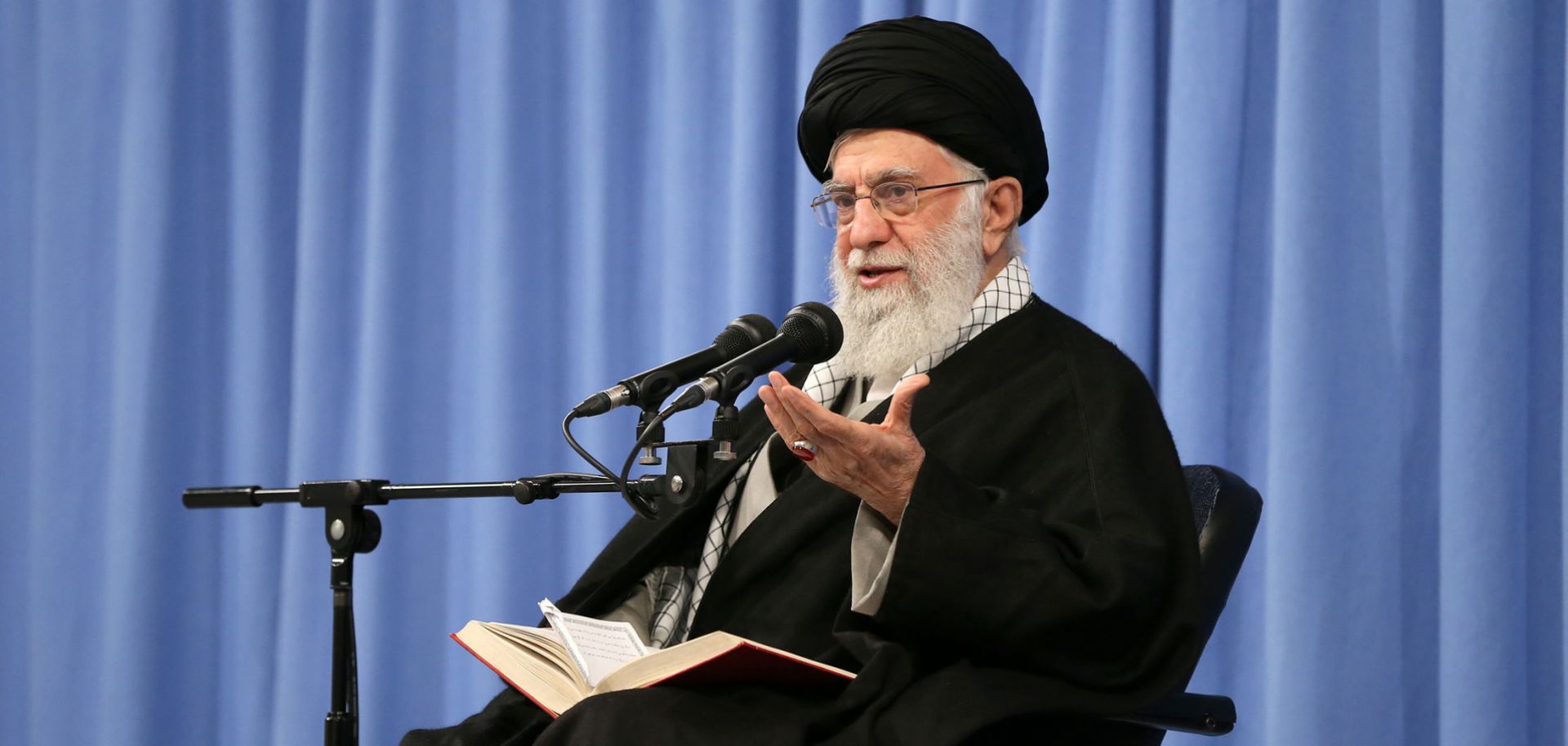
Iranian Supreme Leader Ayatollah Ali Khamenei speaks about the country's coronavirus outbreak and parliamentary elections in Tehran on Feb. 23, 2020.
Iran's parliamentary elections on Feb. 21 produced a conservative parliament that will support more hard-line policies against the United States. The new parliament will clash with the more moderate administration of President Hassan Rouhani over how tactically to manage the country's economy through the next and final year of Rouhani's term. But on a strategic level, regardless of the election results, Iran's government across the political spectrum is still aligned on the need to implement austere economic policies to help weather sanctions and to continue an aggressive foreign policy against the United States. The sanctions-burdened economy is negatively affecting the lives of Iranians; how it fares over the next year will determine the kind of conservative candidate — pragmatist, traditional, hard-line or populist — likely to win Iran's 2021 presidential election.
Election Results: Conservatives Dominate
Conservatives won at least 219 seats in Iran's 290-seat parliament. Their dominant performance leaves Iran's reformists and moderates weakened politically and foreshadows the pursuit of more conservative policies. Of the 170 candidates who ran for reelection, only 56 won; in other words, only about one-sixth of the members of the incoming parliament will have been part of the previous legislature.
Turnout was exceptionally low. Only 43 percent of voters participated, the lowest percentage since the Islamic republic was formed in 1979, and the turnout for Tehran — the largest district and the most important for gauging political sentiment among the powerful elite — was a mere 25.4 percent, which explains, in part, how conservatives won all 30 seats in Tehran. The coronavirus outbreak in the country shortly before the election likely dissuaded some Iranians from voting, but a lack of trust in the government or the electoral process, including the disqualification of many reformist and moderate candidates by the conservative Guardian Council, kept some Iranian voters at home. Disillusionment with the government will become more pronounced the more Iranians struggle with a flagging economy.
It's the Economy, Stupid
Iran's foreign policy is unlikely to change dramatically after last month's elections. The mostly unelected powers that lead Iran, including Supreme Leader Ayatollah Ali Khamenei, the Supreme National Security Council and the Islamic Revolutionary Guard Corps (IRGC), look upon the preferred strategy of the country's moderates, who are open to dealing with the United States through negotiations, with suspicion at this current juncture — a stance underscored by the disqualifications of reformist and moderate candidates. Their strategic priority means even less cooperation with the West, less willingness to hash out a new nuclear deal with the United States and even more aggressive nuclear development moves — policies the Iranian government is already leaning toward.
What has the potential to change is how Iran's government successfully or unsuccessfully deals with Iran's day-to-day economic and financial policies. Iranians, while concerned about sanctions emanating from the U.S. maximum pressure campaign, are arguably more concerned about bread and butter economic issues than about the strategic direction of the country's national security and foreign policy. Enduring high unemployment, a currency that is beginning to look more volatile, difficulty accessing goods and traveling freely are all related to heavy sanctions on Iran's economy. The worsening coronavirus outbreak will also undoubtedly negatively affect the already struggling economy by temporarily shutting down important trade and travel links and hampering domestic consumption and make it even more difficult for the Iranian government to attract and maintain the public's attention and trust.
It's important to pay attention to how this economic stress combines with the disillusionment reflected in the low turnout for last month's elections since Iran's parliamentary elections have a history of predicting the direction of the next government. Parliamentary elections in 2004 had low turnout, and the 2005 presidential election yielded Mahmoud Ahmadinejad, a populist conservative whose economic policies and heavy corruption eventually created discord between him and Khamenei and the conservative establishment.
The Decisions to Come
There are numerous showdowns to come over the next year between a conservative-led parliament and a more moderate administration led by Rouhani. One of the first is the struggle over the passage of the current fiscal year budget. Another (ongoing) battle is whether and how to push through legislation that would remove Iran from the blacklist of the Financial Action Task Force (FATF). On the same day Iran held parliamentary elections, the FATF reinstated financial countermeasures on Iran that will be harder to work around than some of the unilateral U.S. sanctions on Iran's financial sector and trade. A more conservative parliament, especially one with a significant number of hard-liners who don't support connecting Iran more deeply to the global financial system, is less likely to work on FATF-compliant legislation that would help remove Iran from the blacklist and is part of why an even more conservative parliament will make it harder for Iran to rehabilitate its strained ties with the global community, let alone the United States. The sanctions infrastructure and trade barriers the FATF blacklisting creates will especially be a problem to unravel in the long term once Iran is able to negotiate some sort of post-Joint Comprehensive Plan of Action nuclear deal with the West and tries to restart trade.
As the conservatives take power in parliament — the COVID-19 outbreak could hamper the timing on forming a governing coalition — the battle to watch in terms of how their policy will play out over the year is who will emerge as speaker of parliament. The decision can sometimes take place among the candidates in Tehran who yielded the most votes, and the top four are all conservative heavyweights: Mohammad Baqher Qalibaf, Mostafa Mirsalim, Morteza Aghatehrani and Elias Naderan.
As the candidate who won the most votes in Tehran, Qalibaf is a front-runner who would undoubtedly seek to use the speakership as a way to springboard into the presidential campaign. His rich political resume proves him to be a conservative, but not one who is unilaterally hard-line or unilaterally pragmatist. As mayor of Tehran, Qalibaf presided over popular economic development projects, but as police chief, he also presided over crackdowns on protesters. His close relationship with recently assassinated Iranian Gen. Qassem Soleimani is an indication of his support by some prominent voices within the IRGC. If he becomes speaker, Qalibaf can and will likely support a range of conservative policies — though nothing unilaterally hard-line, which will help conservatives in parliament deflect popular anger, especially after Rouhani is no longer in power in 2021 and can't be blamed for any unpopular economic and social policies. Popular anger about corruption and the floundering economy will fall on parliament eventually.
In the long term, a more conservative parliament for the next four years will also contribute to drawing new red lines in future negotiations with the United States. Iran's government is waiting until the U.S. presidential election in November to see whether a more Iran-friendly candidate wins, but in the long term, Iran's government knows it must negotiate with the United States in order to remove sanctions. A more conservative parliament will have harder red lines in those negotiations, ultimately spoiling the well between the United States and Iran for years to come.
