
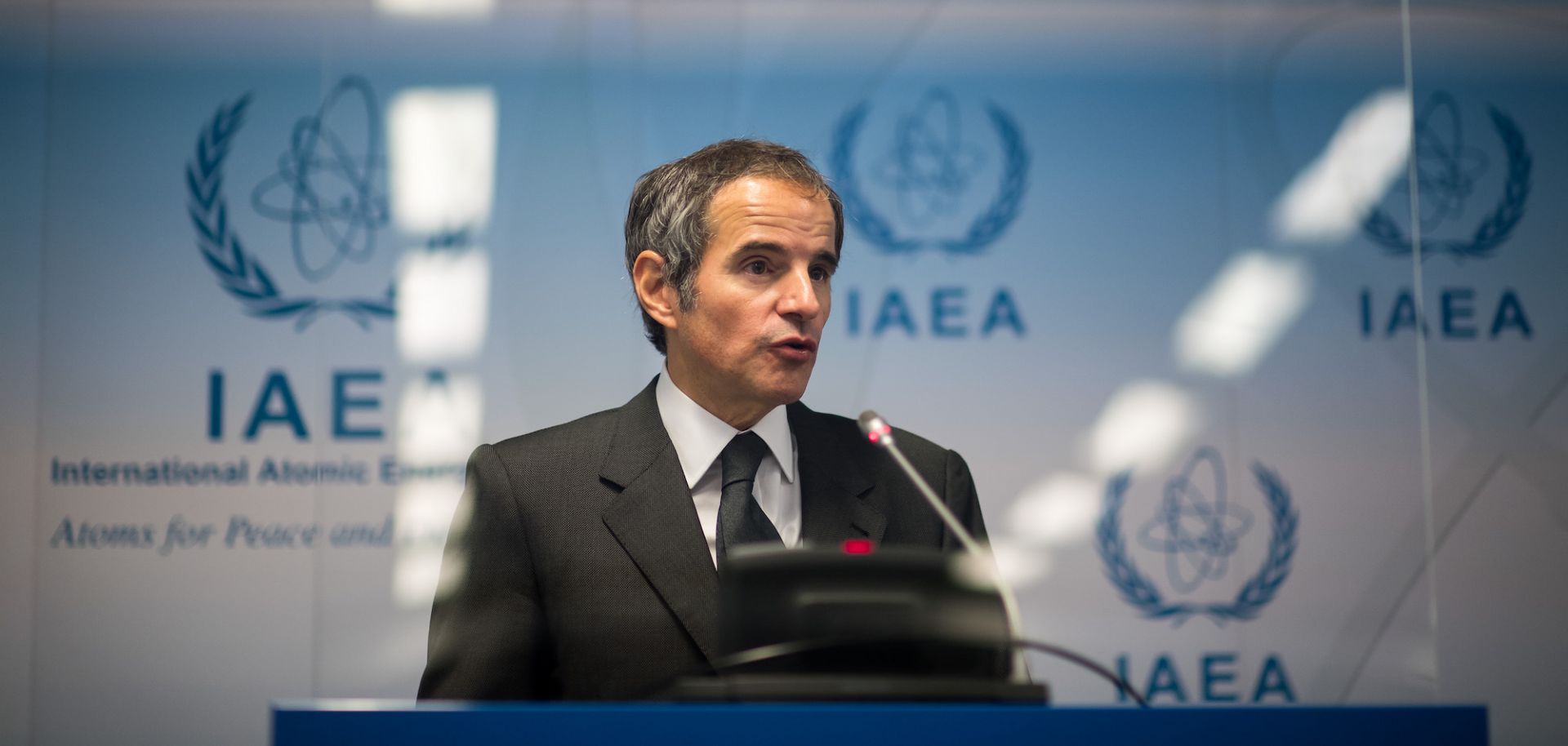
International Atomic Energy Agency (IAEA) Director Rafael Grossi holds a press conference about monitoring Iran's nuclear activities on May 24, 2021, in Vienna, Austria.
Iran’s stalled talks with the United States and hesitance to renew a temporary monitoring agreement with the International Atomic Energy Agency (IAEA) will raise the risk of Iranian action against Western interests, as well as the collapse of nuclear negotiations altogether. The seventh round of negotiations between Iran, the United States and other officials over resuming compliance with the 2015 nuclear deal will not be held in Vienna this week as originally planned, according to four unnamed officials cited in a June 30 Bloomberg report. The officials said that it was unclear when talks between Washington and Tehran would resume. On July 1, the Russian ambassador to the Vienna-based international organizations said that the parties involved in the talks needed more time before holding a new round of talks. When asked about the chances of revising the nuclear pact in a June 29 interview, U.S. Secretary of State Antony Blinken said he couldn’t tell whether the two sides would “succeed in overcoming their differences.” The freeze in U.S.-Iran talks comes after Tehran let a temporary agreement allowing U.N. inspectors to continue monitoring its nuclear activities expire on June 24 by failing to respond to the IAEA’s request for an extension.
Iran’s decision not to immediately extend the IAEA agreement appears to be a result of Tehran recalculating and debating its options internally amid the election of a new president and sluggish progress in U.S. talks. As expected, Iran’s conservative chief justice Ebrahim Raisi won the country’s June 18 presidential election. But now Iranian leaders may be divided on whether they should try to wrap up nuclear talks before Raisi takes office on Aug. 3, or (more concerning to the West) just string on negotiations indefinitely with little intention of conceding on their maximalist demands. Raisi has said he intends to continue talks with the United States and its allies. But for many of the more hard-line Iranian figures who back Raisi, the fact that Iran’s economy has withstood three years of Washington’s “maximum pressure” campaign suggests that Iran can withstand sanctions indefinitely and can thus afford to hold out in such talks.
A prolonged negotiation process will increase the probability of nuclear talks breaking down by allowing more time for potential spoiler incidents to arise. In Iran, the Islamic Revolutionary Guard Corps (IRGC) will have more space to operate and push for their own hard-line regional strategy. This includes potential maritime attacks against oil and gas infrastructure, as well as increased support to Iran-backed militias in Iraq and the Levant against the United States. An uptick in such Iranian provocations could lead to another dramatic escalation of events similar to those seen in December 2019-January 2020 after a rocket attack in Iraq necessitated a U.S. response by killing an American contractor. Moreover, the IRGC may try to limit the scope of any new ad hoc monitoring agreement with the IAEA, even if Tehran Iran finally commits to an extension.
The rising risk of U.S-Iran talks in Vienna failing will continue to compel Israel to sabotage and disrupt Iran’s nuclear and missile programs. Israel's action in the past has proven capable of adding difficulties to diplomacy between Iran and the United States. In December, Iran’s parliament passed a law that calls on the government to suspend its so-called “Additional Protocol” agreement with the IAEA, which allows U.N. inspectors to monitor Tehran’s nuclear program and visit its facilities, particularly with short notice. The law was a direct response to the assassination of an Iranian nuclear scientist, which was widely believed to be carried out by Israel’s intelligence agency Mossad. The suspension of the Additional Protocol necessitated the temporary ad hoc agreement between the IAEA and Iran, which is now at the center of the latest delay in talks.
