
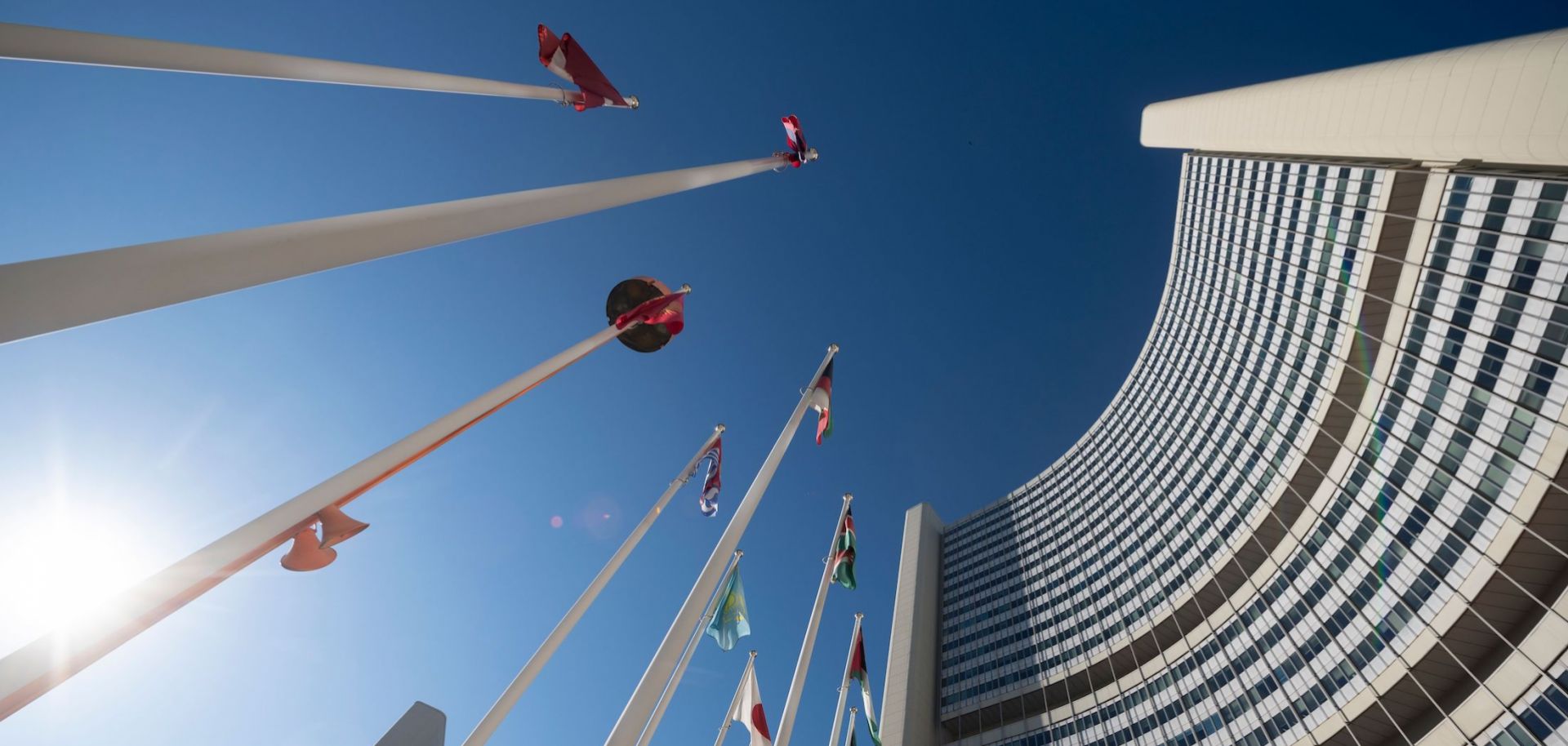
An outside view of the International Atomic Energy Agency (IAEA) headquarters is seen in Vienna, Austria, on Nov. 18, 2020.
Iran’s compromise with the International Atomic Energy Agency (IAEA) buys Tehran three more months to broach negotiations with the United States in the hopes of securing sanctions relief. During IAEA Director-General Rafael Grossi’s recent visit to Iran, the Atomic Energy Organization of Iran (AEOI) said it would stop the voluntary implementation of its so-called “Additional Protocol” on Feb. 23, a confidential agreement that allows U.N. inspectors to monitor Tehran’s nuclear program and visit its facilities, particularly with short notice. But the two sides also reached a compromise on verification and monitoring that will maintain limited IAEA access to nuclear sites.
- The AEOI has agreed to continue implementing the Comprehensive Safeguards Agreement (which allows some nuclear site inspections). The IAEA, meanwhile, will also continue its “necessary verification and monitoring activities for up to three months.” The AEOI clarified that it will retain information and data of the inspected nuclear facilities and equipment for up to three months and will share this information with the IAEA if sanctions are lifted; if not, the data will be destroyed.
- The temporary arrangement was expected and had been telegraphed for weeks, with Iranian Foreign Minister Mohammad Javad Zarif repeatedly stressing that the suspension of the Additional Protocol did not mean that Tehran planned to fully restrict the IAEA’s access to inspections.
- Grossi’s comments on the compromise deal downplayed concerns about IAEA access in the short term. This is a notable sign of positive cooperation with Iran, as Grossi was previously seen as a hardliner on Iran.
Iran’s planned suspension of the Additional Protocol walks back some voluntary compliance with the Joint Comprehensive Plan of Action (JCPOA) nuclear deal, which is required under a new Iranian law. The Additional Protocol is a key part of the JCPOA, giving the IAEA increased access to Iranian nuclear facilities. Its suspension means less visibility into Iranian nuclear activities.
- The Iranian parliament passed a law in December 2020 requiring the AEOI to create leverage for sanctions relief by reducing its commitments to the 2015 nuclear deal. One article of the law requires ending the implementation of the Additional Protocol, which includes ending the IAEA’s right to request snap inspections at certain nuclear facilities.
- The law, as worded, was ambiguous enough to allow for the recent IAEA compromise, which could see further extensions if U.S.-Iran negotiations make progress.
The temporary compromise with the IAEA will grant the Iranian government several more months to pursue diplomacy with the United States at a time when the White House is signaling it’s open to talks. The compromise will also help Iran maintain diplomatic goodwill with the European Union and the rest of the global community, avoiding additional sanctions for steadily advancing its nuclear program in accordance with the new law. Iran and the United States, however, remain at odds over who should make the first move in returning to compliance with the JCPOA.
- The United States has demanded that Iran resume compliance with the JCPOA before it offers sanctions relief. Tehran, however, has argued that Washington must first lift sanctions before it scales back its nuclear activity.
- On Feb. 18, U.S. State Department spokesperson Ned Price said the United States “would accept an invitation” from the European Union to meet with Iran in the P5+1 format (the five permanent members of the U.N. Security Council plus Germany) to discuss Iran’s nuclear program.
- According to a Feb. 22 statement released by Iran’s central bank, Iran and South Korea reached an agreement about a partial unfreezing of Iranian assets in South Korea. Few details on the deal, however, have been released. And such an unfreezing would only be possible with U.S. tacit approval.
- Unlocking Iranian access to International Monetary Fund financing would also only be possible with tacit U.S. approval, and is rumored to be in the works.
Increasing parliamentary pressure on Iranian President Hassan Rouhani and his moderate, negotiation-friendly allies, potentially including calls for impeachment, will hinder his government’s ability to reach a quick deal with the United States. The temporary IAEA agreement adheres to the new Iranian law to ramp up nuclear activity. But conservative lawmakers and politicians are still upset at the Rouhani government for compromising with the IAEA after what they view as years of bending to Western demands with little to show for it. Occupying his traditional role as arbiter, Iranian Supreme Leader Ayatollah Ali Khamenei will have to intervene if parliamentary pushback against Rouhani’s administration — including potentially calls for impeachment — reaches destabilizing levels, especially in the lead-up to June presidential elections.
- On Feb. 22, 221 Iranian lawmakers voted for a motion of complaint to the judiciary over the three-month verification deal with the IAEA. Iranian parliament speaker Mohammad Bagher Qalibaf also tweeted that lawmakers must approve any additional cooperation with the IAEA.
