
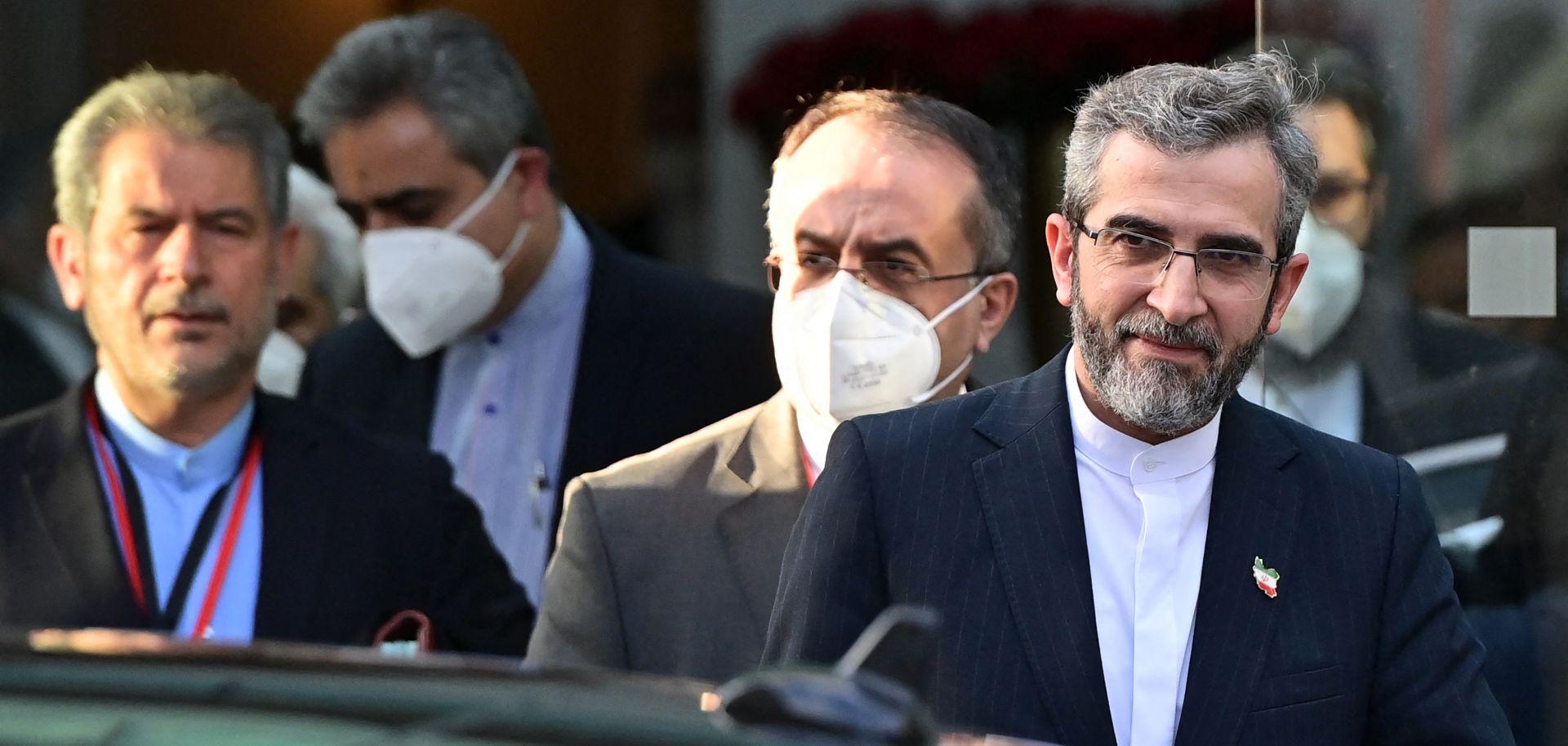
Iran's chief nuclear negotiator Ali Bagheri Kani (right) and members of his delegation are seen leaving the venue of the Joint Comprehensive Plan of Action (JCPOA) talks in Vienna, Austria, on Dec. 3, 2021.
The lack of progress in resumed Iran nuclear talks shows that the potential for negotiations collapsing without a deal is steadily increasing under Tehran’s more hard-line president. U.S., Iranian and European negotiators met in Vienna on Dec. 9 for what was their eighth round of nuclear talks this year and the second round since Iranian President Ebrahim Raisi took office in August. The seventh round of negotiations to restore the 2015 deal, known as the Joint Comprehensive Plan of Action (JCPOA), concluded last week with Iran submitting draft demands adjusting what it agreed to during the previous six rounds of 2021 talks.
- JCPOA talks resumed in Vienna on Nov. 29 after a five-month hiatus. Negotiations were put on hold in June under the assumption they would resume once Iran held elections and Raisi’s administration took office on Aug. 5.
After the five-month hiatus between the sixth and seventh round of talks, Iran came to the table with higher expectations and tougher demands, which will increase tensions with U.S. and European negotiators and limit room for a consensus. Iran’s negotiating team is made up of more conservatives and hard-liners compared with the previous team. This new delegation has pushed for bolder concessions and demands, including:
- Reduced limits on nuclear enrichment. Iran wants to maintain more of its advanced centrifuges than it said it would in JCPOA talks held earlier this year, before Raisi took office. Western negotiators will remain wary to agree to this as it’d enable Iran to quickly build back its stockpile of enriched uranium for a potential nuclear arsenal if the deal falls apart again.
- The removal of more U.S. sanctions. Iran now also wants the United States to remove all sanctions imposed since the signing of the JCPOA in 2015 before agreeing to return to compliance with the nuclear deal. Previously, Tehran had only demanded the removal of JCPOA-linked sanctions.
- Assurances that the U.S. won’t back out of a deal again. Iran has demanded the United States ensure that future White House administrations will not be able to alter or abandon the nuclear deal — something current U.S. President Joe Biden has no way of guaranteeing.
The Iranian government is showing its willingness to trade some domestic economic strain for an optimal deal. Iranian negotiators appear in no hurry to reach an agreement and have sought to rehash previously discussed issues in the two latest rounds of JCPOA talks. The Iranian economy is not prospering, but the Iranian government has seemingly calculated that it can hold out for some time under current sanctions in order to secure a more favorable nuclear deal. This lack of urgency from Tehran has frustrated Western negotiators, who want to ink a deal quickly to avoid the possibility of Iranian nuclear breakout.
- Iran continues to battle rising inflation, which is now about 45%. Consumer prices in the country, however, were high before Raisi took office. The government has likely calculated that, at this point, Iranians have adjusted to the daily reality of inflated prices and that more of the same economic malaise is less likely to spur destabilizing social unrest.
- Some Iranian exports, particularly steel, have also increased in recent months, which could be granting the Iranian government some confidence regarding the country’s economic recovery, even amid sanctions pressure.
With few other leverage points, the U.S. government will continue to increase sanctions on Iran in the hopes of coercing Tehran to stand down on its more hard-line negotiating position. Washington signaled this week that it will tighten the screws on sanctions enforcement in Iran’s key trade partners like the United Arab Emirates. This indicates the United States intends to increase existing sanctions pressure as Iran continues to raise the stakes of nuclear non-compliance. But it also shows the limitations of the U.S. camp’s negotiating leverage as more aggressive moves — like imposing new U.S. sanctions or conducting an overt cyberattack targeting Iran’s nuclear developments — would risk pushing Tehran to abandon talks altogether.
- The United States is sending a delegation of senior officials to the United Arab Emirates next week to discuss Iran sanctions compliance with private Emirati firms and banks. As nuclear talks stall, Washington could also send similar delegations to other countries that do business with Iran, like Malaysia and Turkey, to remind firms of the risk they face by not adhering to existing U.S. sanctions on Tehran.
A limited deal remains the most likely outcome of JCPOA negotiations, but the increasingly tough negotiating environment is increasing the risk of talks collapsing. Iran still wants to access frozen funds and lift sanctions, and the West still wants to slow down Tehran’s nuclear development. An agreement that sees the United States unfreezing some Iranian assets or lifting JCPOA sanctions in exchange for Iran halting the development of its nuclear program is thus still possible. But the collapse of negotiations is also becoming an increasing possibility amid the growing gap between Tehran’s demands and what Western negotiators are willing to accept. The risk of regional conflict, particularly between Israel and Iran, will increase if talks collapse and leave Tehran free to continue advancing its nuclear program. Non-Western powers, meanwhile — particularly Russia and China — may be forced to increase their own diplomacy with Tehran if they want to see the country return to compliance with the JCPOA.
