
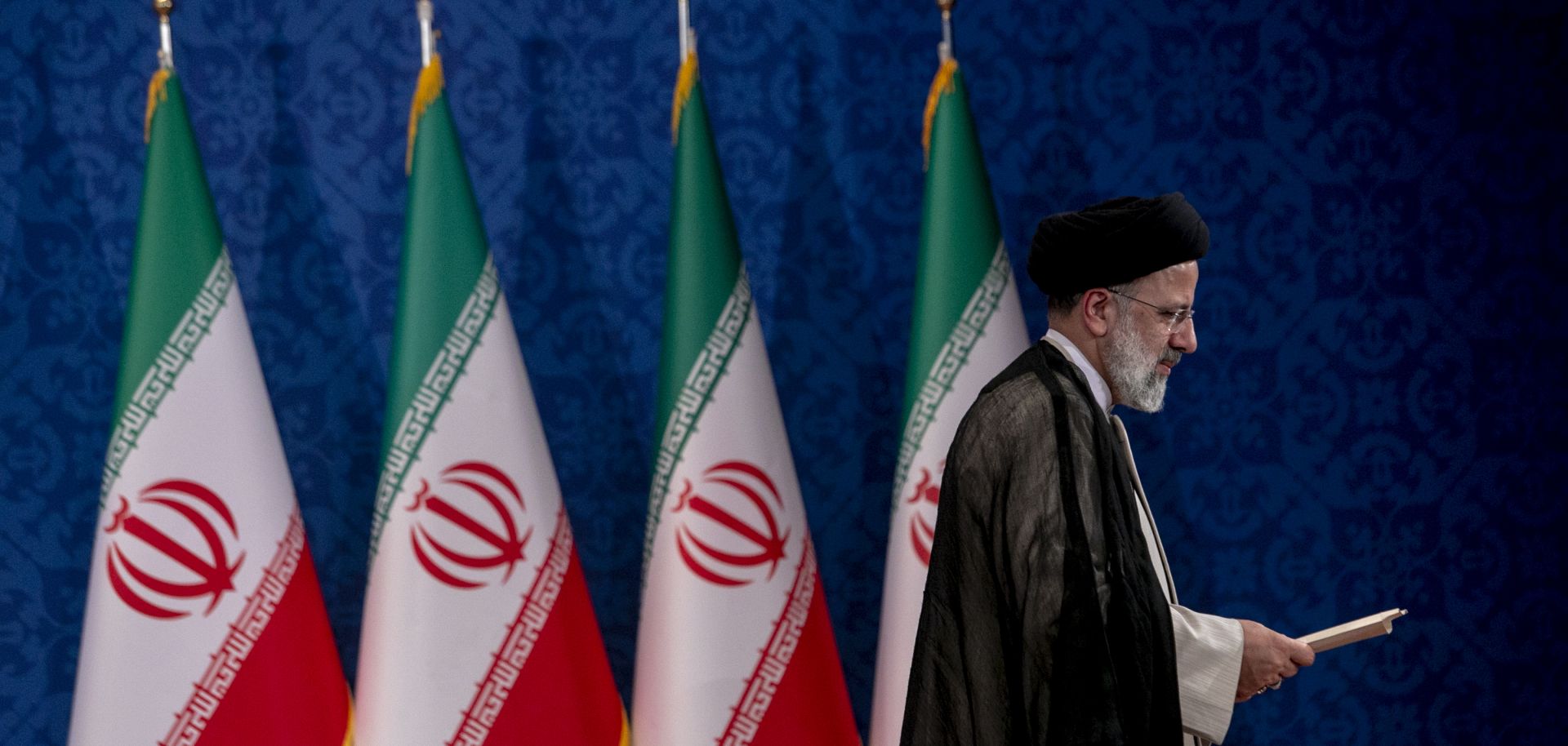
Ebrahim Raisi holds a press conference in Tehran on June 21, 2021, after winning Iran's presidential election.
A set date to restart nuclear talks increases the likelihood of the United States and Iran restoring compliance with their 2015 deal, known as the Joint Comprehensive Plan of Action (JCPOA). But a lengthy negotiation process will see Tehran continue its nuclear advancements and aggressive regional behavior. According to a Nov. 3 tweet from Iran’s chief negotiator Ali Bagheri, JCPOA talks in Vienna will resume Nov. 29. One of Russia’s key negotiators in Vienna confirmed Bagheri’s announcement in a separate tweet shortly thereafter.
- Between April and June, the JCPOA Joint Commission met in Vienna 10 times and held six official rounds of talks. Nuclear negotiations were then put on hold under the assumption they would resume once Iran held elections and Iranian President Ebrahim Raisi’s new administration took office on Aug. 5.
Iran’s push to rehash previous talking points could prolong and complicate negotiations, even as Tehran is motivated to ink a deal that secures sanctions relief. President Raisi’s new administration — which is more hard-line than that of his predecessor, Hassan Rouhani — is likely calculating that the Iranian economy can continue to withstand sanctions pressure during a prolonged negotiation process. The United States and the members of the JCPOA Joint Commission have pushed for resuming talks where they left off in June. But under Raisi, Iran’s government has hinted that they plan to revisit some key sticking points, including over how the United States and Iran sequence nuclear concessions and sanctions relief. In October, specifically, Iranian Foreign Minister Hossein Amirabdollahian said Tehran accepted “the format of Vienna talks” but did not “want to return to negotiations from the point of an impasse” — indicating a desire to resume negotiations at a different point than where they left off, which Tehran viewed as an impasse. This divergence on where talks should pick back up not only bodes ill for the United States and Iran to reach a quick compromise, but also keeps the threat alive of negotiations collapsing altogether.
- Iran’s main goal in nuclear talks is securing sanctions relief and boosting its economy without U.S. interference. In recent months, Iran’s foreign minister has requested that the United States unfreeze $10 billion in assets as a show of good faith in negotiations.
- Several key issues were left unresolved when JCPOA talks stopped in June, including Iranian nuclear advancements that had taken place since the JCPOA was signed in 2015, assurances that the United States would allow financial transactions upon lifting sanctions on Iran, Iran’s demand for financial compensation from sanctions damage on its economy, and U.S. demands for talks with Iran on non-nuclear issues.
Iran is still likely to continue its asymmetric actions throughout talks to maintain leverage and its regional position. The resumption of JCPOA negotiations will mitigate the risk of overt, serious conflict between Iran and the United States or Arab Gulf states, especially if talks start nearing toward a deal. But it won’t change Iran’s national security prerogatives, desire to maintain a strong regional position, and the need to maintain leverage in negotiations. Much of Tehran’s behavior in the Middle East will thus continue — whether that be harassing vessels transiting the Persian Gulf or Sea of Oman, or supporting various proxies in places like Iraq and Lebanon. Restarting talks in Vienna is also unlikely to keep Iran from incrementally advancing its nuclear program — compelled by both a law passed in December that requires Tehran to reduce its JCPOA commitments, as well as the calculus of a more hard-line government less willing to offer concessions on its nuclear activity.
- Iran views advancing its nuclear program as vital to its national security and economic development, in addition to serving a key role in Tehran’s asymmetric pressure campaign against the United States, Israel and their regional allies.
- Advancements that concern the International Atomic Energy Agency (IAEA), including the development of enriched uranium past a certain percentage, will factor into JCPOA negotiations when they resume later this month.
- Iran’s continued nuclear developments will also maintain its mostly covert conflict with Israel, perpetuating regional instability.
