
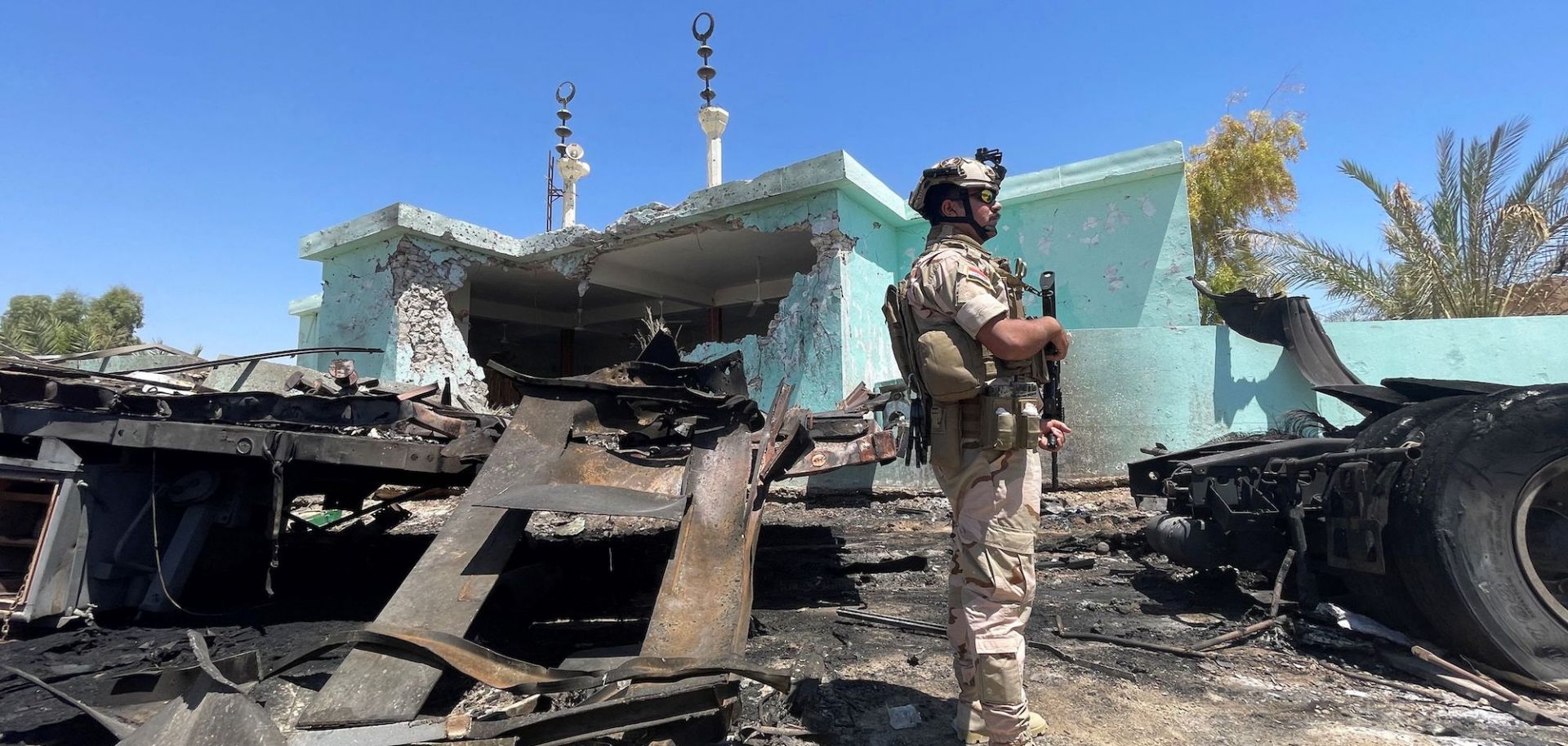
A member of the Iraqi security forces stands by a destroyed vehicle on July 8, 2021, after rockets landed on the Ain al-Asad airbase in Iraq’s western Anbar province, which hosts U.S. troops.
A series of clashes with Iran-backed militias in Syria and Iraq is increasing pressure on the United States to draw down from both countries, while raising the risk of a greater military escalation with Tehran. Iranian-backed militia launched a series of attacks on U.S. targets in Syria and Iraq on July 7, with at least 14 rockets striking the Ain al-Asad airbase in Western Iraq and lightly wounding two U.S. troops. Militia also fired two rockets at the U.S. embassy in Baghdad, causing no damage. In neighboring Syria, a drone attacked near the U.S.-protected Al Omar oil field on the northern side of the Euphrates River. The day before, on July 6, a drone attacked the Erbil airport in Iraqi Kurdistan, which houses U.S. troops, causing no damage. These attacks come as Iranian-backed militias in Kataib Hezbollah and Kataib Sayyid al Shuhada swore retaliation after the United States launched airstrikes near the Iraq-Syria border against infrastructure and storage facilities, killing four militiamen.
The exchanges are likely to continue as Iran-backed militias attempt to pressure the United States to draw down or withdraw, and as the White House attempts to establish a stronger deterrence against their attacks. The administration of U.S. President Joe Biden signaled it will launch airstrikes in reaction to harassment that doesn’t necessarily result in U.S. casualties by striking targets after relatively harmless militia strikes. This is a shift from its predecessor’s posture, which tended to focus on retaliating against actions that caused harm to U.S. personnel. The Biden administration, however, will still seek to avoid a major military escalation by striking a limited set of targets in Iraq and/or eastern Syria. Meanwhile, Iranian-linked militias will likely continue their attacks on U.S. forces, as indicated on June 14 when the leader of Asaib Ahl al Haq said the militias had resumed their resistance against U.S. forces after a pause from April. These attacks, however, will be metered as well to avoid a major military escalation.
Continued fighting will produce criticism of the U.S. military presence in Iraq and Syria in both Washington and Baghdad, while also leaving open the potential for an unintentional major escalation spurred by significant casualties on either side. The June 27 U.S. airstrikes attacks produced criticism from U.S. politicians over America’s long military presence in both countries. They also angered Iraqi politicians, who argued the attacks violated Iraqi sovereignty. Additionally, if the United States or militias cause substantial harm to one another, either by killing large numbers of opposing forces or by harming more senior officials, the two sides could be pulled into a more significant military escalation as they seek to enact revenge and establish deterrence.
- The Biden administration is under public pressure to refrain from military involvement and even withdraw U.S. forces from the Middle East. During his 2020 presidential campaign, Biden pledged to reduce forces to a small number of troops in the region largely to focus on the Islamic State in Syria and Iraq and to monitor the Persian Gulf.
