
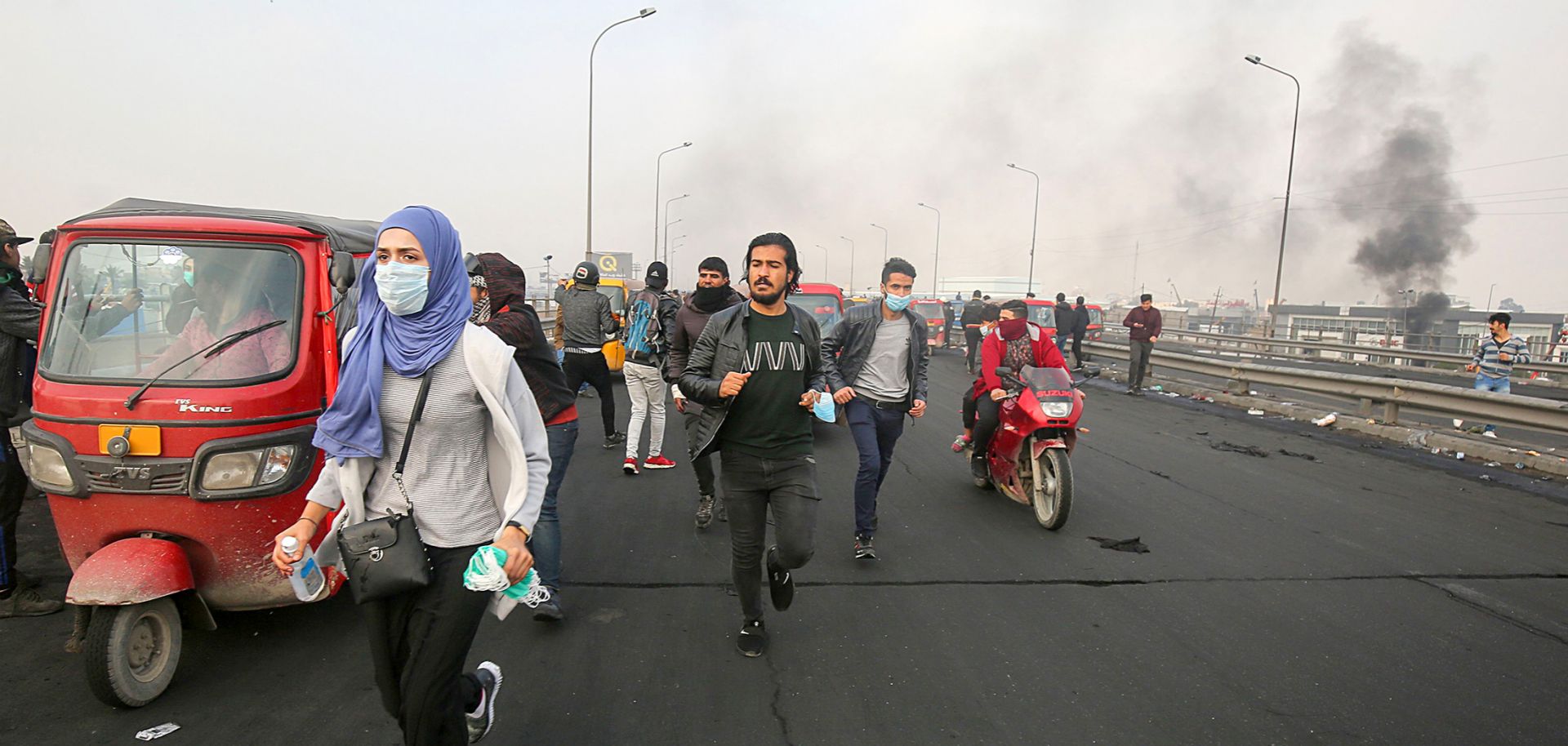
Protesters run for cover on a highway in Baghdad during a Jan. 23 anti-government demonstration. Amid escalating political unrest, the Iraqi government will struggle to keep the country's armed militias from conducting an attack that pushes the United States and Iran toward war.
In Iraq, a mix of violent militias and volatile politics could provide the spark that sends Iran and the United States spiraling into an armed conflict — and with it, any remaining shreds of stability in Baghdad. In June, the United States declared that the killing of any U.S. military personnel and other American citizens in Iraq would warrant retaliation. Washington then proved its willingness to enforce that red line in a series of raids and strikes following a rocket attack that killed an American contractor in December.
In the aftermath of the Jan. 3 assassination of Iranian Gen. Qassem Soleimani, it can be argued that a potential trigger for a full conflict between the two countries was narrowly avoided when an Iranian counterstrike with ballistic missiles didn't kill any U.S. troops in Iraq. But there is no guarantee that a follow-up round of clashes arising from another deadly attack wouldn't push the two countries back to the brink. And indeed — rife with militias, weapons and unrest — Iraq offers the perfect site for such a scenario to unfold in the months ahead.
Setting the Scene
The fact that both Iran and the United States are prepared to use violent action against each other following the recent surge in tensions is further inflamed by the nature of the Iraqi theater itself. Iraq remains highly unstable and awash with weaponry, with the Iraqi government unable to exercise its will on the vast array of disparate militias operating in the country. Of the dozens of militias in Iraq that don't fall under direct state control, there are three broad factions: those closely allied with Iran, those closely allied with Shiite leader Muqtada al-Sadr and those under the leadership of the more mainline Shiite clerical authorities in the holy Shiite cities of Najaf and Karbala. All of these militias are all largely comprised of Shiite Iraqi fighters. Many also assisted and worked alongside Iraqi federal forces and, in some cases, even U.S.-led coalition forces to fight the Islamic State. And while none fall directly under the state's command and control, most Iraqi militias also fall under an umbrella organization, the Popular Mobilization Units (PMU), which has become a formal component of the Iraqi state's security forces.
While the Iran-allied militias logically fall the closest under Tehran's command and control, they remain independent actors. This distance provides Iran some plausible deniability about its culpability when an armed group attacks a U.S. or civilian target in Iraq. But the United States is increasingly willing to directly blame Iran even when a proxy group is the culprit of an attack, which could prompt retaliatory attacks from militias and spark a cycle of escalation. Already, U.S. forces in Iraq are increasingly targeting heavyweight Iranian proxies such as Kataeb Hezbollah and Asaib Ahl al-Haq. Shortly after the assassination of Soleimani, Iran hosted a series of meetings with Iraqi militia leaders. And as this U.S.-Iran pressure intensifies, there will be more efforts between Tehran and its Iraqi proxies to coordinate retaliation against the United States.
But of the plethora of armed groups in Iraq, many are also already hostile to U.S. troops in the country without necessarily being loyal to Iran. This means that some Iraqi militia forces — regardless of whether they're closely allied with Tehran — have both the motivation and the means for further mortar, rocket or improvised explosive device attacks on nearby U.S. forces. So while it's often assumed that most of the militia attacks on U.S. forces in Iraq are somehow tied back to Iran (including the latest attack on the U.S. Embassy on Jan. 26), a strike that results in U.S. casualties could thus also conceivably originate from different armed factions on the ground, only to be misconstrued by Washington as an Iranian-led or -directed operation.
Enduring Iraqi Instability
The intensifying competition between various militia groups, as well as Baghdad's long-standing inability to exert command and control over any of them, further deepens the likelihood of greater overall instability in Iraq. In the same airstrike that killed Soleimani on Jan. 3, the United States also killed the prominent Iran-allied militia leader, Abu Mahdi al-Muhandis. A powerful consolidator, al-Muhandis was increasingly the center of gravity within the PMU umbrella organization. His absence will thus eventually open up space for even greater competition among Iraqi militias, further weakening what little control Baghdad had over the country's militias as they jockey for more power. This will increase the risk for violence, inhibiting cooperation between external actors such as the United States and Iraq's central government and federal security forces on counterterrorism operations.
Compounding this chaos for Baghdad is also an emboldened anti-government, nationalist protest movement that has been demanding government reforms since October. There already have been violent crackdowns by federal security forces on protesters, who managed to prompt the resignation of former Prime Minister Adel Abdul-Mahdi in November. And the unrest is likely to intensify as different political factions in Iraq attempt to manipulate the movement, including the one led by al-Sadr.
Al-Sadr's recent decision to switch from supporting the protests to opposing the movement reflects his desire to maintain his political power, which over the years has grown in tandem with the central government's weakening authority. The move also appears to show some coordination between al-Sadr, Iran-allied militias and the federal government who otherwise have fundamentally opposing visions for Iraq's political future. Rather than a larger political alignment, however, al-Sadr's decision to reverse his position is more reflective of a shared desire among Iraq's political elites to avoid disrupting a status quo that has allowed them to flourish in Baghdad. But the appearance of a more coordinated front against the anti-government movement is likely only to inflame protesters' frustration with the powers that be in Iraq — raising the risk for even more unrest and, in turn, more destabilizing crackdowns in the near term.
Amid the recent surge of tensions between Washington and Tehran, there remains a fair chance that the red line of U.S. casualties will be crossed in the coming months. And with even less control over both its armed militia groups and angry citizens, there's little the Iraqi government will be able to do to keep a bloody proxy war from breaking out on its turf. Iraq — as an activated front between Iran and the United States — will, therefore, remain one of the likeliest flashpoints for another confrontation for the foreseeable future.
