
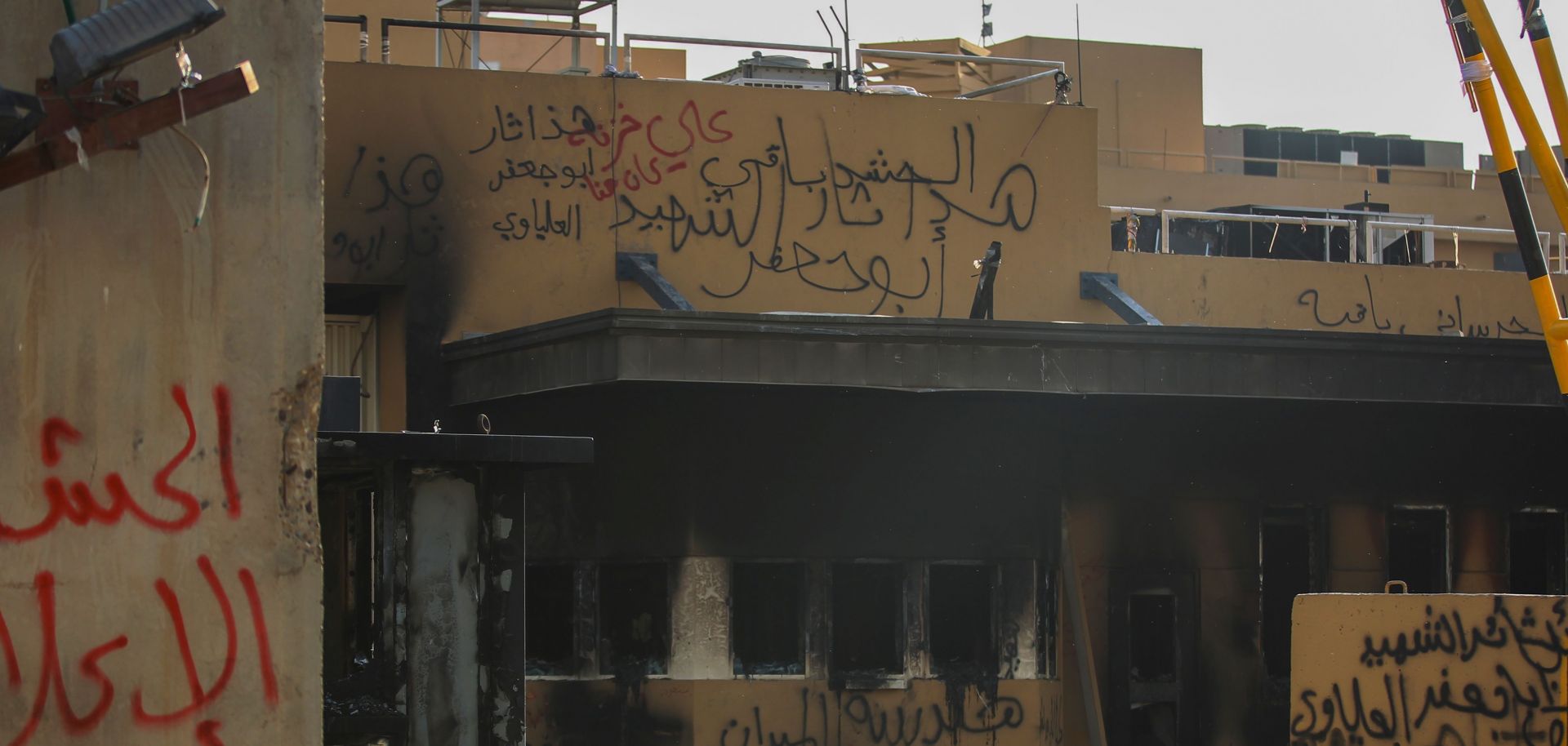
The U.S. Embassy in Baghdad is seen on Jan. 2, 2020, following an attack on the facility. If Iraq pushes U.S. troops to leave, the country will find itself in America's economic crosshairs.
For companies active in Iraq, threats to physical security — whether from a possible military conflict between the United States and Iran, militia violence or a resurgent Islamic State — aren't the only thing they need to worry about. That's because dark economic times could also be on the way, especially as U.S. President Donald Trump has threatened to enact sanctions on Iraq if Baghdad continues to push for a withdrawal of U.S. forces in Iraq following the U.S. assassination of Qassem Soleimani. If Baghdad pushes U.S. forces out, the aftermath, bluntly speaking, will be messy. Given that bilateral diplomatic relations inevitably would take a nosedive in such a situation, the United States would most likely impose punishing sanctions on Iraq. And even if such measures don't come to pass, the United States' campaign of maximum pressure on Iran will certainly leave Iraq worse for wear as well.
Below are some of the actions — some more likely than others — that the United States could take against Iraq amid its larger battle with Iran.
Most Likely: Tighten Enforcement of Existing Sanctions
On Jan. 10, the United States announced new sanctions on Iran's metal, construction, mining and textile sectors; beyond this, though, there is little that Washington can target to ratchet up the economic pressure on Iran. Accordingly, the next wave of pressure is likely to focus on tightening the enforcement of existing sanctions on Iran — something that could place a lot more scrutiny on Iraq's significant economic connections to Iran. Regardless of whether circumstances push U.S. forces out of Iraq, more Iraqi companies and financial institutions that work with Iran are likely to become the target of U.S. sanctions, meaning they could lose access to the international financial system. Ultimately, the United States' intent is not so much to compel Iraq's companies and banks to take a harder line on Iran but to force Iraqi firms to sever their own ties with their eastern neighbor for their own economic and security interests.
So far, the United States has not enforced its sanctions on Iraq to the fullest extent over fears about the economic and political repercussions. Washington, however, could try to shape Baghdad's decisions by taking action on waivers that allow Iraq to continue buying Iranian electricity and natural gas for power generation. With the waivers set to end next month, the United States could threaten to end them or only renew them under specific conditions.
Very Likely: Widen Sanctions on Militias and Iranian-Linked Politicians
Over the past year, the United States has substantially increased its sanctions on Iranian-backed militias in Iraq. Most recently, it announced on Jan. 3 that it was implementing new sanctions on Asaib Ahl al-Haq leader Qais al-Khazali, although it is likely to extend such measures to other groups and their leaders. At the same time, the United States could legally designate more groups and entities as foreign terrorist organizations, further circumscribing their activity and creating more of a legal basis for drone strikes.
After that, the United States could consider sanctions on Iraqi political entities linked to Iran — a line of action that would become far more likely if U.S. troops are forced out of Iraq. Unsurprisingly, the targets would likely be those pushing for the United States' expulsion, including Hadi al-Amiri, the head of the Fatah political bloc, one of the largest in Iraq's parliament, and the Badr Organization militia. As it is, U.S. Secretary of State Mike Pompeo accused al-Amiri of being an Iranian proxy following his appearance at protests outside the U.S. Embassy in Baghdad on Dec. 31. A move against al-Amiri would be particularly incendiary, driving retaliation against the United States.
Possible: Limited Economic Sanctions
Economic sanctions on Iraq are possible, but likely only in the event that Iraq continues to push U.S. forces to leave. One of the first things that Washington could cut is financial support to Baghdad. The United States supports Iraq in a number of ways, providing foreign, security and other aid. Washington allocated $451 million in assistance for Iraq in the 2019 fiscal year and has so far earmarked $165.89 million in assistance for the 2020 fiscal year (although the final figure is likely to be far more under normal circumstances). Restricting the White House's actions, however, is Congress, which could pass legislation to limit Trump's aid cuts.
Another option is limited financial sanctions, in which the United States could emulate its measures against Russia by imposing restrictions on the Iraqi government or preventing Iraqi state-owned companies from raising debt. In this, Washington would not seek to starve the Iraqi government immediately but rather slowly impinge on its long-term economic security. Such a move would contrast sharply with the United States' current measures against Iran and Venezuela, which are designed to deal an immediate, significant blow.
Washington could also consider sectoral sanctions as part of a limited sanctions campaign against Iraq that targets the country's lifeline — oil and gas. Initially, the United States would likely only impose sanctions that limit U.S. companies and entities from participating in projects in Iraq. Again, this mirrors current sanctions on Russia, in which the United States has targeted Russia's Arctic, deep-water and shale production. Again, the United States would not seek to take Iraqi oil off the market quickly but rather impede its long-term expansion. Sanctions would likely focus on just U.S. companies, but given the U.S. importance to the global financial system and America's centrality to the global oil and gas industry, this would hamper all foreign companies looking to invest in Iraq's oil sector and its growth.
Iraq, furthermore, is considering buying Russian military equipment amid fears that it will become the battleground between the United States and Iran as Russia has offered to sell S-400 surface-to-air missiles to the country. Doing so, however, could trigger U.S. measures under the Countering America's Adversaries Through Sanctions Act (CAATSA), but Iraq is unlikely to make such a purchase until after the United States pulls out of Iraq, if it does.
Whether the United States extends sectoral sanctions to Kurdistan depends on the Kurds' support — or lack thereof — for Iraq's push against U.S. forces. Kurdish members of the Iraqi parliament, for instance, sharply opposed a Jan. 4 resolution that demanded the federal government withdraw its invitation to U.S. forces to remain in the country. It is possible that instead of blanket sanctions against all of Iraq, the United States could simply focus on entities that are linked to Baghdad. For example, the U.S. could place sanctions on new deals with Iraq's Oil Ministry and some state-owned oil companies, like the Basra Oil Co., while sparing the Kurdish Oil Ministry.
Unlikely: Significant Economic Sanctions
In responding to the resolution demanding U.S. troops leave, Trump specifically threatened to impose sanctions on Iraq that were even larger than those against Iran. Realistically, the United States would not go that far, but if the U.S.-Iraqi breakup creates a political mess amid frequent attacks on U.S. forces, the United States could view Iraq as essentially an Iranian client state — putting it on a par with Syria — meaning it could enact sanctions with the goal of immediately torpedoing the Iraqi economy.
Already, the United States has reportedly threatened to freeze Iraq's access to the Iraqi central bank's account with the New York Fed, having previously done so once in 2015. A move like that would affect Iraq's ability to trade in U.S. dollars and require it to become more creative in accepting payments for oil. Even so, the United States would likely only freeze access for an extended period of time in the event of a more significant breakdown in relations.
In addition, the Trump administration could impose direct sanctions on Iraq's central bank due to its transactions with the Iranian central bank and impose substantial secondary sanctions to reduce Iraq's oil exports. Still, at least at the outset, the United States would likely not cut the Iraqi central bank's access to the U.S. financial system as a result of its involvement in importing oil from Iran — as it has for the central lenders of other countries that have purchased Iranian oil. Instead, such U.S. sanctions would more likely echo the current sanctions against Venezuelan oil exports, which focus more on the companies themselves. After all, attempting to hit Iraq's oil exports would certainly reverberate across the global oil market, meaning the United States would carefully have to weigh the pros and cons before proceeding.
In the end, rather than knock Iraq's economy out for the count if U.S. troops are forced out of the country, the United States is likely to take a different tack by reviewing just how stringently it enforces existing sanctions on Iraqi companies, politicians and militias with ties to Iran. But even if U.S. soldiers get to stay in the country, Iraq — as well as the foreign firms that operate in it — have little chance of escaping the blowback from the wider U.S.-Iranian battle.
