
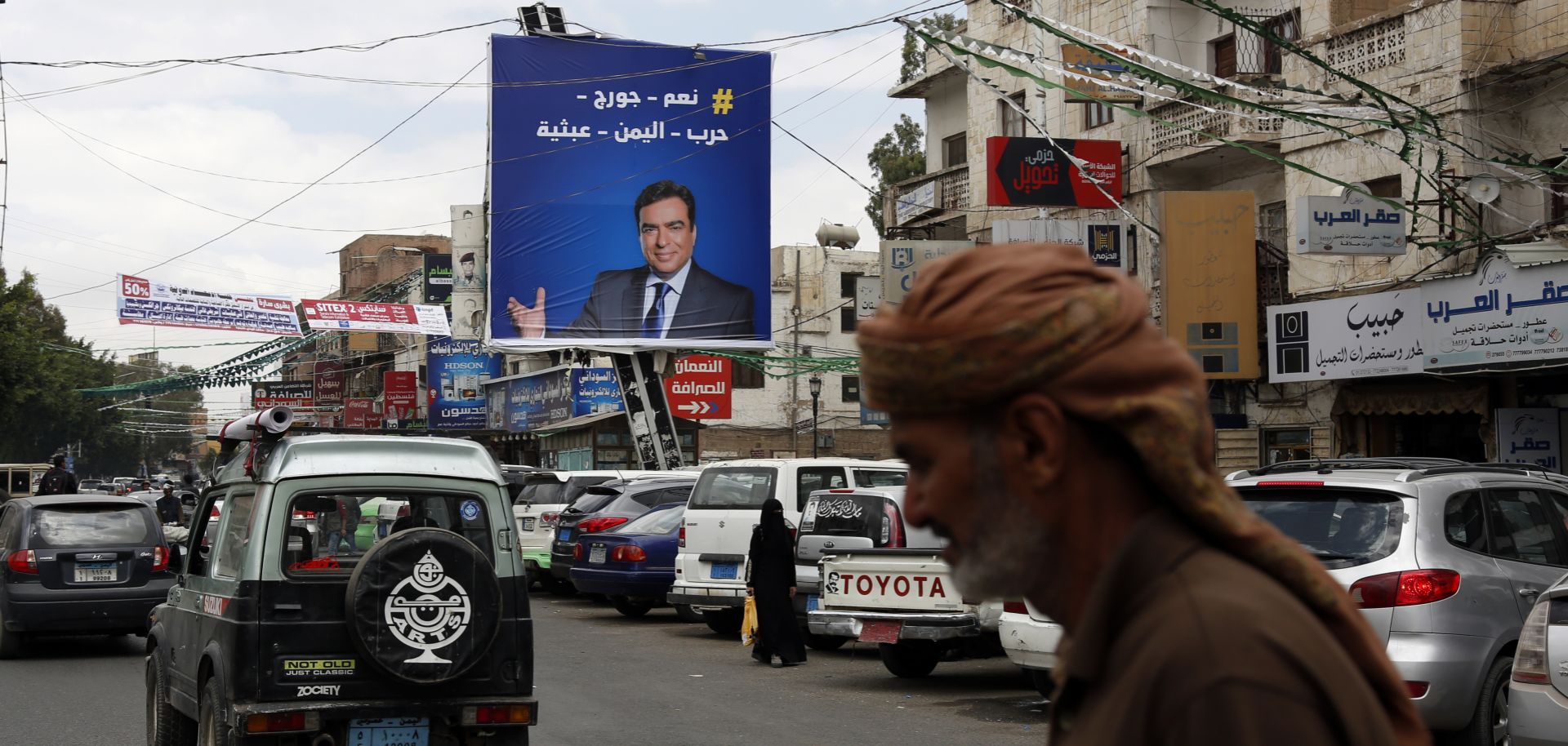
A portrait of Lebanese Information Minister George Kordahi is seen on a billboard in Sanaa, Yemen, on Oct. 31, 2021.
The quick deterioration of Lebanon-Gulf ties over an official’s controversial comments on the Yemen conflict reflects Arab Gulf states’ willingness to act against Iranian proxies and risks further harming Lebanon’s already fragile economy. In a media interview that aired last week, Lebanese Information Minister George Kordahi argued Houthi rebels were “defending themselves” against “external aggression” in Yemen, where Saudi Arabia has led an anti-Houthi military campaign since 2015 with varying levels of support from other Arab Gulf states. In response to the apparent criticism of its Yemen intervention, Saudi Arabia suspended imports from Lebanon on Oct. 29, summoned the Lebanese envoy from Riyadh for talks (who it has since expelled), and sent an “official protest note” to Kordahi. Fellow Gulf Cooperation Council (GCC) members Bahrain and Kuwait have also expelled their Lebanese envoys amid the controversy. And on Oct. 30 the United Arab Emirates said it was withdrawing its envoys from Lebanon and summoned the Lebanese envoy in Abu Dhabi for talks as well.
- Kordahi is a celebrity television presenter in Lebanon and a member of the country’s Maronite Christian church. Over the course of his career, he’s also expressed support for the Palestinian cause and “Arab Islamic civilization” more broadly.
Lebanon’s drawn-out government formation process over the past year revealed the extent of Hezbollah and Iran’s influence in Beirut, prompting Saudi Arabia to retaliate when offered the trigger. Lebanese Prime Minister-designate Najib Mikati announced a new government on Sept. 10 after 13 long months of negotiations. During the formation process, Saudi Arabia and other Arab Gulf states — concerned about Iran’s deep influence in the region — sought to support Sunni groups in Lebanon that could counter Iran-backed Hezbollah, a strong military and political actor in Lebanon’s government. Kordahi’s recent comments regarding the Houthis also indicate a level of support for Iran, even if indirect, that Saudi Arabia has always viewed as intolerable.
- Iran and Saudi Arabia have been engaged in a decades-long cold war for regional influence. This has played out in overt battlegrounds like Yemen, where Iran-supported Houthi forces battle Saudi-backed Yemeni forces. Tehran and Riyadh have also battled for political influence in countries such as Lebanon and Iraq.
In response to Kordahi’s comments, Saudi Arabia appears to have successfully cajoled a shared GCC position. Individual Arab Gulf states, however, have their own points of tension with restive Lebanon. Saudi Arabia, the United Arab Emirates and Bahrain all view Hezbollah-affiliated groups as a domestic and regional security threat. These states also view Lebanon’s political situation as a shared concern and Kordahi’s statements as a threat that could bolster public opinion in favor of Yemen's Houthi rebels, who pose a physical threat to Saudi Arabia and the broader Arab Gulf.
This aligned GCC sentiment will prolong the current diplomatic spat. Kordahi’s resignation would be the easiest way to resolve the dispute. But despite pressure from the Lebanese political establishment, Kordahi has so far refused to do so. The GCC-wide nature of the dispute is likely to encourage more damage control on the part of the Lebanese establishment to ensure other countries don’t follow Saudi Arabia’s lead by suspending their imports. Amid the ongoing row, other Arab Gulf states could also advise their nationals against traveling to or investing in Lebanon. GCC governments may potentially even go so far as to expel Lebanese citizens from their countries as well.
The longer the dispute continues, the more it will exacerbate Lebanon’s financial crisis and regional isolation. Arab Gulf states are among the countries that typically help Lebanon with financial assistance, and whose citizens invest in Lebanese businesses and travel to Lebanon for tourism. Lebanese nationals also make up important components of Arab Gulf states’ expatriate communities and labor forces. Weeks or potentially even months of chilled Lebanon-Gulf relations will threaten these commercial ties at a time when the Lebanese economy cannot afford to lose any external support. Although Lebanon is not a major source of imports to Saudi Arabia, Saudi Arabia is a top export destination for Lebanese produce exporters, and losing any export revenue will hurt amid Lebanon’s severe financial crisis. Newly imposed U.S. sanctions on Lebanese politicians could also aggravate the damage a GCC boycott could cause.
- Lebanese imports to Saudi Arabia amounted to $282 million in 2019.
- Earlier this year, Saudi Arabia temporarily suspended agricultural imports from Lebanon after a drug seizure angered the Saudi government. The suspension cost Lebanon roughly $33 million in anticipated revenue.
