
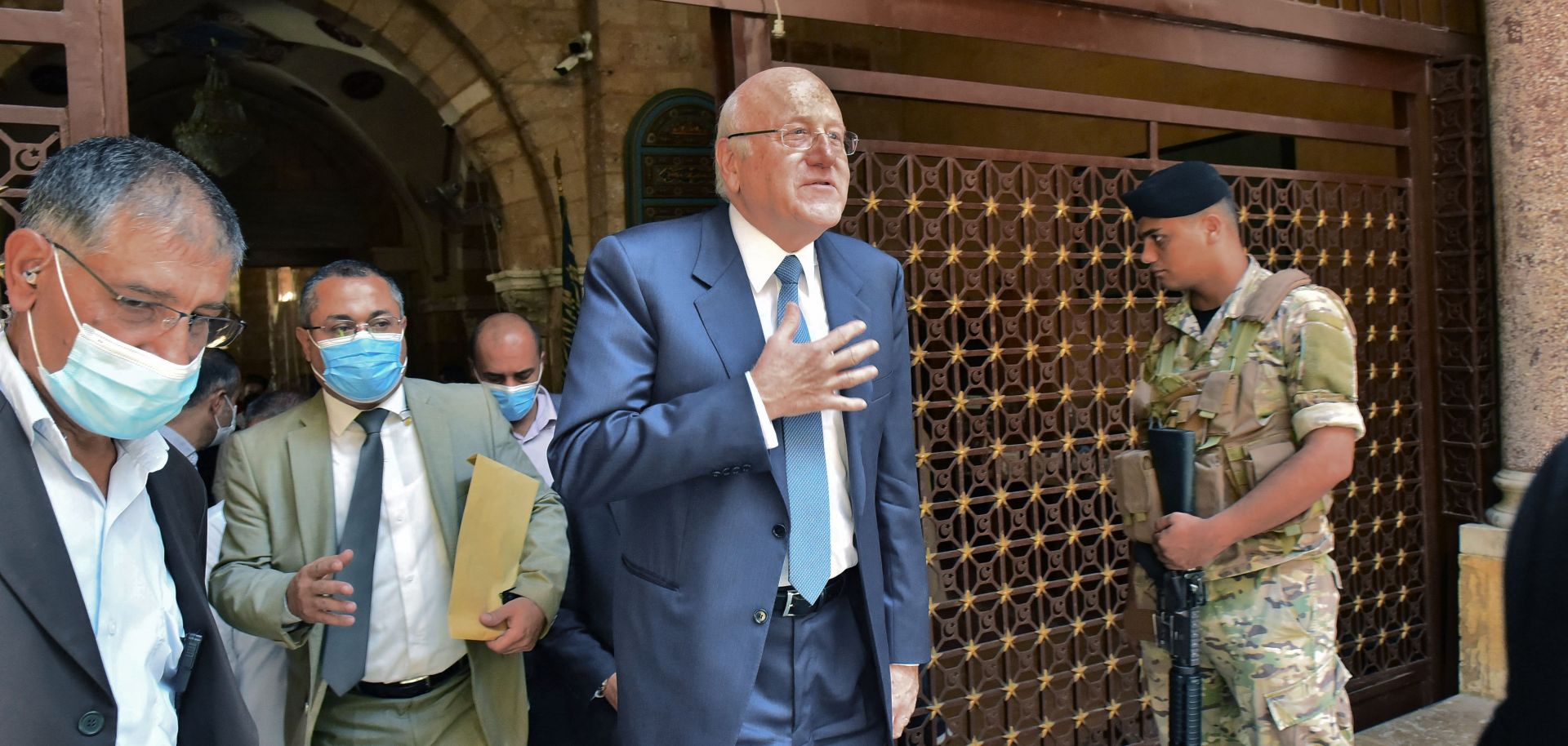
Lebanese Prime Minister-designate Najib Mikati leaves a mosque in Beirut on Sept. 10, 2021.
The new Lebanese government could ease the country’s crises by enacting basic economic reforms. But political infighting within the sectarian Cabinet will once again impede Beirut’s ability to secure the country’s fast-deteriorating economy and social stability. Lebanese Prime Minister-designate Najib Mikati announced a new government on Sept. 10 after 13 long months without a government and numerous failed attempts at forming one. The 24-member Cabinet is made of a mix of political insiders and technocrats, including several fresh faces. However, in terms of parties and sects represented, the Cabinet still generally resembles those of both former Prime Minister Hassan Diab and his predecessor Saad Hariri, which suggests Mikati’s new government will face similar challenges in implementing the sweeping reforms needed to ease Lebanon’s myriad of crises.
- Diab resigned in the wake of the August 2020 Beirut port explosion, which killed over 200 people and damaged thousands of homes. Various external investigations have linked the explosion to government negligence.
Mounting fuel, electricity and financial crises in Lebanon expedited the government formation process. Since late 2019, Lebanon has experienced hyperinflation that has disrupted every aspect of daily life for those living in the country, particularly the lower and middle classes. Lebanese leaders’ continued failure to form a government over the past year has left Beirut unable to enact basic policy to keep the country’s economy from spiraling further, let alone tackle deeper structural problems. As a result, Lebanon’s already fragile financial situation has only worsened since Diab resigned in August 2020, which has most recently manifested in widespread fuel shortages that have left a growing number of homes, schools, hospitals and businesses without electricity. The severity of the economic catastrophe unfolding in Lebanon has stoked fears the country is teetering toward a complete collapse, increasing both domestic and external pressure on the political elite in Beirut to finally form a government in the hopes of regaining some sense of stability.
- The World Bank earlier this year classified Lebanon’s financial crisis as one of the three worst in global history since the 1850s.
The new government will prioritize mitigating Lebanon’s power crisis and easing hyperinflation via piecemeal measures. In his first addresses to the Lebanese people since assuming office, Mikati has stressed his intention to ease their daily struggles by increasing the availability of fuel, cash and electricity, all of which have become increasingly scarce. Some of this will come through financial aid from institutions like the International Monetary Fund, as well as from foreign partners like France and the United States. A broader restoration of trust in both Lebanon’s government could also spur more domestic and foreign investment, as well as stabilize the country’s local currency. Once basic confidence is restored, some minor reforms including restructuring some bad loans and conducting some restructuring of the country’s inefficient electricity firm could be achieved in the coming months, once that basic confidence is restored. Just having a formal government in office will also help defuse the threat of sanctions from EU countries, which France had threatened over the last year as Lebanon fell further into crisis and political paralysis.
- The European Union adopted a framework for sanctions in late July that it threatened to impose if Lebanon continued to resist and delay government formation. France imposed entry restrictions on some unnamed Lebanese officials in April for alleged corruption.
- Mikati, who is often described as a moderate, served as prime minister during two previous moments of crisis in Lebanon — in 2005, and in 2011-2014. During both terms, however, he made little headway to address Lebanon’s deep political problems.
- Within days of Mikati’s government, the IMF announced it will allocate roughly $1 billion in Special Drawing Rights (SDRs) to the country’s central bank. The funds will be available on Sept. 16, and the Lebanese government will have full discretion over the money’s use. This is a small amount in the scope of what Lebanon really needs to ease its overall massive crisis, but the funds will nonetheless help buoy the country’s depleted financial reserves. Lebanon’s foreign currency reserves dropped from about $38 billion in 2019 to $15 billion as of June 2021.
Sectarian infighting will likely halt efforts to broach deeper reforms that could solve — rather than temporarily ease — Lebanon’s deeper financial crisis. Because this government looks similar to those before it in terms of sectarian allotment of seats, it is likely to fall into the same tradition of bickering that has held up previous attempts at major reforms. Things like redoing the subsidy system, holding a census that leads to new electoral laws that help break the sectarian impasse, or restructuring the commercial banking sector — all of which are necessary for Lebanon’s long-term political and economic stability — would require major agreement between all of Lebanon’s political stakeholders. Those trying to stay in power, including those in the new Cabinet, will likely again reject anything that threatens the country’s economic and political patronage system that benefits them.
- Lebanon’s new finance minister is a former central bank official who played a key role in building the system that imploded in 2019. Deeper central bank reforms could thus be difficult to achieve under his leadership.
- Mikati is already talking about the need for a bigger IMF agreement that would allot Lebanon significant amounts of financial aid. But talks over such a deal broke down last summer amid accounting-related disputes between the central bank, finance ministry, Cabinet, parliament and the president’s office. It is easy to envision similar breakdowns happening within the Mikati government.
- Reforming the public wage bill is one major reform that would likely need to be completed in order to stabilize Lebanon’s financial sector in the long term. But doing so would change not only the security of government jobs and wages, but the way in which politicians are able to offer certain benefits to constituents who vote for them — making such reforms difficult to implement.
