
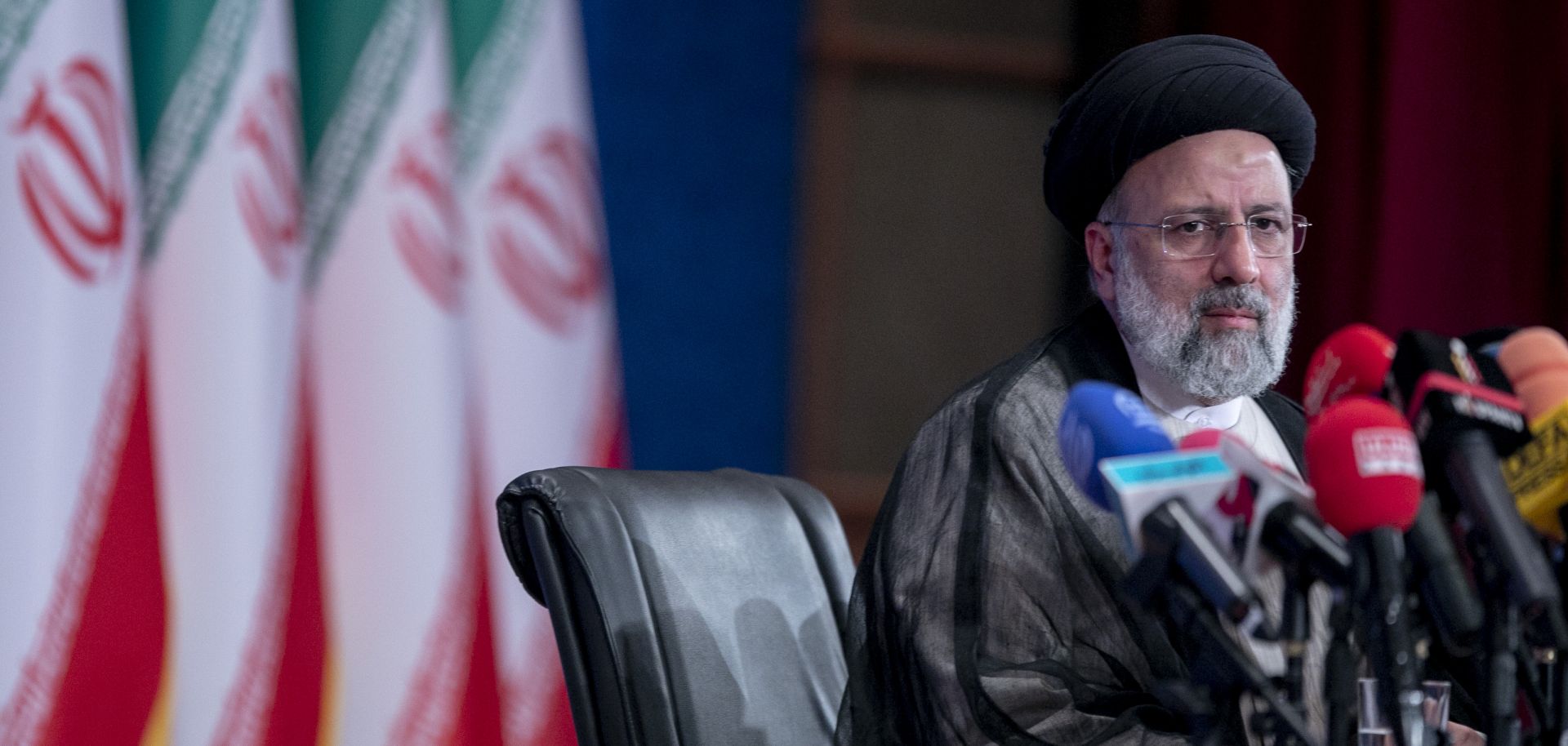
Iran’s incoming president Ebrahim Raisi holds a press conference in Tehran on June 21, 2021.
Iran’s rejection of a draft agreement with the United States to rejoin the Joint Comprehensive Plan of Action (JCPOA) increases the probability of stalled nuclear talks failing, despite both sides appearing willing to continue negotiations. Iran’s Supreme National Security Council (SNSC) — which formulates foreign policy — concluded the draft agreement was inconsistent with the country’s Strategic Action Plan for Lifting Sanctions law, according to a July 20 statement by Iranian government spokesman Ali Rabiei. Rabiei did not cite any specific issues the SNSC had with the draft agreement, which has not been made public. Nuclear talks with the United States are not expected to resume until at least mid-August after Iranian President-elect Ebrahim Raisi is inaugurated.
- The Iranian parliament passed the Strategic Action Plan for Lifting Sanctions law in December 2020, which requires Iran to reduce its commitments to the 2015 nuclear deal. Among other things, the law requires the removal of sanctions on Iran’s military programs.
The SNSC’s determination signals that Tehran is likely to take a harder line on demands related to sanctions removal under Raisi’s upcoming government. Two of the most contentious issues that do not appear to be entirely hammered out include what Iran must do with some of the more advanced centrifuges that it has installed over the last two years, and the extent to which the United States will remove additional sanctions it’s imposed on Iranian figures. Iran has also been demanding that guarantees be put into place that would ensure international financial institutions have the confidence to reconnect with Iran’s financial sector. The United States is pushing for Iran to destroy or render unusable its IR-4, IR-6, and IR-9 centrifuges at the Natanz Fuel Enrichment Plant. This is essential to the United States’ goal of extending Iran’s nuclear breakout timeline from two-to-three months to more than a year. For Iran, merely putting the centrifuges in storage would increase its options if the United States attempts to leave the JCPOA again.
- Tehran is demanding the removal of all new U.S. sanctions imposed since the United States left the JCPOA in May 2018. This would include the U.S. government’s move to list the Islamic Revolutionary Guard Corps (IRGC) — a formal branch of the Iranian military — as a foreign terrorist organization in April 2019, as well as the U.S. sanctions imposed on Raisi in November 2019.
- The United States has signaled that it is willing to suspend some of these sanctions. But suspending those against the IRGC, in particular, would incur domestic political blowback, givent that IRGC-backed militias in Iraq continue to target bases housing U.S. troops.
While a U.S.-Iran deal remains a likely outcome, the high stakes move by the SNSC to demand more from the United States increases the probability that negotiations fail. Tehran appears to have assessed that it can continue to withstand Washington’s sanctions campaign — which is now more than three years old — without having to rush to a deal in negotiations. This assessment may be giving the SNSC second thoughts as to whether or not a deal is even necessary, particularly now that Iran’s conservatives and hard-liners have cemented their power domestically. Nevertheless, for the United States and Israel, the status quo of Iran increasing its nuclear enrichment and stockpiling more highly enriched uranium is not sustainable. This means that if talks drag on, the probability of Israel taking more aggressive action — up to and including overt military action — increases. The United States is also reportedly discussing a plan to increase sanctions enforcement on Iran-China oil trade — one of Iran’s remaining key avenues for foreign currency. This would not only increase pressure on Tehran by raising the costs of Vienna talks failing, but grant the United States a contingency plan in case those negotiations do collapse.
