
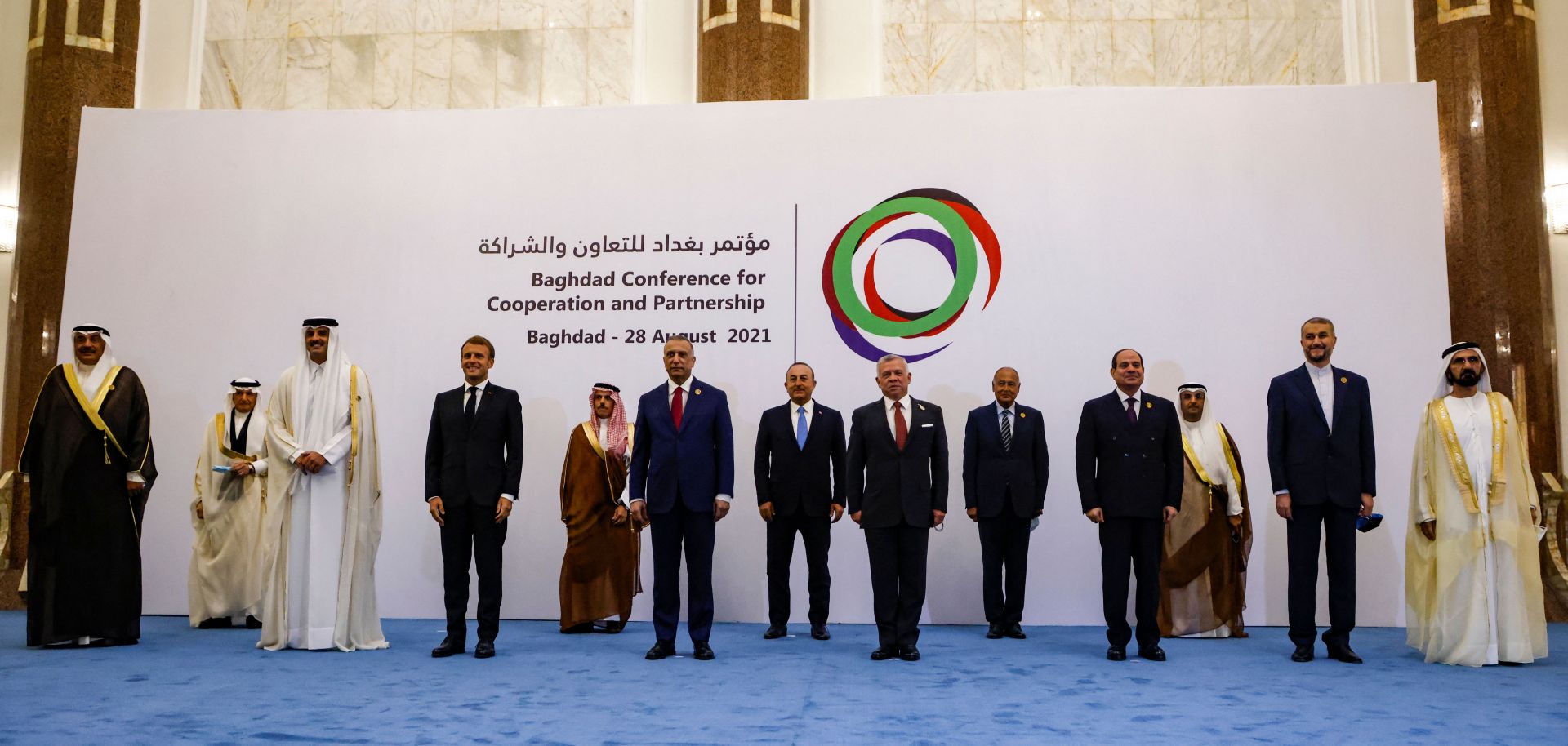
The attendees of the Baghdad Conference for Cooperation and Partnership pose for a group photo on Aug. 28, 2021.
Cordial inter-regional relations on display at a recent conference in Baghdad could portend deeper cooperation and improved stability across the Persian Gulf in the event of Iranian-Saudi rapprochement. The Baghdad Conference for Cooperation and Partnership on Aug. 28 featured Middle Eastern partners and rivals convening together to discuss the shared goal of greater Iraqi stability. Although Saudi and Iranian officials reportedly did not meet directly, they were both present at the event. Iran’s foreign minister also met with officials from both Kuwait and the United Arab Emirates — two of Saudi Arabia’s closest and most strategically aligned neighbors.
- The conference featured high-level officials from Egypt, Jordan, Qatar, France, Kuwait, the United Arab Emirates, Saudi Arabia, Iran, Iraq and Turkey. The discussions were focused on the shared goals between the attendees — many of whom are regional rivals — which is a rarity in broader Middle Eastern politics.
- The summit was also touted as the first time an Iraq-focused conference took place in the country, a testament to how Baghdad’s independence has strengthened in recent years following its emergence from the fight against the Islamic State.
During the summit, Iraq pushed for mediation between Iran and Saudi Arabia, which would both benefit Baghdad and help stabilize the broader region. Many Iraqi leaders believe that stability for Iraq is dependent on powerful regional countries like Iran and Saudi Arabia resisting using Iraq as a proxy theater. The Iraqi government’s hope for Iranian-Saudi rapprochement, which Baghdad shared publicly prior to the conference, also reflects how Riyadh and Tehran’s decades-long cold war has impacted the wider Middle East.
- The first in-person Iranian-Saudi talks in years reportedly took place in Iraq earlier this year. Iraqi officials had hoped the Aug. 28 summit would feature a public reprise of these talks. Iran’s ambassador to Iraq said on Aug. 30 that the next round of bilateral Iranian-Saudi talks had been scheduled and would take place in Iraq.
- Iraq’s security challenges have enabled other regional powers to gain political influence in the country by offering economic and military support. Iran, in particular, has deeply entrenched itself in Baghdad through its various proxy militia groups. But Saudi Arabia and other Arab Gulf states have also sought, albeit less successfully, to create similar points of leverage in Iraq.
The Iraqi government’s hope for Iranian-Saudi rapprochement, which Baghdad shared publicly prior to the conference, also reflects how Riyadh and Tehran’s decades-long cold war has impacted the stability of the wider Middle East. Tensions between Saudi Arabia and Iran surged following the 1979 Iranian Revolution, and have waxed and waned in the decades since. Riyadh and Tehran have opposing visions on regional governance and foreign involvement in regional affairs. They’ve also directly competed for influence in theaters like Iraq and Yemen, exacerbating existing tensions there. Iranian-Saudi rapprochement could thus de-escalate violence in those conflict zones, which would also make it easier for the United States and other Western countries to withdraw military forces from the region.
Improving Arab Gulf state cooperation will enable the Gulf Cooperation Council (GCC) to come to a shared understanding on Iran, which is necessary for any Iranian-Saudi rapprochement. While the Baghdad summit focused largely on bolstering Iraqi stability, one of the more important outcomes was the possibility of better Persian Gulf relations. The GCC’s own internal disputes have dissipated in recent months, with Saudi Arabia and the United Arab Emirates dropping their blockade on fellow GCC member Qatar earlier this year. Each government’s varying level of support for both Iran and political Islam remains the primary point of contention between GCC states. But the visibly more pragmatic ties between these Muslim countries — which were on full display during the recent Iraq conference — suggest they have discussed these issues behind closed doors and have come to some form of understanding.
- A high-level Aug. 26 meeting in Abu Dhabi between Emirati and Qatari officials showcased warming relations between the neighbors. Saudi Arabia and Qatar also signed a joint cooperation protocol the day prior, further signaling diplomatic healing.
The continued improvement of tepid Persian Gulf relations, however, will largely depend on Iran and Saudi Arabia’s own efforts to mend their bilateral ties. By publicly bridging some of the frigid relations between Arab Gulf states and Iran, the conference was a small but notable step to that end. But high-ranking Saudi Arabian and Iranian officials will need to meet directly and publicly in order for regional reconciliation to maintain momentum.
- Iran’s newly elected President Ebrahim Raisi has said he plans to prioritize resetting some of Iran’s most caustic regional relationships, including with Saudi Arabia.
