
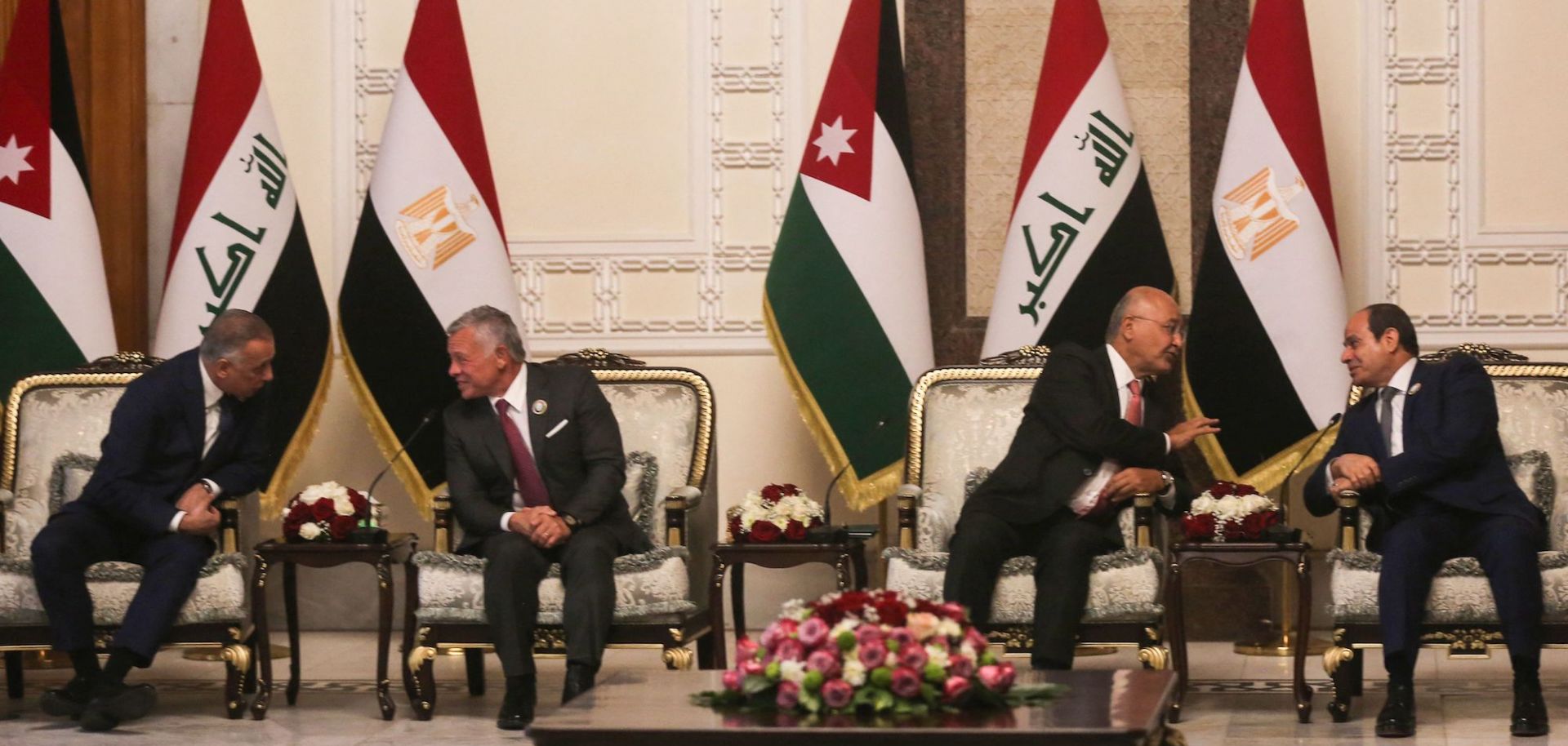
Iraqi Prime Minister Mustafa al-Kadhimi, Jordan's King Abdullah II, Iraqi President Barham Saleh and Egyptian President Abdel Fattah al-Sisi (from left to right) meet in Baghdad on June 27, 2021.
An emerging partnership between Jordan, Egypt and Iraq will yield security and commercial gains for each country, as well as provide an alternative Arab voice in the wider region. On June 27, the leaders of Iraq, Jordan and Egypt met in Baghdad for high-level talks on commercial, strategic and security matters. These three Arab middle powers’ dependence on external support will constrain the rapid formation of their new tripartite alliance. But shared economic and political interests will still fuel the pact's incremental creation, especially if the threat of Turkish and Iranian regional influence grows.
- The talks followed months of preparations and a meeting between the countries’ foreign ministers in Baghdad in March, and also marked a historic return of an Egyptian head of state to Iraq after 30 years.
- Iraq’s prime minister, the host of the June 27 meeting, specifically cited the existence of a “critical historic turning point” in both the global fight against COVID-19, as well as in the regional fight against terrorism, in allowing the creation of a new regional alliance, which seeks to achieve stronger ties in three areas: economic partnership, political cooperation, and security and intelligence coordination.
Iraq, for its part, is trying to broker better relationships with other Arab majority countries to bolster its ability to withstand growing pressure from Iran and, to a lesser extent, Turkey. Iraq’s government was the primary instigator in forming the new Arab alliance. Fortifying relations with other Arab nations is part of an effort by Sunni politicians to reduce Iraq’s heavy economic and energy dependence on Iran, which can be a liability due to sanctions and Western opposition to Tehran. The United States, for example, has repeatedly demanded that Iraq weaken its ties with neighboring Iran. Iraq is also dependent on Turkey for some of its water supply, as well as trade — especially in resource-rich northern Iraq, where the Kurdistan Regional Government works closely with Ankara to export oil.
- Iraqi Prime Minister Mustafa al-Kadhimi invited Jordan and Egypt’s leaders to the June 27 meeting.
- Iraq is dependent on Iran for roughly a third of its energy and electricity supply, which has led to both disruptions in electricity service and tensions between Baghdad and Washington.
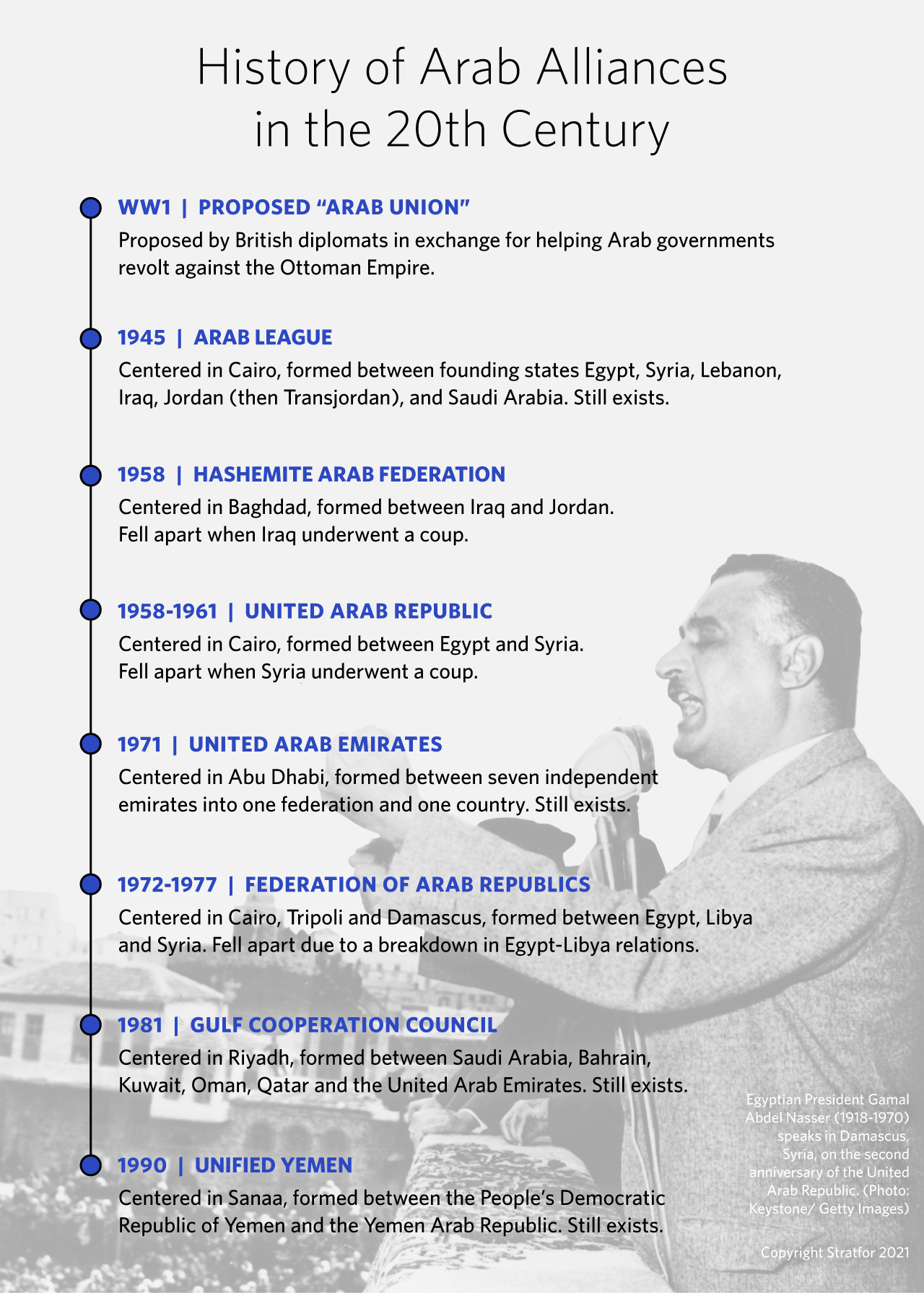
Less cooperation against common enemies like the Islamic State could enable Turkey and Iran to gain greater influence in the region, which some Arab states will view as a threat. The chaos of the 2011 Arab Spring and the militancy that reared its head in the following years brought a number of regional rivals together, including Iran and Turkey, as well as Jordan, Egypt and Iraq. The Islamic State threat also led to a deeper U.S. military presence in the region. While the global jihadist group is far from defeated, the Islamic State has lost its ability to rapidly grow and gain territory as Iraqi security forces and other regional military forces have better developed their counterterrorism abilities.
- Egyptian, Jordanian and Iraqi leaders have all recently acknowledged a strong desire to reduce their focus on the Islamic State and the militancy that sprung from events like the Syrian civil war, which have characterized the last decade following the Arab Spring with instability.
- Turkey and Iran’s governments, meanwhile, are both seeking to deepen their Middle Eastern partnerships. Closer Turkish and Iranian ties could work in Egypt, Jordan and Iraq’s economic favor, but at the risk of eroding broader Arab regional influence.
- The United States has been clear about its desire to draw down some of the military presence in the region that increased due to the Islamic State threat, and is currently negotiating a withdrawal timeline with the Iraqi government.
Jordan, Egypt and Iraq’s dependence on external powers for some of their economic and security interests will not only slow the formation of their alliance, but limit its ultimate scope. These three Arab states are all reliant on foreign aid in some way and cannot afford to burn bridges with their wealthier patrons. For this reason, their new alliance is aimed at only diversifying their tie while still maintaining their existing aid and commercial relationships. Egypt and Jordan are just behind Israel in terms of receiving the most security aid from the United States, and there is no indication that that will change even as Washington tries to draw down its military presence in the region. Egypt, Jordan and Iraq share concerns about the regional dominance of Arab Gulf powers like the United Arab Emirates and Saudi Arabia seeking to cajole the Arab world to support their politics and priorities. But Cairo, Amman and Baghdad are also unlikely to turn down Arab Gulf investment money, giving Riyadh and Abu Dhabi some political influence in their respective governments. Oil-dependent and debt-ridden Iraq, in particular, is in no position to turn down foreign funding, as the country faces a deepening financial crisis.
- An emerging middle-power alliance between the less wealthy Arab Gulf states will provide some pushback against the United Arab Emirates and Saudi Arabia, who have channeled their wealth into efforts to become leaders of the broader Arab world. Abu Dhabi and Riyadh will likely try to co-opt or at the least draw some benefit from any growing ties from some of their key Arab partners in the region, regardless of whether or not they are in control of the burgeoning relationships.
Better coordination between Jordan, Egypt and Iraq’s intelligence services could help circumvent the development of another transnational threat in the region like that once posed by the Islamic State. All three countries have capable intelligence and security forces that have undergone a significant amount of Western and U.S. training. Stronger ties between three of the United States’ closest security and diplomatic partners will also reassure Washington that a further withdrawal of U.S. forces in the future won’t greatly disrupt regional stability in line with U.S. goals.
There are some potential untapped commercial benefits in terms of energy and trade ties that could be mutually beneficial for all three countries as well. Jordan is eager to restore trade to neighboring Iraq that evaporated during the Islamic State fight. Egypt is also hoping to broker deeper ties between Egyptian energy companies and their Iraqi counterparts — especially with Egypt on the cusp of developing more Mediterranean oil and gas reserves, and Iraq eager to court regional investors into its own oil and gas assets.
