
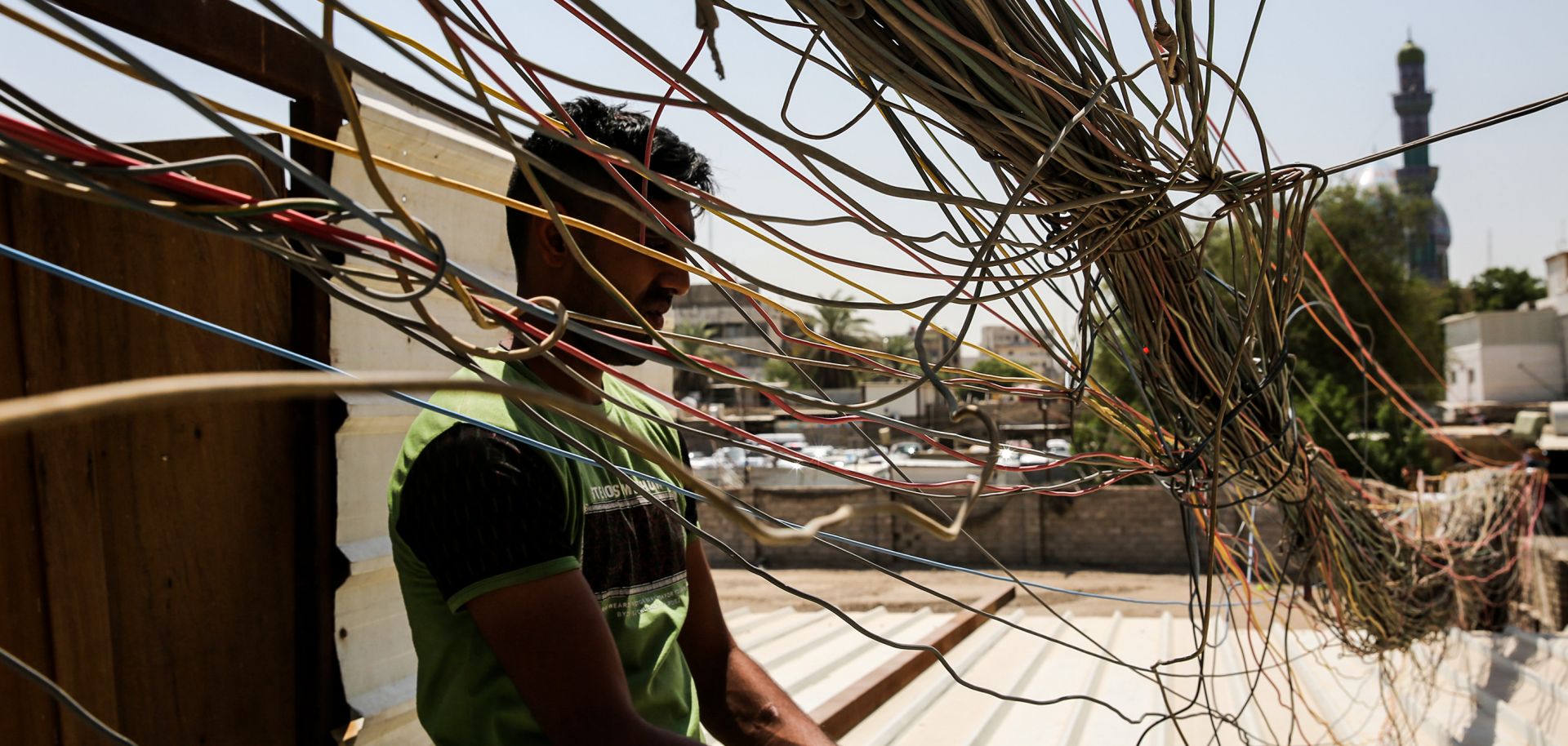
A man checks the wiring on electric cables that run to home on Saadoun Street in Baghdad on July 29, 2018. Chronic power shortages have forced residents to buy electricity from private entrepreneurs who run generators on street corners across the country.
Iraq has an electricity problem. Blackouts and brownouts are common during the country's broiling summers. Its aging and inefficient generation and transmission systems suffered $7 billion in damage at the hands of the Islamic State, but even before the jihadist group's push through Mosul in 2014, Iraq's electricity sector was struggling to keep up with demand. To supplement its own production, the country imports electricity and natural gas from Iran, but even that incomplete solution to its power shortages could soon be coming to an end. As the United States continues its pressure campaign against Iran, Washington has demanded that Baghdad come up with a plan to wean itself off Iranian energy supplies, which constitute a significant chunk of Iraq's electricity needs. That presents new Prime Minister Adel Abdul-Mahdi with a formidable challenge.
Annual demand for electricity in Iraq, which hit a peak of 24,000 megawatts (MW) in 2018, is climbing by about 7 percent a year, a pace expected to remain steady for the foreseeable future. However, the capacity of the Iraqi power sector, at 16,000 MW, falls well short of meeting even the current demand. To help overcome that shortcoming, Iraq has a contract to import up to 1,200 MW of electricity from Iran. The shortages have created critical issues for both the Iraqi government and its citizens. A lack of electricity, water and employment has led to widespread unrest in the southern economic hub of Basra and elsewhere. To increase its capabilities, Iraq’s power sector will have to overcome a number of technical, economic and political hurdles in a process that promises to be difficult and slow.
Iraq’s Inefficient Electricity Sector
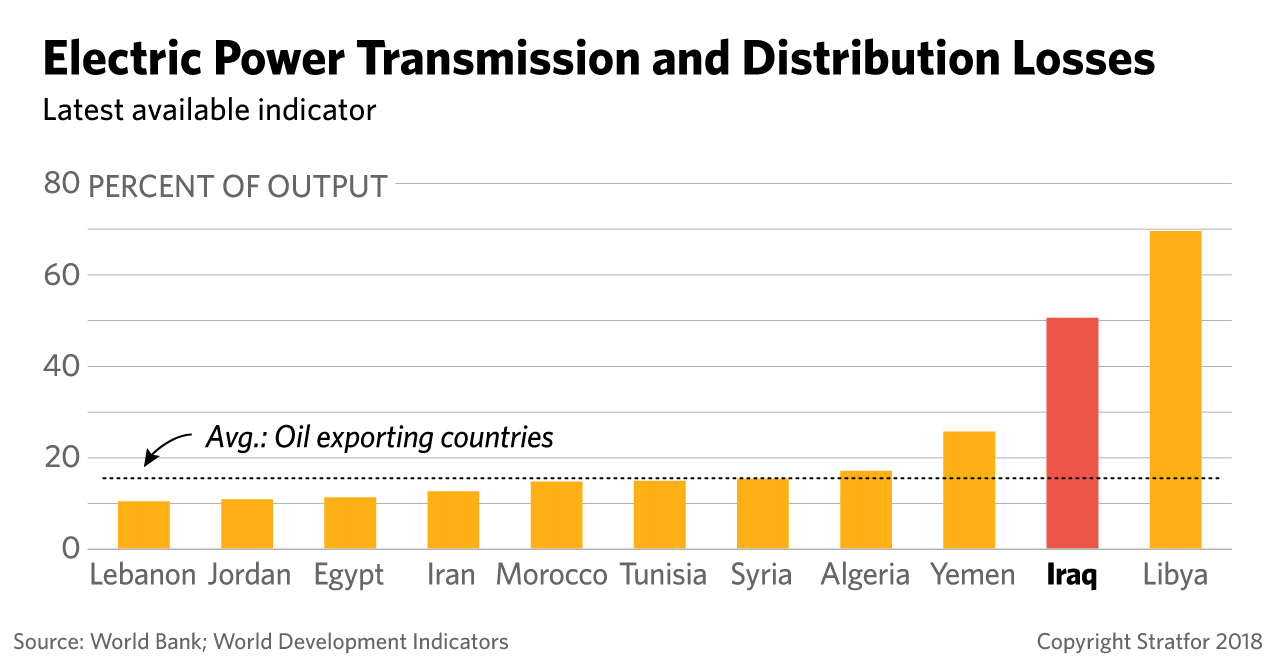
Iraq's electricity problems begin with aging and inefficient physical infrastructure. Most of Iraq's electricity is generated by old-style gas turbine and steam turbine power plants that use natural gas or diesel as a fuel source (steam turbine plants can also use crude oil and fuel oil). Once the electricity is generated, it travels to the end user through a decrepit transmission and distribution system that suffers from 50 percent line loss (meaning that half of the power sent out on the lines doesn't reach the customer). In a healthy electrical grid, line loss is typically between 5 and 15 percent. The sector has started to address the power plant issue by building plants that use combined-cycle generation, a highly efficient method of creating electricity, but their use is limited by insufficient supplies of natural gas for fuel and water to generate steam to drive the turbines.
Although Iraq is rich in oil, it has a chronic shortage of natural gas production. Most of the country’s natural gas is a byproduct of crude oil production, but Iraq has not focused on investment in systems to capture that gas. Instead, most of its associated natural gas is flared off, proving both an economic waste and environmentally damaging. In 2017, for instance, Iraq captured just 10.4 billion cubic meters (bcm) of the 28.2 bcm of natural gas its wells brought up, with the rest being flared. It has made recent efforts to capture more gas at the wellhead, including through the Basra Gas Company, a $17 billion joint venture set up in 2013 with Shell and Mitsubishi. But thus far, that venture is capturing only about half of its goal of 57 million cubic meters per day. Even if Iraq were able to capture all of the natural gas it currently flares, it might still need to import natural gas. Currently, the power sector alone consumes 9.4 bcm annually, and the power plants that will come online over the next few years are expected to require an additional 15 bcm. Beyond flaring, Iraq has also sought to import natural gas from Iran.
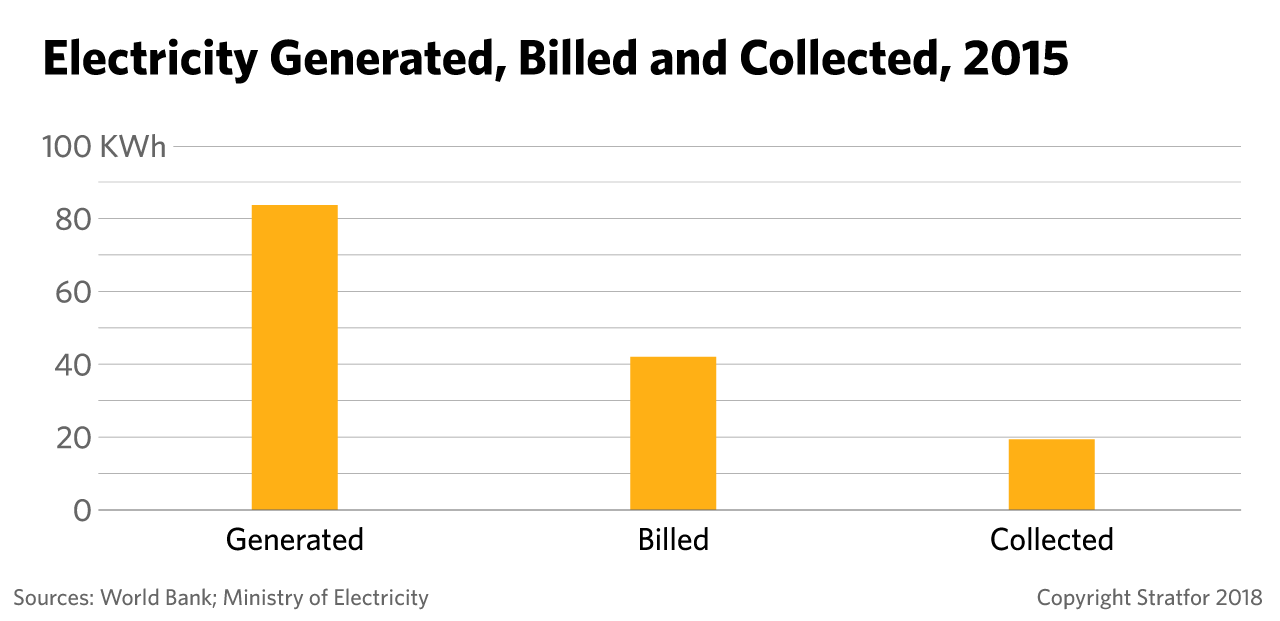
While Iraq can ultimately overcome many of those shortcomings with time and investment, the power sector is beset with other economic and political problems. Finding financing for infrastructure improvements may be one of them. Iraq has spent much of this year trying, in a largely fruitless search, to attract sufficient investment to rebuild infrastructure left in tatters by years of war. And Iraq’s power sector cannot break even financially despite the high demand for electricity. The collection rates for electricity bills stood at just 28 percent in 2017. And even if customers actually paid their bills, power is being sold at a loss: Electricity rates are set too low to recover generation, transmission and distribution costs. The World Bank estimates that between collection shortfalls and poor infrastructure, the losses in the electricity sector reduce Iraq's annual gross domestic product by 5.2 percent. Baghdad operates at a loss on natural gas sales as well. It pays the Basra Gas Company $2.50 per mmbtu for captured natural gas and pays Iran a price indexed to 11 percent of the price of Brent crude (currently around $6.75 per mmbtu). Baghdad turns around and sells that gas at around $1.20 per mmbtu. In addition, the Electricity Ministry itself is bloated, with more than 100,000 employees. The size of the ministry, in contrast with the efficiency of services it provides, was one of the factors driving some of this summer’s heaviest protests in Basra.
It will not be easy politically to make the sector solvent. Cutting off service for those who don’t pay their electricity bills would quickly lead to street demonstrations. Iraq could also further increase electricity rates, but that would also provoke unrest. Any attempt to reduce the size of the ministry's workforce would also lead to protests, as unemployment is a serious issue in the country. With no good choices, Iraq has had to maintain its focus on generating as much electricity as possible and setting aside a large chunk of the federal budget to provide investment and transfers to the power sector to make up for revenue shortfalls. Even then, Iraq has fallen behind on its payments for energy imports from Iran. Over the summer, Tehran cut off electricity exports for nonpayment, helping contribute to shortages that led to protests. In its 2019 budget, Iraq has set aside more than $1.2 billion to cover arrears in electricity and natural gas.
At this point, Iraq's electricity sector has to swim at full speed just to tread water. Resolving its myriad issues is a difficult proposition, but considering that demand is projected to continue increasing by 7 to 10 percent annually, Baghdad will need to figure out how to increase generation capacity and efficiency at a faster rate to keep up.
Iran: Iraq’s Easiest Answer
Over the past five years, Iraq has considered imports of electricity and natural gas from Iran as an easy, relatively cheap way to help shore up its electricity picture. And Tehran, always eager to deepen its influence with the Shiite-led Iraqi government, has been happy to oblige. In 2013, Iraq signed a deal to import 25 million cubic meters (mcm) per day of Iranian natural gas – 9.1 bcm annually – to feed three Baghdad-area power plants. In total, the natural gas imports from Iran feed power plants with a capacity of about 5,000 MW. Adding in the direct electricity imports means that Baghdad depends on Tehran to fulfill about a third of its peak demand.
Replacing that amount of generation quickly will not be easy. Technically, the purchases of Iranian natural gas and electricity could run afoul of U.S. sanctions, considering that Iraq would have to deal with sanctioned entities in Iran to pay for the imports. Iraq has offered to set up a barter-like system that would give Iran credit for its gas exports that can be exchanged directly for Iraqi goods. However, the countries' trade relationship skews heavily toward Iranian exports. There are few Iraqi goods that Iran would desire besides agricultural exports, but Iraqis consume most of what their country produces, leaving little for export.
Thus far, Iraqi officials have said that they will launch an 18-month plan to reduce imports from Iran, while presenting a five-year power sector strategy designed to solve some of its broader structural challenges. It hopes that the plan will appease the United States enough to grant Iraq an extended waiver from sanctions.
A Difficult Long-Term Strategy
Any Iraqi strategy to bolster its energy infrastructure and replace Iranian energy would necessarily center on three principles: increasing domestic infrastructure and power plant investment; securing more natural gas and electricity supplies; and reforming the sector itself.
In the 2019 budget, Iraq has earmarked $3.3 billion to pay for capital investments in electrical infrastructure. This year, Iraq has been negotiating with GE and Siemens over a potential $15 billion deal to boost its generation capacity. On Oct. 21, GE announced that it had signed a memorandum of understanding with Baghdad to build power plants and rehabilitate older infrastructure to boost capacity by 14,000 MW. GE said that under the plan, 1,500 MW could be brought online by 2019. The next day, Siemens announced a separate agreement with Baghdad to increase Iraq’s power generation capacity by 11,000 MW over the next four years. Neither deal is binding.
But in addition to the expense, cultivating more economic ties with the GCC will be politically difficult for Iraq. While there has been a relative warming of relations between Iraqi Shiite leaders like Muqtada al-Sadr and the GCC, the expanding relationship is still in its early stages. Any quick expansion of GCC economic activity into southern Iraq could provoke Iran’s allies as well as nationalist Iraqis who increasingly reject both Iranian and Gulf influence in internal Iraqi affairs. Abdul-Mahdi will also have to deal with Iran’s allies pushing back against any plan to bring in substantial connections to Saudi Arabia and the GCC.
This leaves Iraq in a difficult position. The United States has sought a long-term plan to reduce Iraq's Iranian energy imports, but because Washington needs the Iraqi government in its fight against the Islamic State, it is not in a position to cut off waivers and sanction Baghdad. Nor is a collapse of the Iraqi economy in the U.S. interest. This means the United States will likely continue issuing waivers when it comes to Iranian energy exports to Iraq, but it will still expect Baghdad to make progress in reducing its imports from Tehran. And more importantly, the United States can use the promise of continuing to grant waivers as leverage to push Iraq to strengthen connections to Saudi Arabia and the GCC, both of which accord with its strategic goal of reducing Iranian influence over Baghdad.
Nevertheless, until Iraq's long-term plans to improve its electricity generation and transmission systems come to fruition, its power outlook will remain dim. And the added sanctions pressure from the United States and continued political and financial woes in the sector mean that electricity, or the shortage of it, will continue to drive unrest in Iraq, particularly in Basra, for the foreseeable future.
